PHNOM PENH — In disputes between neighboring countries, tough rhetoric may rally domestic support. But winning public approval at home does not necessarily translate into diplomatic success abroad.
Nationalism can strengthen a political leader’s popularity. Yet when nationalist sentiment begins to drive foreign policy, it may also limit a country’s ability to negotiate and resolve disputes peacefully.
That concern has emerged from within Thailand itself as its border dispute with Cambodia continues to attract international attention.
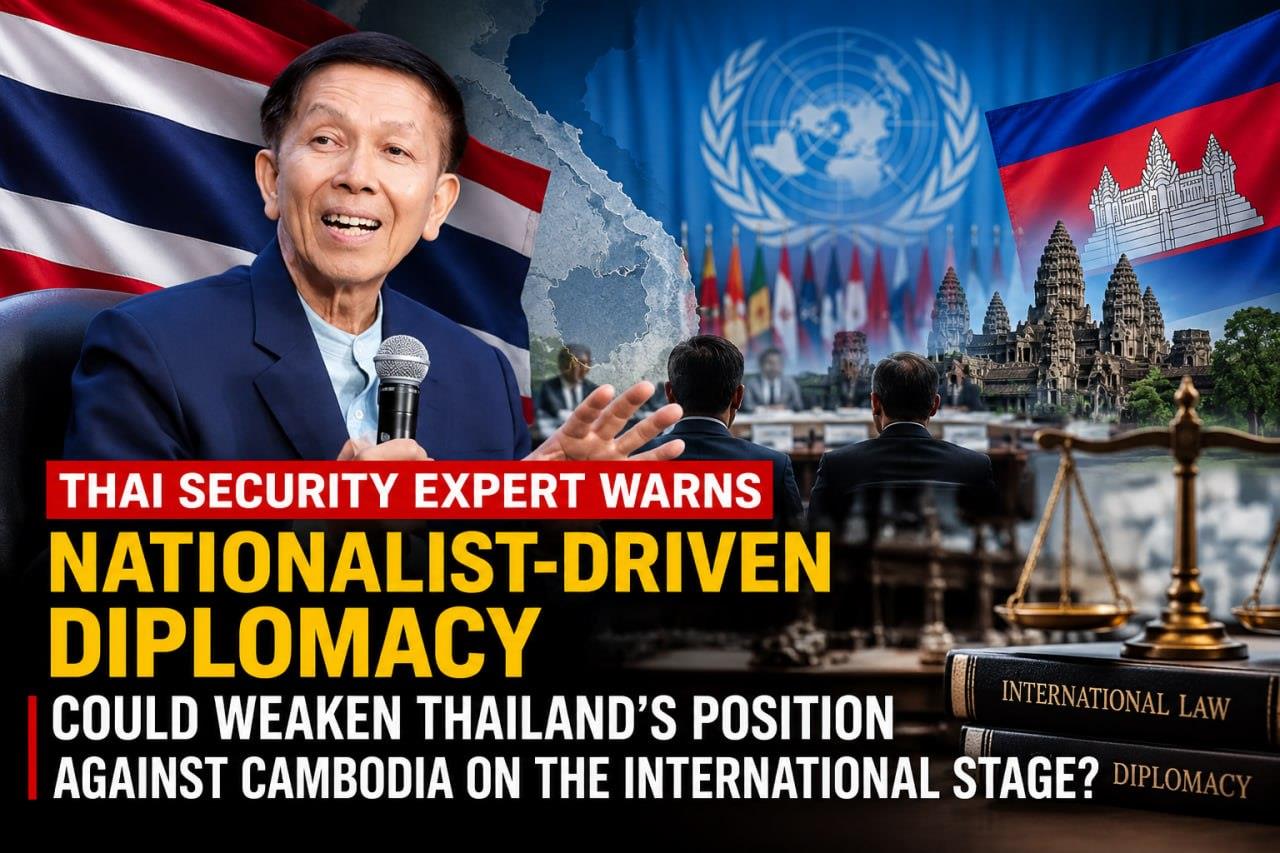
Rather than concentrating on diplomatic solutions, Thailand’s foreign policy leadership is facing criticism from a prominent Thai security expert who argues that it may be prioritizing nationalist sentiment at home over effective engagement with Cambodia.
In an article published by Matichon Weekly on October 8, 2026, Professor Surachart Bamrungsuk, a Thai political scientist specializing in national security, military strategy and international relations, strongly criticized what he sees as the growing influence of nationalism and confrontational rhetoric on Thailand’s foreign policy toward Cambodia.
Surachart used the expression “marketplace-style diplomacy” to criticize the approach taken by Thailand’s foreign minister, arguing that verbal attacks had overshadowed efforts to create a constructive environment for resolving disputes.
His criticism comes as Cambodia continues to emphasize international law and peaceful dispute-settlement mechanisms in addressing its territorial disagreements with Thailand.
According to Surachart, such confrontational diplomacy is unlikely to resolve the dispute. Instead, it risks weakening Thailand’s diplomatic standing and undermining its international image.
Nationalism May Boost Domestic Politics, but It Does Not Necessarily Win Elections
Surachart suggested that the Thai government may be using what he described as the “Cambodia issue” to sustain its domestic political popularity.
However, he questioned whether the Bhumjaithai Party’s electoral success was genuinely driven by anti-Cambodian nationalist sentiment.
His assessment was that nationalism was not the decisive factor.
Instead, he attributed the party’s success primarily to the influence of “Baan Yai,” a Thai political term referring to powerful local political families, patronage networks and influential provincial political figures.
In his analysis, nationalist sentiment served mainly to reinforce these established political networks rather than determine the electoral outcome.
This distinction raises an important political question.
If anti-Cambodian nationalism was not the decisive factor behind electoral success, why would the Thai government continue to place such emphasis on confrontation with Cambodia to mobilize domestic support?
The broader issue is whether Thailand’s foreign policy is being shaped primarily by long-term national interests or by short-term domestic political calculations.
When disputes with neighboring countries become instruments of domestic political competition, governments may find themselves under pressure to maintain uncompromising positions, even when negotiations require flexibility.
“Marketplace-Style Diplomacy”: A Sharp Criticism From Within Thailand
One of the most striking aspects of Surachart’s article is his criticism of Thailand’s diplomatic conduct.
He referred specifically to remarks made by Thailand’s foreign minister at the opening of the first round of Cambodia–Thailand maritime conciliation proceedings.
The meetings took place in Singapore in September 2026 under a conciliation mechanism established by the United Nations Convention on the Law of the Sea (UNCLOS).
Surachart argued that the international forum should have provided Thailand with an opportunity to present its position through reasoned arguments and project a constructive diplomatic image.
Instead, he criticized the foreign minister for focusing on verbal attacks against Cambodia.
He characterized this approach as “marketplace-style diplomacy,” a disparaging description of what he regarded as unnecessarily confrontational diplomatic behavior.
Surachart warned that if Thailand continued to pursue this approach, it would be unable to gain the upper hand over Cambodia.
His criticism reflects a broader concern: confrontational rhetoric may appeal to nationalist audiences at home, but it cannot substitute for an effective diplomatic strategy.
In international relations, diplomacy is not simply about projecting strength or delivering forceful statements.
It also requires the ability to present convincing arguments, build confidence, engage other parties and demonstrate a genuine commitment to peaceful dispute settlement.
Speaking more forcefully does not necessarily mean negotiating from a stronger position.
On the contrary, poorly judged rhetoric can undermine a country's credibility and weaken its ability to persuade international audiences.
Why Does the Thai Expert Believe Cambodia Could Gain a Diplomatic Advantage?
Another notable element of Surachart’s analysis concerns Cambodia’s response to criticism and verbal attacks from Thailand.
He observed that Cambodia had not recently deployed Major General Maly Socheata, its military spokesperson, to engage in the kind of confrontational public exchanges seen previously.
Surachart interpreted this as a calculated decision by Cambodia to hold back a strategic “card” rather than engage directly in escalating verbal exchanges.
Meanwhile, he argued, Thai officials continued to issue critical and accusatory statements.
This observation highlights an important principle of diplomatic communication:
In diplomatic competition, controlling the message and choosing when to respond can be more effective than reacting immediately and emotionally.
From this perspective, Cambodia’s restraint does not necessarily indicate weakness.
Instead, avoiding unnecessary verbal confrontation may allow the country to maintain a more measured diplomatic image while leaving international audiences to assess the statements and conduct of both sides.
However, diplomatic advantage cannot be measured solely by the tone of public statements or a government's willingness to remain silent.
It also depends on the consistency of official positions, compliance with agreements, the strength of supporting evidence and the ability to persuade international partners.
Nevertheless, Surachart’s criticism suggests concern that Thailand’s confrontational rhetoric could inadvertently strengthen Cambodia’s image as a party favoring restraint, diplomacy and international legal mechanisms.
From the 1904–1907 Treaties to Diplomatic Competition
Surachart’s warning also provides an interesting point of comparison with recent remarks by Cambodian Prime Minister Hun Manet.
The Cambodian leader recalled the 1904 and 1907 treaties and the territorial settlement of 1946 while reaffirming Cambodia’s determination to pursue its territorial claims through international law rather than military force.
The 1904 and 1907 treaties between Siam and France remain important historical and legal instruments in examining Cambodia–Thailand boundary disputes.
The International Court of Justice’s 1962 judgment concerning the Temple of Preah Vihear and its 2013 interpretation of that judgment further demonstrate the role of international legal mechanisms in resolving specific territorial disputes.
However, those rulings did not settle every disputed section of the Cambodia–Thailand boundary.
Against this background, the dispute between Cambodia and Thailand extends beyond military strength and diplomatic rhetoric.
It also involves the strength of legal arguments and supporting evidence.
This is what makes Surachart’s warning particularly relevant.
While Cambodia continues to emphasize international law as a means of resolving territorial disputes, the Thai scholar is questioning whether his own government is giving excessive priority to nationalist-driven diplomacy.
In his assessment, such an approach may satisfy domestic political audiences without bringing the dispute closer to a solution.
It could also weaken Thailand’s position in the international diplomatic arena.
What Could Thailand Lose Through Nationalist-Driven Diplomacy?
Surachart’s warning points to three potential strategic risks for Thailand.
First, reduced flexibility in negotiations.
When a government relies heavily on nationalist sentiment to mobilize domestic support, any compromise with Cambodia may be portrayed by some supporters as a political defeat.
Such pressure can make it more difficult for leaders to pursue negotiated solutions.
Second, damage to international credibility.
A government may publicly support peaceful dispute settlement while simultaneously using confrontational rhetoric against its neighbor.
This apparent inconsistency can raise questions about the coherence of its diplomatic approach, although any assessment of credibility must ultimately consider actions and evidence rather than rhetoric alone.
Third, prolonged disputes.
Territorial and maritime disagreements cannot be resolved through verbal confrontation.
They require sustained negotiations, credible legal evidence and peaceful dispute-settlement mechanisms.
The central implication of Surachart’s criticism is that nationalism may help a government maintain domestic popularity, but if it obstructs diplomacy, it can undermine the country's longer-term strategic interests.
Conclusion: Domestic Political Victory Is Not the Same as Diplomatic Success
Professor Surachart Bamrungsuk’s warning highlights a fundamental distinction between winning political support at home and securing diplomatic advantages abroad.
Nationalism may strengthen a government's domestic standing. But when it becomes the driving force behind foreign policy, it can also weaken a country's ability to negotiate effectively and resolve disputes.
For Cambodia, the Thai scholar’s analysis underscores the importance of maintaining a consistent approach grounded in international law, credible evidence and responsible diplomatic communication.
Nevertheless, diplomatic credibility alone cannot establish legal sovereignty over disputed territory. Territorial claims must ultimately be assessed on their applicable legal merits and supporting evidence.
The central lesson is clear: Winning voters through nationalism is not the same as winning diplomatic arguments on the international stage.
Lasting success depends not on the intensity of political rhetoric, but on the ability to pursue peaceful solutions supported by international law, sound evidence and effective diplomacy.
For both Cambodia and Thailand, the most meaningful long-term achievement would be a peaceful and durable settlement—not victory in a war of words.