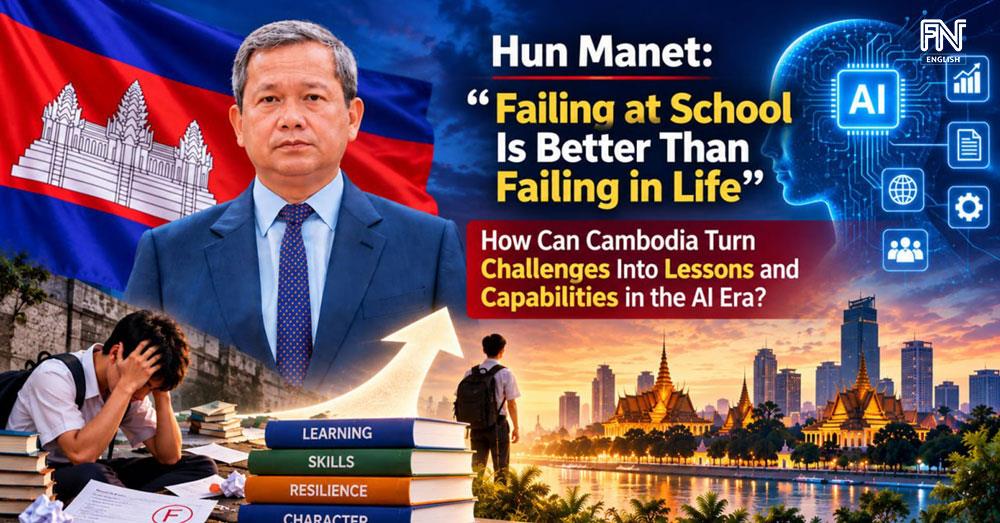
(Phnom Penh): At school, failure may mean failing an exam, performing poorly on an assignment, or having to start over. Yet such setbacks can teach something that a diploma alone cannot show: how to learn from mistakes, persevere and get back up.
The same principle can apply to a country.
Economic crises, wars, conflicts, geopolitical uncertainty and rapid technological change can all inflict losses and put societies under pressure. But if a society can learn from those challenges, adjust its thinking, strengthen its capabilities and prepare itself better for the future, a crisis does not have to remain merely an obstacle to overcome. It can also become a school for the future.
That broader lesson can be drawn from remarks by Cambodian Prime Minister Hun Manet, who said:
“Failing at school is better than failing in life. What we learn at school also provides lessons for life.”
Schools Are About More Than Diplomas
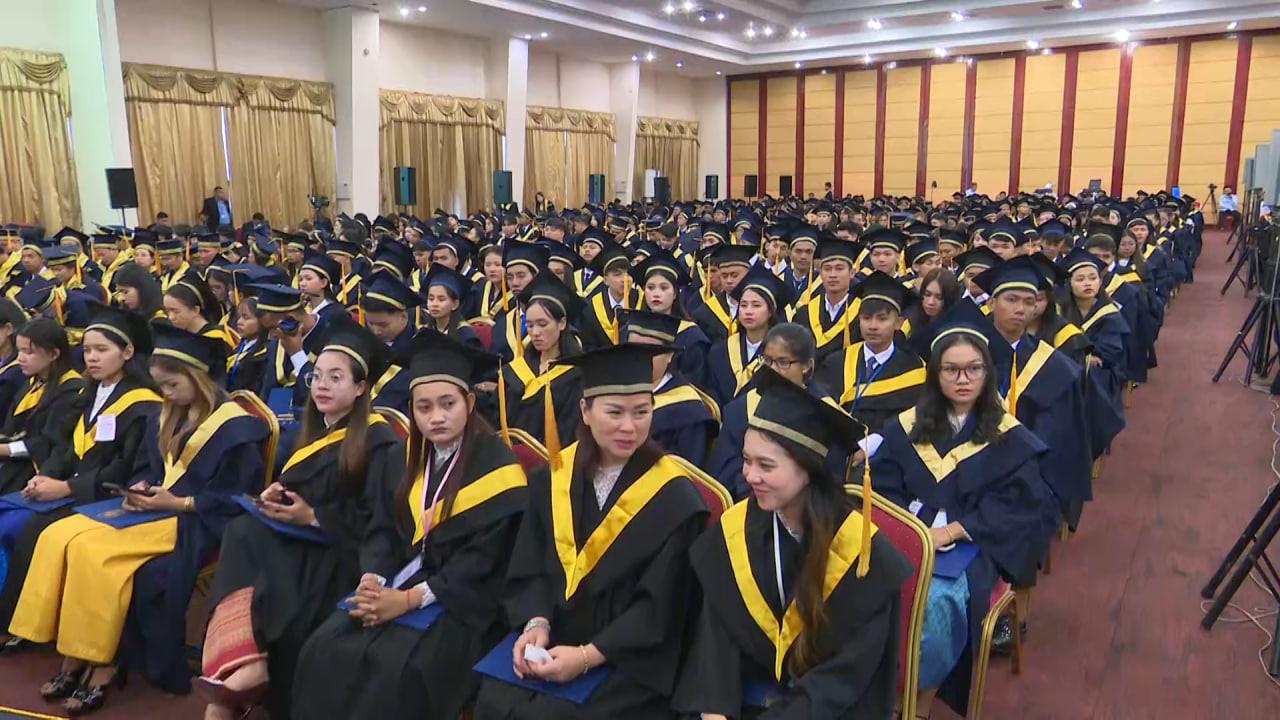
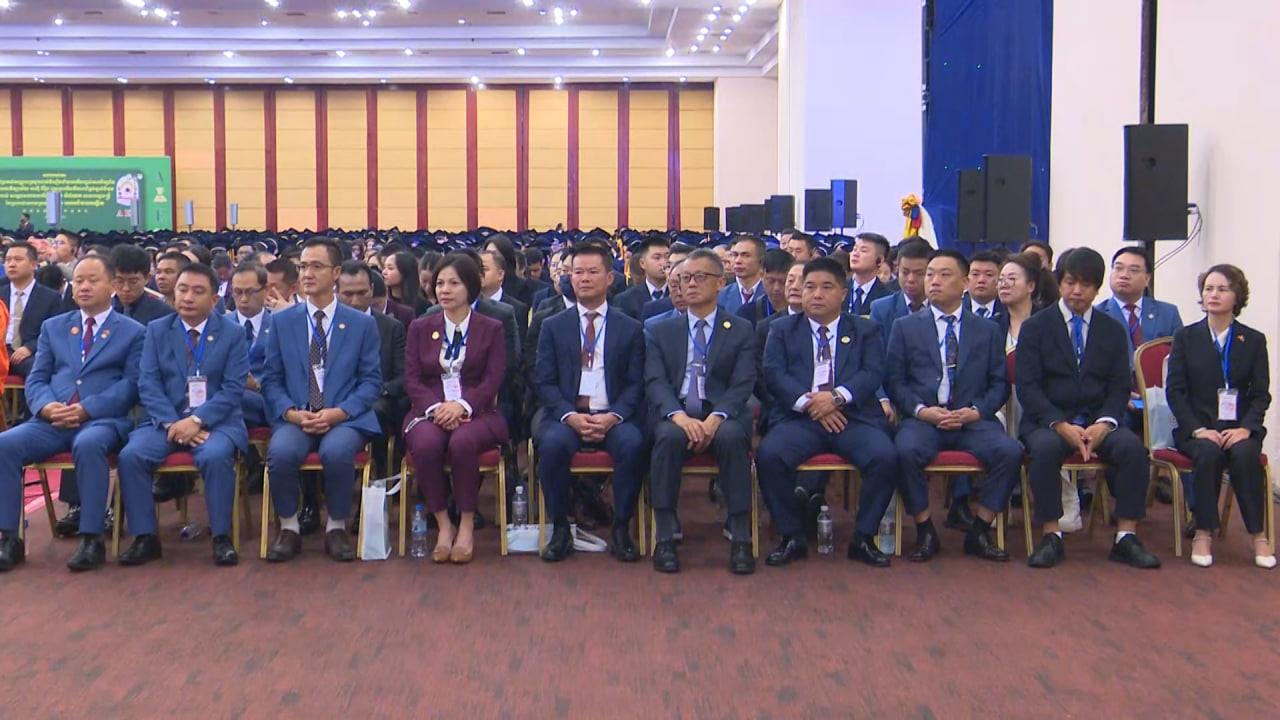
Speaking at a graduation ceremony for 2,573 Asia Euro University graduates at the Koh Pich Convention and Exhibition Center on October 2, 2026, Hun Manet framed education as something broader than simply transferring knowledge.
At the heart of education, he argued, is the development of “competence and character” — the ability to do something, combined with the values and conduct that guide how that ability is used.
This distinction becomes increasingly important in the age of artificial intelligence.
Perhaps the biggest question facing education in the future is not simply, “How intelligent is our technology?” It is also: “Are we developing people with the competence and character needed to use increasingly intelligent technology responsibly?”
Competence + Character: Why Do We Need Both?
Hun Manet’s argument presents a simple but important equation: people need both competence and character.
Competence determines what a person is capable of doing. Character helps determine what that capability is used for and how it is used.
A highly capable person without ethical judgment can use knowledge and technology in ways that harm others. The same technology that can support research, expand knowledge and improve productivity can also be used for online scams, deepfakes and the creation or dissemination of false information.
Conversely, a person may have good intentions and strong ethical values, but without adequate knowledge and skills, may struggle to solve the increasingly complex problems of a modern society.
In other words, competence without character can send capability in the wrong direction, while character without competence may produce good intentions without the ability to turn them into effective results.
This principle is also reflected in international thinking about education in the AI era.
UNESCO’s AI Competency Framework for Students goes beyond technical AI skills. It identifies four major competency areas: a human-centered mindset, ethics of AI, AI techniques and applications, and AI system design.
For teachers, UNESCO similarly combines a human-centered mindset and ethical considerations with AI knowledge and its pedagogical use.
The message is clear: knowing how to use AI is not enough. People must also know when to use it, why they are using it, how to verify what it produces and who remains accountable for the outcome.
This is where competence and character must work together: one gives people the ability to use technology; the other helps determine the direction and boundaries of that use.
Failure at School: Part of Building Capability
Another notable element of Hun Manet’s remarks was his treatment of failure not as the end of learning, but as part of the process of education and human development.
Schools should not merely teach students how to arrive at the correct answer. They should also provide a space where students can get things wrong, learn from mistakes, make corrections and try again.
Failing an exam can be discouraging. Research may not produce the expected results. A project may fail. Yet going through those experiences can develop qualities that textbooks alone cannot provide: patience, perseverance, the ability to learn from mistakes, adaptability and resilience.
Those qualities are becoming increasingly important in a rapidly changing labor market.
The World Economic Forum has identified AI and big data among the fastest-growing skills in demand. At the same time, human capabilities such as creative thinking, resilience, flexibility and agility, analytical thinking, and lifelong learning are also becoming increasingly important.
This is where the idea of “failing at school” intersects with the realities of the 21st-century economy.
As technology changes the skills required in the workplace, people cannot assume that what they know today will be sufficient for tomorrow. They must be able to learn new skills, adapt, correct mistakes and, when necessary, start again.
Failure at school, therefore, is not simply preparation for the next examination. It can also be training for the day when real life knocks someone down — and they have to know how to get back up.
Fresh AI: From Using Technology to Building Local Capability
In this context, the emergence of AI platforms developed in Cambodia represents more than the availability of another chatbot. It can also be viewed as part of a broader effort to develop domestic technological capacity and digital resources.
Fresh AI is one example. Developed with a focus on the Khmer language and Cambodia-related data, the platform had, according to figures released by the company, accumulated approximately 1.5 billion words of data and around 100,000 users by July 2026.
Its functions have expanded beyond AI Chat to include news and legal information searches, image, document and video-to-text conversion, spell-checking and other productivity tools.
The larger issue, however, is not how many functions a particular AI platform offers. The more important question is: To what extent can Cambodia move from being primarily a user of technology to developing its own technological capabilities?
In the AI era, a country cannot rely entirely on technologies developed elsewhere. It also needs investment in human capital, Khmer-language data, research, digital infrastructure and domestic technological capacity.
This direction is consistent with Cambodia’s emerging national AI policy, which emphasizes human-capital development, infrastructure and data, and the application of AI in priority sectors.
Yet having a domestic AI platform, or improving in international AI-readiness indicators, does not by itself mean that Cambodia has developed comprehensive AI capabilities.
A more meaningful measure will be whether the country can develop skilled professionals, high-quality data, research and innovation — while ensuring that AI is used safely, ethically and responsibly.
Here, Hun Manet’s concept of Competence + Character comes back into the picture: Cambodia needs not only people who know how to use AI, but people who can develop, improve, verify and use it responsibly.
The Bigger Lesson: Do Not Let AI Do So Much That Humans Stop Learning
This is where two central messages from Hun Manet’s remarks come together: failure at school can become a lesson for life, and people who know how to use AI will have an advantage over those who do not.
Taken together, the lesson is not simply to “use more AI.”
Rather, it is to use AI to strengthen human capability — not to replace the processes through which human capability is developed.
AI can help find information, but people still need to verify it. AI can assist with analysis, but people still need to exercise judgment. AI can help with writing, but people still need to think and understand what they are writing.
Technology can make work faster and easier. But convenience should not replace critical thinking, research, patience, perseverance, responsibility and ethical judgment.
The goal should not be to make machines increasingly capable while humans become increasingly dependent on them. AI should help people perform better while their own capacity to think, learn and judge grows stronger as well.
Conclusion: From the Classroom to National Resilience
In a world where AI is transforming work and geopolitical uncertainty is increasing, one of the most valuable capabilities may not be the ability to avoid failure altogether. It may instead be the ability to learn from failure and come back stronger.
For students, that means learning again after failure. For institutions, it means allowing mistakes to lead to better systems. And for a country, a crisis should not end merely with surviving it — it should leave behind lessons and stronger capabilities.
Seen from this perspective, Hun Manet’s statement that “failing at school is better than failing in life” carries a meaning that extends beyond encouraging students who have struggled academically.
It points to a broader principle of resilience: fail, learn, adjust and rise again.
In the AI era, resilience is not about never facing failure or crisis. It is about turning the lessons of adversity into stronger capabilities — and those capabilities into greater resilience for the future.