(Phnom Penh): On the occasion of the National Day of the People’s Republic of China, I would like to extend my warm congratulations and best wishes to the Government and people of China.
This occasion is not only a moment to reflect on China’s remarkable journey of national development, but also an opportunity to consider the enduring friendship between Cambodia and China and the direction in which this relationship is moving.
Cambodia-China relations are not a recent phenomenon. They are rooted in a long history of exchanges between our peoples, stretching from the ancient Silk Road, which connected peoples and civilizations, to the Belt and Road Initiative of the present era, which has opened a new chapter of connectivity and cooperation. These relations have been carefully nurtured by successive generations of leaders.
In the modern era, the friendship forged by Cambodia’s late King Father Norodom Sihanouk and generations of Chinese leaders was further nurtured under the leadership of Samdech Techo Hun Sen and continues to be strengthened under Samdech Thipadei Hun Manet. This enduring commitment has created a strong political foundation upon which bilateral relations have continued to develop.
Today, this historically rooted friendship has evolved into a comprehensive relationship encompassing political trust, trade and investment, infrastructure, agriculture, education, culture, tourism, security, and people-to-people exchanges.
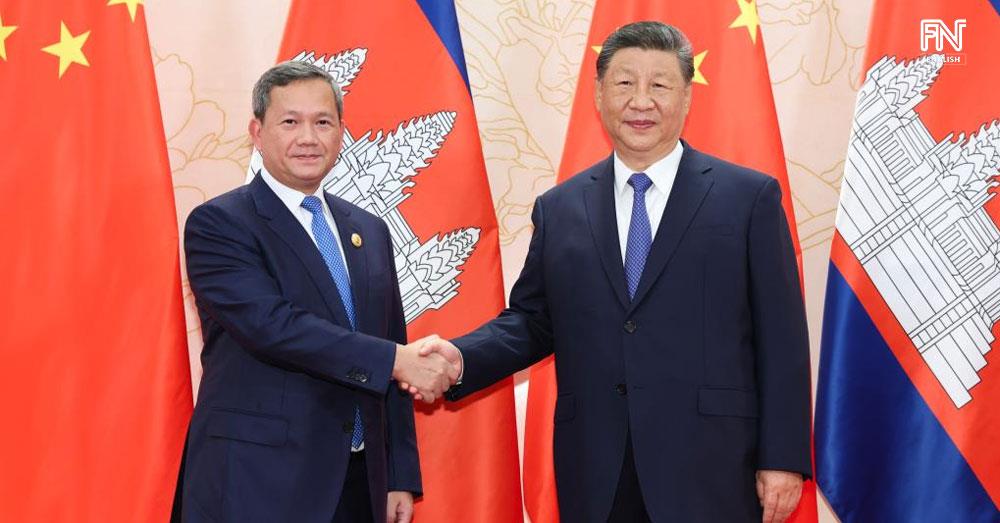
A significant new chapter was opened during the state visit of President Xi Jinping to Cambodia in April 2025. Cambodia and China agreed to build an all-weather Cambodia-China community with a shared future in the new era. The two sides also agreed to deepen cooperation through the “Diamond Hexagon” framework and advance the development of the Industrial Development Corridor and the Fish and Rice Corridor.
The term “all-weather” deserves particular attention. In my view, it should not be understood merely as a diplomatic expression. It reflects the aspiration to build a relationship capable of enduring changes in the regional and international environment. International politics is never static.
The balance of power changes, economies experience periods of growth and uncertainty, and new security and technological challenges emerge. A durable partnership, therefore, requires more than political declarations. It requires mutual trust, practical cooperation and, above all, tangible benefits for the peoples of both countries.
Economic cooperation is one of the most visible dimensions of Cambodia-China relations. China remains Cambodia’s largest trading partner and an important source of foreign investment, while cooperation has expanded across infrastructure, agriculture, industrial and supply-chain cooperation, technology and other sectors.
These areas of cooperation have the potential to support Cambodia’s broader development objectives when they are closely aligned with national priorities and translated into productive capacity, employment, skills and opportunities for Cambodian businesses and communities.
China remained Cambodia’s largest trading partner in 2025, with bilateral trade reaching approximately USD 19.73 billion, according to Cambodian customs data.
The next stage of cooperation should therefore focus not only on the quantity of projects, investment or trade, but increasingly on their quality, sustainability and long-term contribution to development.
Infrastructure should connect not only places, but also markets and opportunities. Investment should generate not only capital flows, but also jobs, skills and technological capacity. Agricultural cooperation should help farmers move beyond primary production toward processing, value addition and stronger access to markets. Educational and research cooperation should generate knowledge and human capital that can support the next generation.
The relationship is also becoming increasingly institutionalised. In April 2026, Cambodia and China convened the first meeting of the “2+2” Strategic Dialogue Mechanism between their foreign and defence ministers, a mechanism agreed upon by the leaders of the two countries in 2025.
This illustrates how bilateral cooperation is expanding beyond individual projects toward more regular mechanisms for dialogue and strategic coordination.
At the same time, relations between countries ultimately rest on relations between people. Governments can sign agreements and institutions can establish frameworks, but friendship becomes sustainable when people understand, respect and benefit from one another. Education, tourism, cultural exchange, academic cooperation and youth engagement are therefore not secondary elements of Cambodia-China relations; they are among the foundations that can sustain the relationship across generations.
The framework advanced during President Xi Jinping’s 2025 visit also emphasized stronger people-to-people exchanges alongside political, economic and security cooperation.
As President of the Royal Academy of Cambodia, I particularly value the role of academic institutions, academies and think tanks. Our responsibility is not simply to recognise achievements, but also to study the relationship carefully, identify opportunities and challenges, and provide evidence-based ideas that can help cooperation produce lasting benefits. Academic exchanges between Cambodia and China can contribute to mutual understanding while helping both sides better appreciate each other’s history, development experiences and perspectives.
Looking toward the future, Cambodia and China have an opportunity to transform a long-standing friendship into an increasingly mature partnership, one that respects national priorities, responds to emerging challenges and delivers practical benefits to ordinary people.
Cambodia and China are different in many respects, in history, size, economic capacity and stages of development, but our differences need not prevent us from pursuing common goals. What brings us together is a shared aspiration for peace, development, cooperation and prosperity.
Indeed, cooperation does not require two countries to be identical; rather, it requires them to understand their differences while identifying the interests and aspirations they share.
The strength of Cambodia-China friendship should therefore be measured not only by how long it has existed, but also by what it can build for the future and what it can deliver for future generations.
On the occasion of the National Day of the People’s Republic of China, I wish the Chinese people continued peace, prosperity and progress. I also hope that Cambodia-China friendship will continue to flourish through mutual respect, mutual understanding and mutually beneficial cooperation.
Happy National Day of the People’s Republic of China.
By President of the Royal Academy of Cambodia, Academician Sok Touch. All views in the article is his own.
=FRESH NEWS