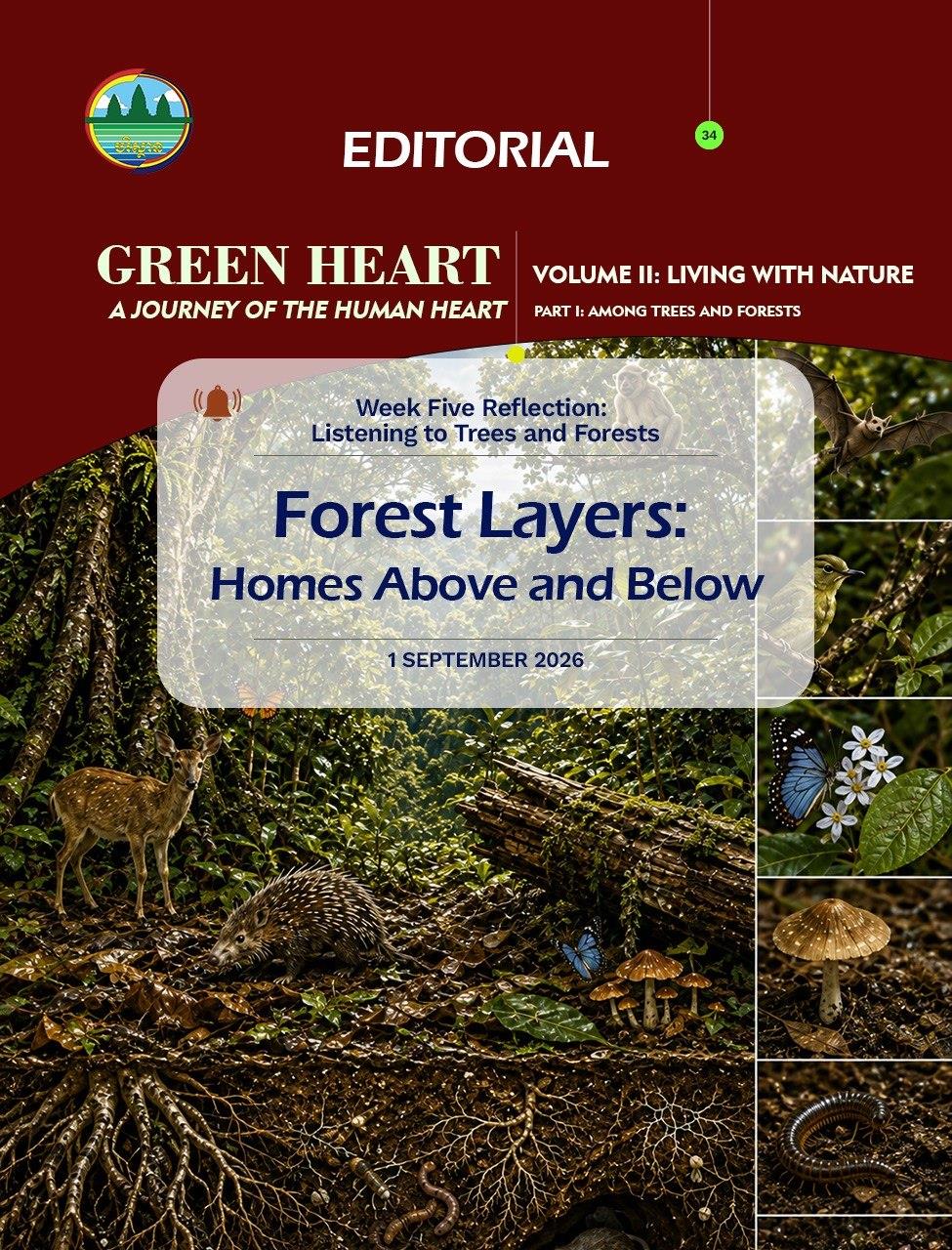
(Phnom Penh): Enter a forest and look upward. The tallest crowns may form an upper layer exposed to strong sunlight. Below them, smaller trees receive filtered light. Shrubs, herbs, seedlings, fallen leaves, roots, and soil create further layers.
The exact structure differs among forests, but vertical variety creates many living spaces.
“A forest rises in layers, and every layer opens another door to life.”
Birds may feed or nest at particular heights. Insects use bark, flowers, leaves, dead wood, or soil. Mammals move through branches or across the forest floor. Fungi and microorganisms work within wood and earth. Water, temperature, wind, and light change from canopy to ground.
This structure explains why a forest is more than a green photograph taken from above. Two places may show similar tree cover while offering very different habitats.
A diverse forest with multiple ages, species, and layers can hold relationships that a simplified stand cannot.
The forest floor deserves special respect. Fallen branches and leaves may look untidy, but in many natural forests they provide habitat and materials for decomposition. Removing everything can interrupt nutrient cycles and shelter.
In parks or fire-prone areas, management needs may differ; local expertise should guide decisions.
Below the floor lies another world. Roots, burrowing animals, fungi, bacteria, water, air spaces, and minerals interact in the soil. Heavy trampling, vehicles, or careless digging can damage this hidden layer.
Forest layers also teach us to examine communities beyond the most visible members. A society needs leaders, but also caregivers, workers, teachers, artists, farmers, children, and elders.
Different roles create strength when they are connected and respected.
Protection must therefore think in three dimensions. We care for the canopy, understory, ground, soil, streams, and the movement between them.
We protect nesting sites and feeding areas, living trees and appropriate dead wood, young growth and mature structure.
Students can practice layered seeing even in a small garden. Look above eye level, at eye level, on the ground, and just beneath loose leaf litter without disturbing animals. Each view reveals different activity.
A forest is a building without walls, filled with homes that human eyes may miss. When we learn to see its layers, our idea of habitat becomes deeper, and our care becomes more complete.
Layered seeing can improve restoration. Planting only tall species may leave the understory, ground cover, and soil community without support. Recovery usually takes time, natural processes, and attention to the full structure appropriate to that particular forest.
Buddhist Reflection
Right view expands beyond the obvious. What appears empty may contain hidden life; what appears disorderly may serve a natural function. Humility encourages us to observe carefully before changing a place.
Today’s Reflection
Which forest layer have I usually overlooked, and what might live there?
Today’s Action
Observe a vegetated place at four levels: canopy, middle, ground, and soil surface. Record one sign of life at each level without disturbing it.
Today’s Pledge
Today I will look beyond the visible and respect every layer that gives life a home.
When we protect nature, we protect all beings, including ourselves.
=FRESH NEWS