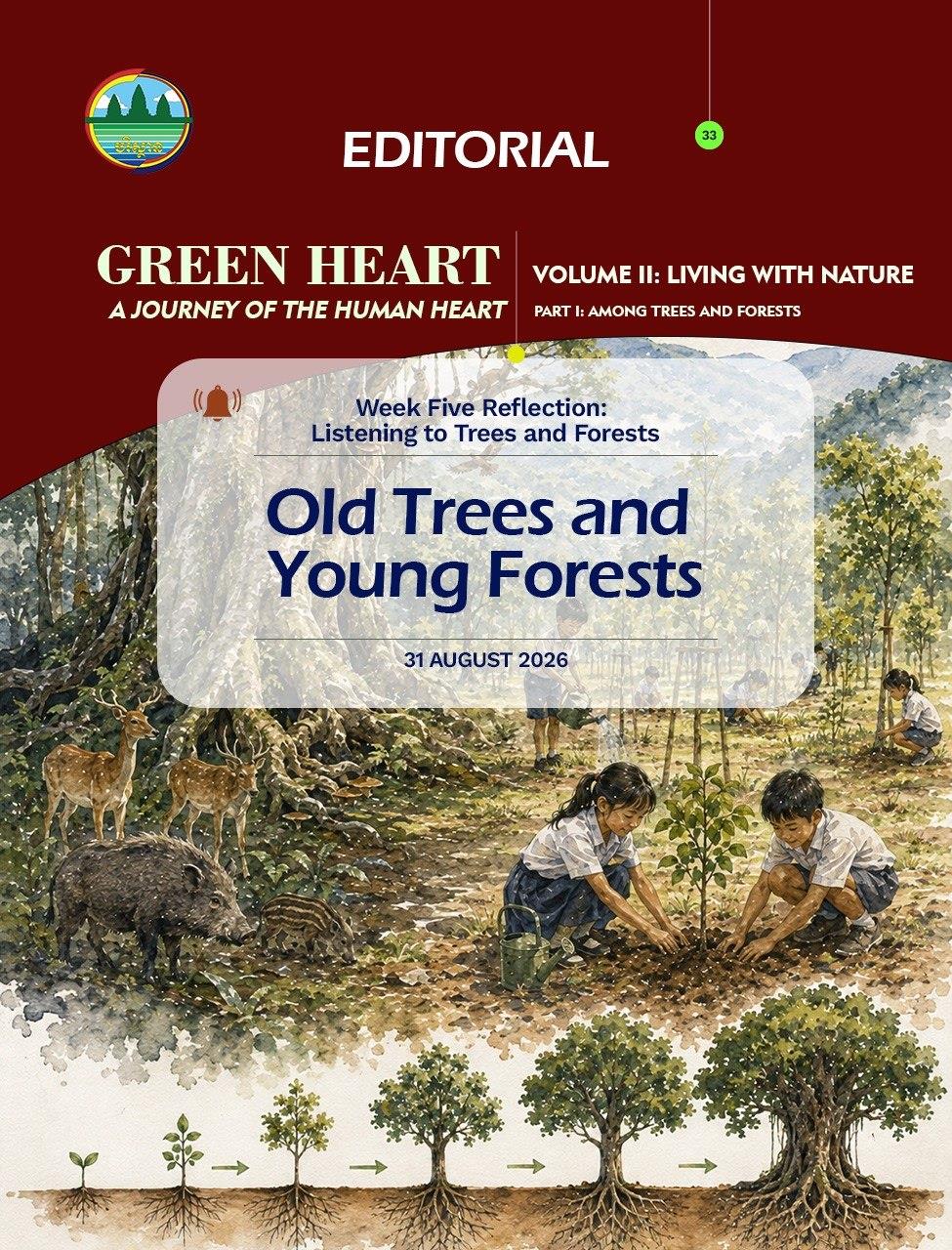
(Phnom Penh): A newly planted tree brings hope. Its stem may be thin, its shade small, and its future uncertain, but it represents a promise.
“A sapling carries tomorrow, while an old tree carries time.”
A mature tree represents something different: years of survival, accumulated growth, and relationships formed over time.
Old and large trees can provide cavities, thick bark, broad crowns, dead wood, fruit, and other features used by many species.
They store substantial amounts of carbon and shape the microclimate around them. Their exact value depends on species, health, and setting, but their ecological roles cannot be replaced instantly by seedlings.
Young forests matter too. They can recover on disturbed land, protect soil, store increasing amounts of carbon, and become future habitat.
Different stages of forest growth may support different species. A healthy landscape can include young growth, mature stands, open areas, and other habitats arranged according to local ecology.
The mistake is believing that planting young trees always gives permission to remove old ones.
Sometimes trees must be removed for safety, disease management, essential development, or ecological reasons. Such decisions should be informed, lawful, and careful. Where avoidance is possible, the value of mature trees deserves serious consideration.
Old trees also hold human memory. A community may remember gatherings, ceremonies, childhood games, or historical events beneath them. Protecting a tree can therefore protect both ecological and cultural heritage.
Age should not be confused with perfect health. A qualified assessment may be needed when branches, roots, or trunks create risk. Responsible care avoids both careless removal and careless neglect.
The relationship between old and young teaches balance. We need the wisdom to preserve what time has created and the hope to begin what future generations will receive.
A forest with only old trees may lack regeneration; a landscape with only young trees lacks the structures that age provides.
Human communities are similar.
Elders carry memory and experience. Young people carry energy and possibility. When generations respect one another, continuity becomes stronger.
Stand near an old tree, then near a sapling. Offer gratitude to both. One has traveled far; the other is preparing to travel. Our responsibility is to protect the journey between them.
That journey includes middle-aged trees too, the quiet generation that will replace today’s elders. A healthy tree population needs continuity across ages.
Counting only seedlings and the oldest landmarks can leave a missing generation unnoticed until it is too late.
Buddhist Reflection
Impermanence does not make age meaningless. Because all things change, mature life deserves careful attention while it is present, and young life deserves conditions for growth. Wisdom honors both continuity and renewal.
Today’s Reflection
What can an old tree provide that a newly planted tree cannot yet provide?
Today’s Action
Identify one mature tree and one young tree nearby. Record what each contributes and one care need for each life stage.
Today’s Pledge
Today I will honor the wisdom of age and protect the promise of new growth.
When we protect nature, we protect all beings, including ourselves.
=FRESH NEWS