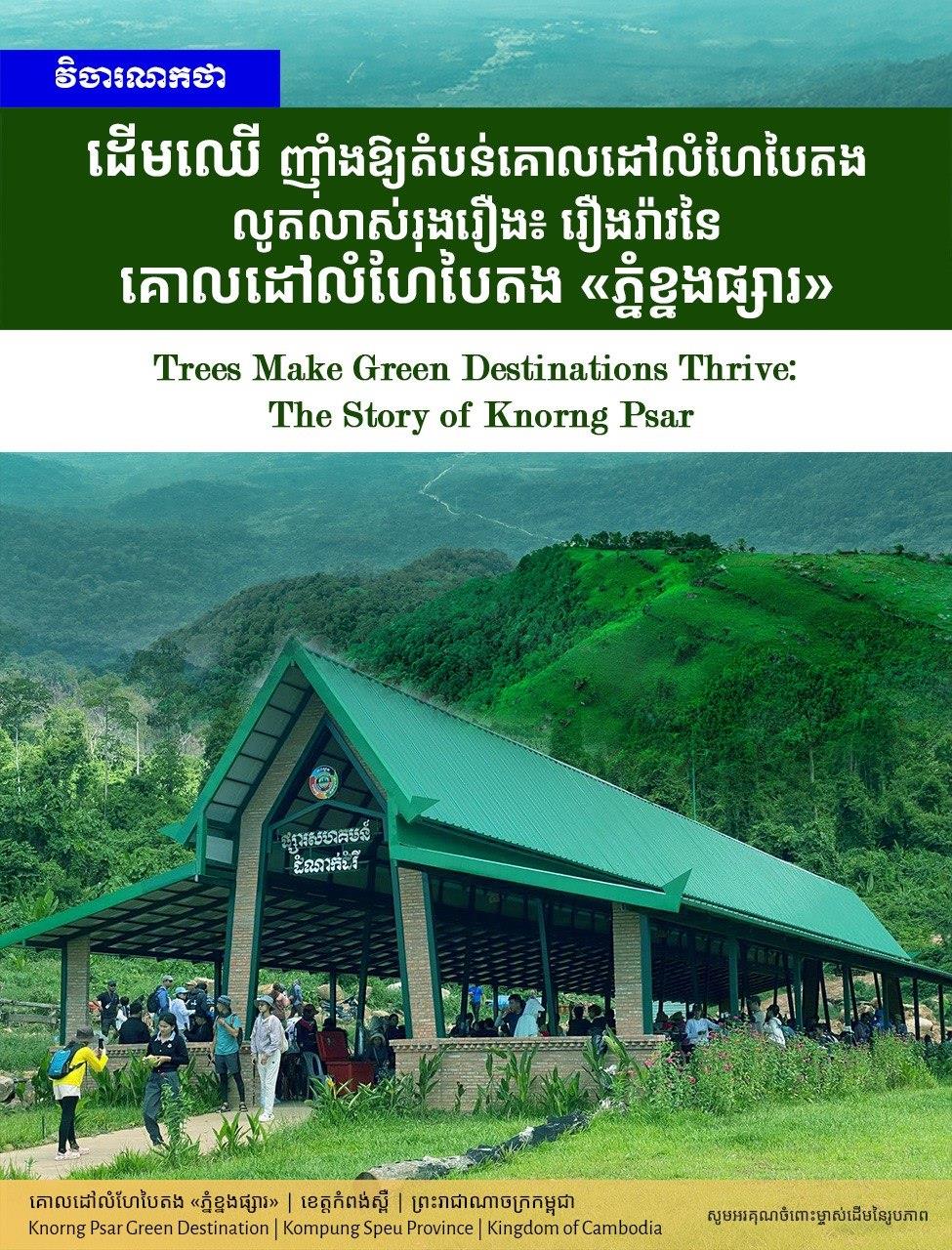
(Phnom Penh): There is a saying that forests are worth more standing than cut down.
Few places demonstrate this truth more clearly than Knorng Psar Green Destination.
Not long ago, many families living around Knorng Psar depended largely on harvesting forest and non-forest products to support their livelihoods.
Today, the same forests have become the foundation of a different future, one built on conservation, ecotourism, and community stewardship.
This transformation teaches us an important lesson.
The health of a green destination begins with the health of its trees.
Without forests, there is no green destination.
Without healthy trees, there are no cool walking trails, no waterfalls flowing through shaded valleys, no birds singing in the morning, no wildlife to discover, no fresh mountain air, and no peaceful landscapes that inspire visitors to return.
Trees are the true architects of ecotourism.
They create shade that cools the trails even on warm days. Their roots protect mountain streams, ensuring clean water flows throughout the year. Their branches provide homes for birds whose songs become part of every visitor’s experience.
Their leaves enrich the soil, sustaining flowers, insects, butterflies, and countless other forms of life that make every journey into nature unforgettable.
When tourists visit Knorng Psar, they are not simply coming to see trees.
They come to experience everything healthy trees make possible.
They come for the cool air.
They come for the clean streams.
They come for the beautiful landscapes.
They come for the peaceful forests.
They come for the opportunity to reconnect with nature.
Every tree contributes to that experience.
But the value of trees extends far beyond tourism.
Healthy forests create healthy communities.
As visitors arrive, local people provide guiding services, transportation, food, accommodation, first aid, and hospitality. Families earn income by protecting nature rather than exploiting it.
Young people find opportunities within their own communities.
Local businesses grow. Villages become cleaner and more attractive. Conservation becomes not only an environmental responsibility but also an economic opportunity.
Knorng Psar has shown that when communities become guardians of their forests, forests become guardians of their communities.
This is the true meaning of a green destination.
A green destination is not defined by beautiful scenery alone.
It is defined by healthy forests.
Healthy wildlife.
Clean rivers.
Safe walking trails.
Responsible tourism.
Fair prices.
Warm hospitality.
Community pride.
And above all, people who understand that protecting nature is the foundation of lasting prosperity.
As Cambodia continues to develop more green destinations across the country, the lesson from Knorng Psar is clear.
If we want more visitors, we must first protect more trees.
If we want stronger local economies, we must first build stronger forests.
If we want tourism to remain sustainable, we must ensure that every development project respects nature rather than replaces it.
Every tree planted today is an investment in tomorrow’s tourism.
Every forest protected is a destination preserved.
Every bird protected enriches a visitor’s experience.
Every clean stream increases the beauty of the landscape.
Every community that protects its natural heritage strengthens its own future.
The success of Knorng Psar reminds us that conservation and development are not opposing goals.
When guided by wisdom and community participation, they become partners.
The greenest destinations become the strongest local economies.
The healthiest forests become the most valuable tourism assets.
And the communities that protect nature become the communities that benefit most from it.
Let us continue planting trees.
Let us continue protecting our forests.
Let us continue supporting community-led green destinations like Knorng Psar.
Because every tree we protect today is not only preserving nature; it is creating opportunities, improving livelihoods, welcoming visitors, and building a greener, more prosperous Cambodia for generations to come.
For in the end, the greatest attraction of every green destination is not a building or a road.
It is the living forest itself.
=FRESH NEWS