(Phnom Penh): In the history of international relations, some state visits are purely ceremonial. Others, however, take place at moments that lead observers to ask whether a political message lies behind the protocol.
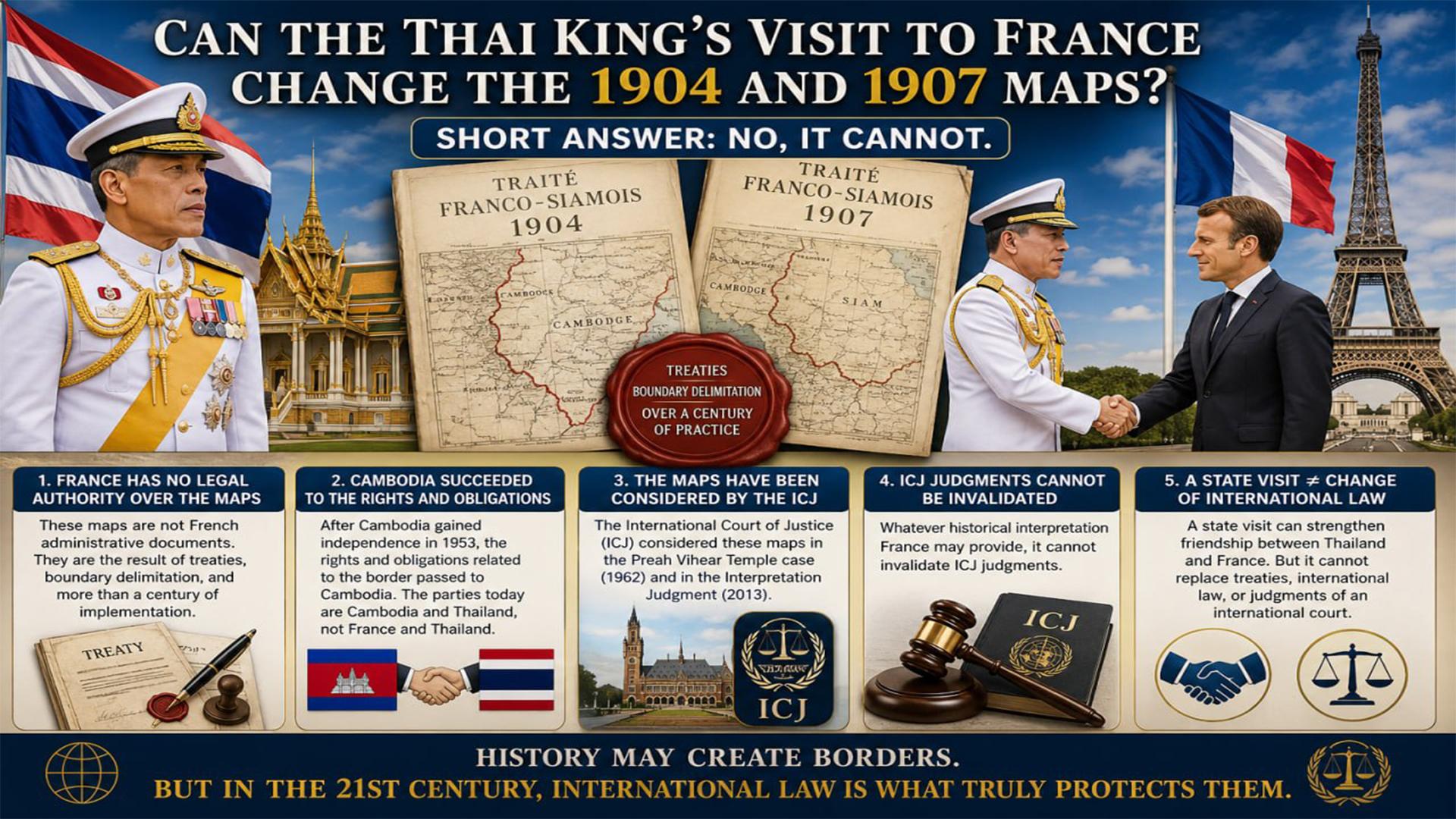
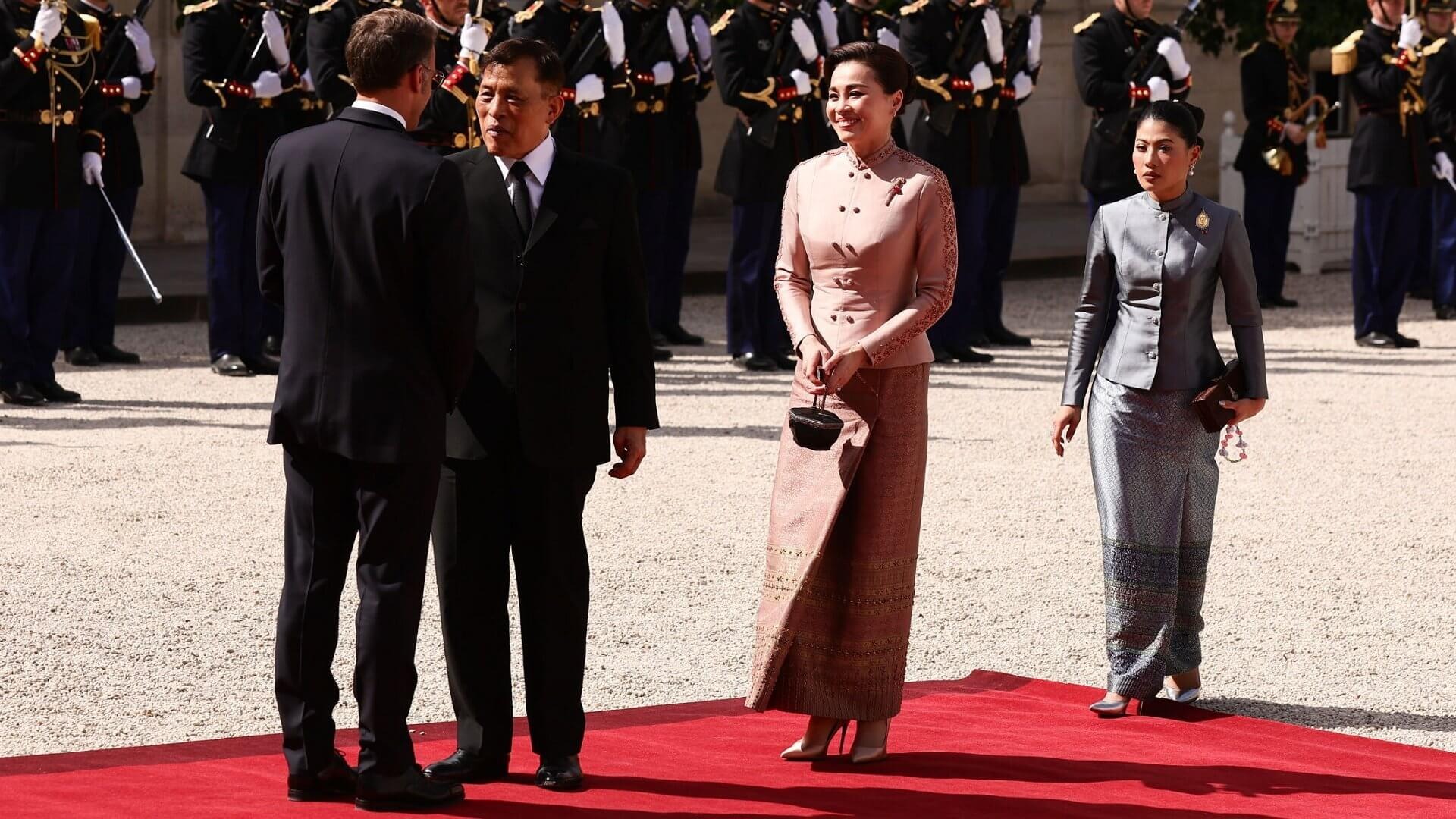
The state visit of Thailand’s King Maha Vajiralongkorn to France, marking the 170th anniversary of diplomatic relations between the two countries, comes at a time when the Cambodia-Thailand border dispute is once again heating up. This coincidence has raised a question many are now asking:
Could this visit open the way to revising or invalidating the 1904 and 1907 maps that form part of the foundation of the Cambodia-Thailand border dispute?
This question has become even more significant after Thai leaders declared that Thailand no longer recognizes the 1:200,000-scale maps prepared under the 1904 and 1907 Franco-Siamese treaties as the basis for determining the border.
But from the perspective of international law, the real question is not whether Thailand recognizes the maps or not.
The real question is this: Can maps that have become part of the legal history of an international boundary and have been considered by the International Court of Justice be invalidated by the decision of one state, or by France’s agreement?
Does France Still Have Authority Over the 1904 and 1907 Maps?
Some may assume that because the 1904 and 1907 border maps were prepared during the French colonial period, France can decide whether to continue recognizing them or withdraw recognition.
Under international law, however, that assumption does not reflect the current legal status of the Cambodia-Thailand border.
The 1904 and 1907 maps are not merely French administrative documents that France can revise or withdraw at will. They are the result of treaties between France and Siam and the work of a mixed boundary commission, implemented for more than a century.
After Cambodia gained independence in 1953, the rights and obligations relating to the border passed to the Cambodian state under the principle of state succession. In other words, France is no longer a party to this border.
Therefore, the question today is not whether France recognizes or rejects the maps. The real question is how Cambodia and Thailand will resolve their border issue based on international law and treaties that remain valid.
Why Do ICJ Judgments Carry Greater Legal Weight Than France’s Position?
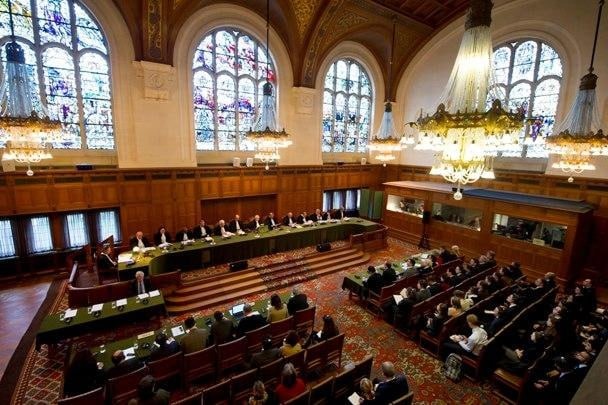
The most important point is that the 1904 and 1907 maps are not merely historical documents preserved in French archives. They were considered by the International Court of Justice in the 1962 Preah Vihear case and again in the 2013 interpretation judgment.
Crucially, the ICJ did not decide the case based solely on France’s view. The Court assessed the maps together with the 1904 and 1907 treaties, the conduct of the parties, continued acquiescence, and the practical behavior of both states over many decades.
This means the maps are not administrative documents that France can unilaterally revise or withdraw. They became evidence considered by an international court and given legal significance in its judgments.
Therefore, whatever views or interpretations France may offer regarding its historical documents, they cannot alter the validity of ICJ judgments or the legal situation already established.
The ICJ did not “create” the 1904 and 1907 maps. Rather, it assessed their legal value within the context of treaties, the conduct of the parties, and principles of international law.
What If France Agrees With Thailand?
A question many people are asking is this: If France agrees with Thailand’s position and declares that it no longer recognizes the 1904 and 1907 maps, would those maps lose their legal force?
The answer, under international law, is no.
France may express views or provide interpretations of historical documents in its archives. But France is no longer a party to the Cambodia-Thailand border. Therefore, France cannot cancel treaties that have already been implemented or invalidate ICJ judgments through a unilateral declaration.
Moreover, ICJ judgments are legal determinations by an international court, not expressions of France’s opinion. Whatever political position or historical interpretation France may take, it cannot change the legal effect of those judgments.
If the Cambodia-Thailand border were ever to change, it could happen only through means recognized by international law, such as a new agreement jointly accepted by Cambodia and Thailand, or a decision by a competent international court if both parties agree to submit the dispute to that body.
In other words, France may interpret its own history, but it cannot decide the future of the Cambodia-Thailand border on behalf of the two sovereign states.
What Questions Does the Thai King’s Visit Raise?
The Thai King’s state visit to France is a historic event in the 170-year relationship between the two countries. In diplomatic terms, it is a visit focused on strengthening friendship and cooperation.
However, the timing has drawn particular attention because it comes as the Thai government is taking the position that it no longer recognizes the 1:200,000-scale maps derived from the 1904 and 1907 Franco-Siamese treaties. It is therefore natural for analysts and the public to ask what effect the visit may have on discussions surrounding the Cambodia-Thailand border.
Still, it is important to distinguish between diplomatic politics and legal status. Meetings, exchanges of views, or searches through historical archives may be part of diplomacy. But they do not mean that implemented treaties or ICJ judgments can be automatically changed.
Thus, the most important message of this visit may not be that the Cambodia-Thailand border will change. Rather, it shows that the border issue remains an important diplomatic subject in the region, while the final solution must remain within the framework of international law, not diplomatic ceremony alone.
Conclusion
The Thai King’s state visit to France is an important event for relations between the two countries and may open doors for new cooperation in many areas.
But for the Cambodia-Thailand border dispute, this visit does not mean that the 1904 and 1907 maps can be annulled or changed by France’s unilateral agreement.
Since Cambodia gained independence, the border issue has no longer been a matter between France and Siam, as it was more than a century ago. It is now a matter between two sovereign states, Cambodia and Thailand, to be resolved in accordance with international law, valid treaties, and the judgments of the International Court of Justice.
History can be studied and reinterpreted. Politics can also shift with circumstances. But the legal status of an international border cannot be changed by historical reinterpretation or by the political position of a single third party.
In other words, a state visit can strengthen friendship between nations, but it cannot replace treaties, international law, or the judgments of international courts. That is the principle that protects stability and certainty of borders among states in the international community.
Indeed, history may create borders. But in the 21st century, it is international law that truly protects them.