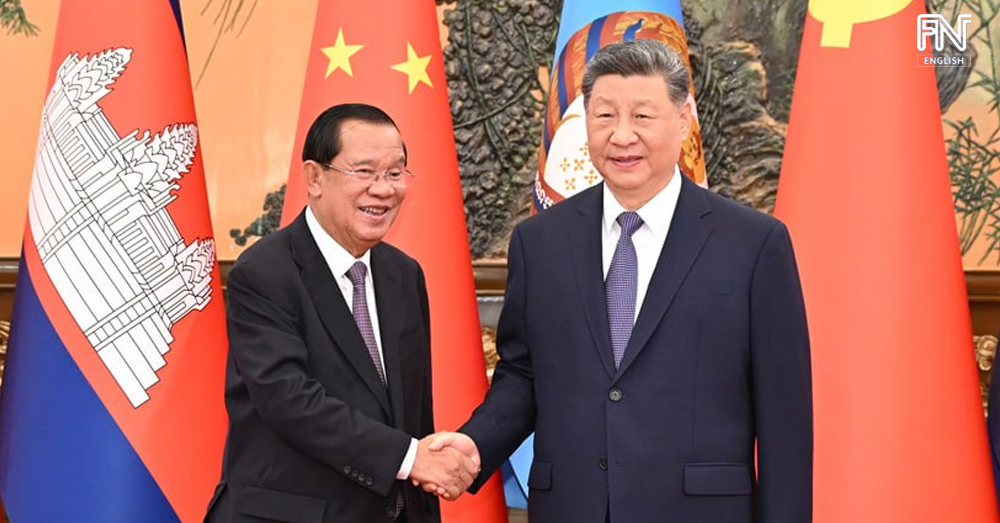
(Beijing): As widely anticipated, the official visit of Samdech Techo Hun Sen, President of the Senate and President of the Cambodian People's Party (CPP), to the People's Republic of China from June 25–27, 2026, stands as one of the year's most significant diplomatic and political events. More than a high-level exchange, the visit reflects the enduring strength of the ironclad friendship between Cambodia and China and reaffirms both countries' commitment to deepening their comprehensive strategic partnership.
The visit underscores the determination of the highest leaders of both nations to further strengthen bilateral cooperation while reinforcing the vision of building a Cambodia–China All-Weather Community with a Shared Future in the New Era.
Over nearly seven decades, Cambodia–China relations have remained resilient despite profound regional and global transformations. Through changing geopolitical landscapes, the partnership has continued to expand in both breadth and depth. Today, China remains Cambodia's foremost comprehensive strategic partner and its largest source of investment, development assistance, and infrastructure financing, while also serving as one of Cambodia's leading trading partners and an increasingly important partner in people-to-people exchanges.
Against a backdrop of global economic uncertainty and intensifying geopolitical competition, Samdech Techo's visit sends a clear political signal of both countries' shared commitment to strengthening mutual trust, expanding practical cooperation, and aligning their long-term development strategies.
Particular attention is expected to focus on advancing cooperation under the Belt and Road Initiative (BRI) in synergy with Cambodia's national development agenda. Closer coordination is anticipated to generate new opportunities in infrastructure, industrial development, modern agriculture, digital technology, green development, and human capital, contributing to Cambodia's long-term economic transformation.
Beyond government-to-government cooperation, the visit also reinforces the longstanding relationship between the Cambodian People's Party and the Communist Party of China. For decades, exchanges between the two ruling parties have provided an important political foundation for bilateral relations, encompassing governance, party-building, public administration, economic development, and leadership development. These sustained interactions have helped cultivate the high level of political trust that continues to underpin Cambodia–China cooperation.
Observers also expect the visit to further expand cooperation between the youth organizations of the two ruling parties. In an increasingly interconnected and digital world, investing in youth engagement has become essential to preserving and strengthening the long-term friendship between the two countries.
Through leadership exchanges, training programs, academic seminars, youth forums, and other cooperative initiatives, young leaders from both countries are expected to deepen their understanding of each other's history, culture, governance systems, and development aspirations, building upon the memorandum of understanding recently signed between the two parties.
Such investment in the next generation extends beyond strengthening party-to-party relations. It represents a strategic commitment to ensuring that Cambodia–China friendship remains resilient, dynamic, and sustainable for decades to come. As greater mutual understanding and trust are fostered among young people, both state-to-state and people-to-people relations will continue to rest on an even stronger and more enduring foundation.
Overall, Samdech Techo Hun Sen's visit to China from June 25–27, 2026, represents a strategically important milestone in the continuing evolution of Cambodia–China relations. Beyond advancing cooperation in politics, economics, culture, and development, the visit is expected to lay a stronger foundation for friendship and collaboration between the younger generations of the two ruling parties.
Ultimately, the visit represents an investment in the future—one that will help ensure that the partnership between the two governments and peoples continues to flourish, guided by stability, mutual trust, shared prosperity, and a common vision for long-term development.
By Dr. Chea Monirith
President, the Cambodia–China Development Research Association
=FRESH NEWS