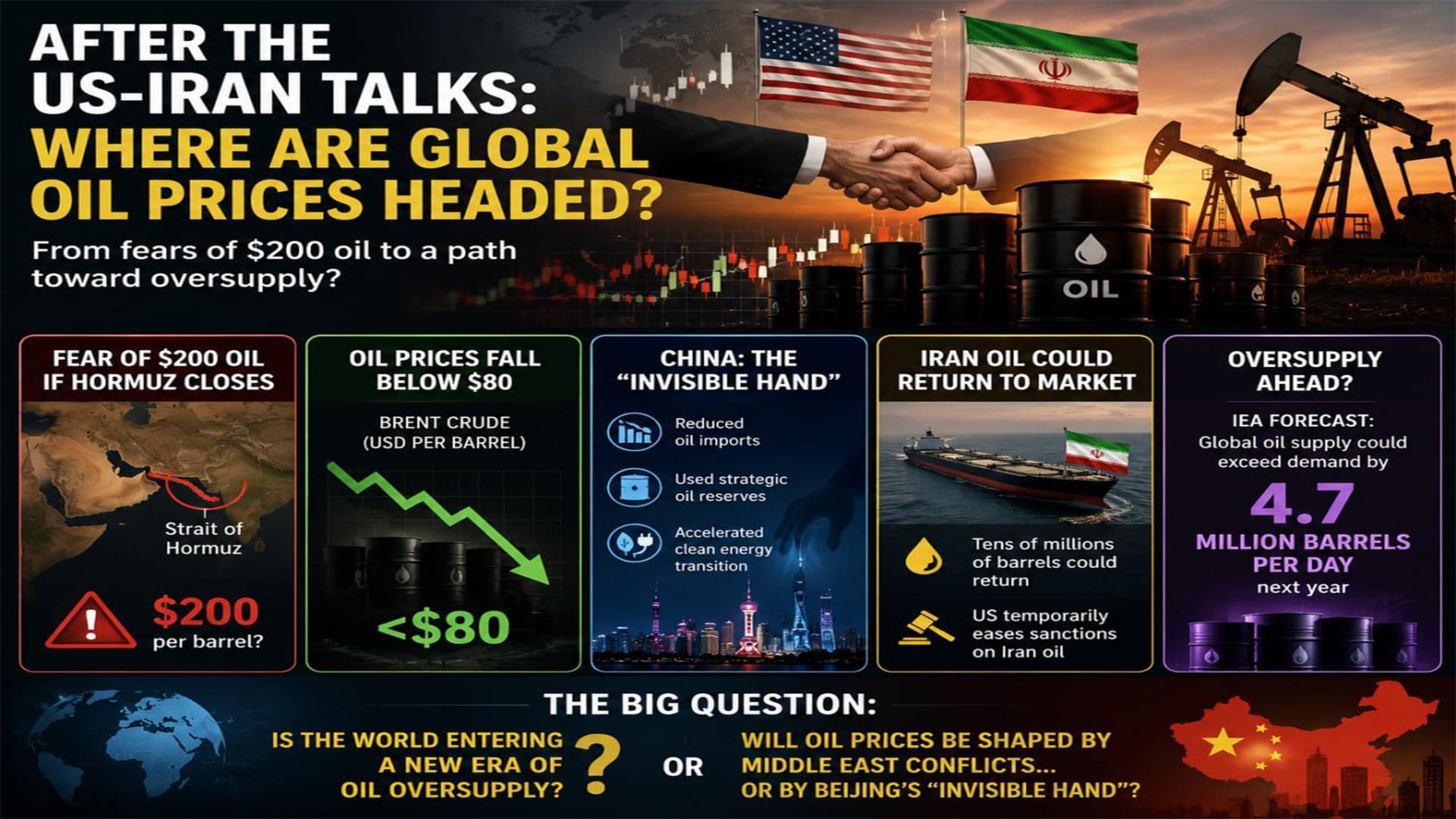
(Phnom Penh): A few months ago, the world was bracing for a worst-case scenario: oil prices soaring to as high as $200 per barrel if the conflict between the United States and Iran escalated and the Strait of Hormuz was completely shut down.
Today, however, the oil market is sending a very different message.
Following US-Iran negotiations in Switzerland and growing signs that the Strait of Hormuz could soon return to normal operations, a major question has emerged: Is the world moving away from fears of an oil shortage and toward an era of oversupply?
The negotiations between the United States and Iran are not merely an attempt to end the war. They could also determine the future direction of the global energy market.
As Washington temporarily eases sanctions on Iranian oil exports and shipping traffic through the Strait of Hormuz gradually increases, many analysts believe the global oil market could face an oversupply as early as next year.
Nevertheless, the future of oil prices may ultimately hinge on one critical question: Will China continue to buy oil in large volumes?
From Fears of $200 Oil to Prices Falling Below $80
In the early stages of the US-Iran conflict, many analysts warned that oil prices could surge to $200 per barrel if the Strait of Hormuz were closed, as the strategic waterway carries roughly one-fifth of the world's oil supply.
But that worst-case scenario never materialized.
Instead, Brent crude, the global benchmark, has fallen below $78 per barrel as markets increasingly expect the Strait of Hormuz to resume normal operations while negotiations between Washington and Tehran continue.
In this context, while the world's attention has focused on the conflict in the Middle East, the global oil market appears to have been stabilized by an "invisible hand" operating from Beijing.
Many analysts believe that China has been one of the key factors preventing a sharp surge in global oil prices. By cutting oil imports, drawing on vast strategic reserves, and accelerating the transition toward clean energy, China has helped cushion the impact of supply disruptions.
Daan Walter, an energy specialist at Ember, noted:
"China has played a critical role here to buffer this for the rest of Asia, thereby buffering the global economy."
Indeed, at a time when war fueled fears of a global oil shortage, China emerged as one of the most important stabilizing forces preventing a full-scale global energy crisis.
Iran Could Return to the Oil Market in a Big Way
The preliminary agreement between the United States and Iran has prompted Washington to temporarily ease sanctions on Iranian oil exports for 60 days.
Al Jazeera reported that this decision could allow Iran to sell oil at full market prices, eliminating the need to offer deep discounts as it had under previous sanctions regimes.
Muyu Xu, Senior Crude Research Analyst at Kpler, said:
"If the Strait of Hormuz reopens quickly, that means 100 million barrels of stranded oil injected back into the market."
Her assessment suggests that global oil supplies could increase rapidly in the short term, putting downward pressure on prices unless global demand rises at the same pace.
China: The Most Important Factor for Future Oil Prices
CNN described China as "the invisible hand that is rebalancing the market."
China has the capacity to reduce oil imports by as much as three million barrels per day — nearly equivalent to Japan's total crude oil demand.
David Fishman, an energy expert at the Lantau Group, described China as: "a wonderful release valve for the global crude market." However, Fishman also cautioned: "The thing that can't be sustained forever is the stockpiles of crude."
This warning suggests that China's ability to contain global oil price increases may have limits. If Beijing begins replenishing its strategic petroleum reserves, global demand could rise sharply, potentially driving oil prices higher once again.
Could the World Be Heading Toward an Era of Oil Oversupply?
Having just emerged from one of the most severe oil crises in modern history, the world may now be facing an entirely different scenario: oil oversupply.
The International Energy Agency (IEA) forecasts that global oil supply could exceed demand by as much as 4.7 million barrels per day next year as Middle Eastern production gradually returns to normal.
In its latest report, the IEA stated: "This may provide a welcome respite to the market and an opportunity to replenish depleted inventories."
At the same time, the rapid expansion of clean energy is playing an increasingly important role in reducing dependence on fossil fuels.
Cosimo Ries, an analyst at Trivium China, observed: "This acceleration to electrification is picking up."
In other words, if US-Iran negotiations continue to progress, oil supplies expand, and the adoption of electric vehicles and clean energy technologies continues to accelerate, the global oil market may enter a new era in which oversupply becomes a greater challenge than scarcity.
Conclusion
After months of war and fears of an oil shortage, the world appears to be moving toward a new era characterized by the possibility of oil oversupply.
Yet before predicting whether oil prices will rise or fall, the world may first need to watch what the "invisible hand" in Beijing does next.
As analyst Muyu Xu asked: "What does China want to buy?"
Indeed, in the new era of global energy, the future of oil prices may no longer be determined solely by conflict in the Middle East. It may increasingly be shaped by the decisions made in Beijing.