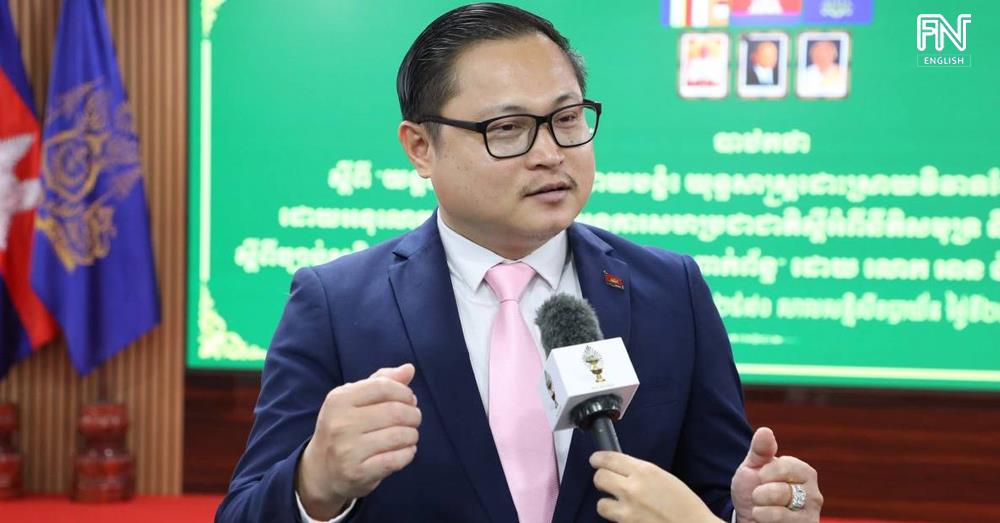
(Phnom Penh): On 25 May 2026, an international legal expert, An Pasty, who received direct training from the United Nations in the field of the Law of the Sea, delivered an important presentation at the National Assembly of Cambodia in his capacity as an international law expert, a Cambodian intellectual, and in a spirit of national service for the collective benefit of all Cambodian citizens.
In this address, An Pasty outlined a strategic diplomatic roadmap for Cambodia’s response to violations of Cambodia’s territorial integrity by Thailand.
The core elements of the approach he proposed include:
First, further advancing the proactive mechanisms under the United Nations Convention on the Law of the Sea (UNCLOS), particularly through the Convention’s mechanism of Compulsory Conciliation, and making fuller and more active use of this legal framework.
Second, strengthening active and proactive diplomacy with regional and international partners, while firmly calling upon Thailand to respect the international rules-based order, the ASEAN Charter, and the Charter of the United Nations.
An Pasty proposed that Cambodia should intensify its diplomatic measures by building stronger alliances with key actors across ASEAN, Europe, Asia, and other relevant regions, while also utilising ASEAN mechanisms and the broader international community as witnesses to the issue of Thailand’s continued encroachments against Cambodia over centuries.
He further emphasised the need to enhance proactive diplomatic mechanisms in order to secure broader international support in the collective spirit of upholding the international rules-based order and opposing all forms of aggression that violate international law.
By insisting upon respect for the ASEAN Charter and the United Nations Charter, Cambodia, together with the international community, can continue exerting diplomatic pressure on Thailand to engage in the peaceful settlement of sovereignty disputes.
This strategic framework is aimed not only at safeguarding Cambodia’s sovereignty, but also at reinforcing integrity in the application of international law and promoting regional and international rules-based order. Furthermore, it seeks to establish a model for the peaceful settlement of disputes under the framework of international law and the international rules-based order originating from Cambodia itself.
The statement by An Pasty reflects one of the most fundamental doctrines of modern international law: illegal conduct cannot generate legal entitlement. This principle is deeply rooted in the post-1945 international legal order established by the United Nations and reinforced through state practice, judicial decisions, treaty law, and customary international law.
In the complex landscape of international law, the stability of state obligations and respect for sovereignty remain paramount. An Pasty, a distinguished international law expert and former Cambodian diplomat, critically examines Thailand’s recent unilateral disengagement from the 2001 and 2000 Memoranda of Understanding (MoUs) with Cambodia.
Anchored in the foundational principles of the United Nations Charter and customary international law, Pasty argues that unlawful acts cannot create lawful rights, and that treaty obligations, once undertaken, persist despite political shifts. Through a detailed legal analysis, he situates the Cambodia–Thailand MoUs within a broader framework of legal continuity, highlighting that political transitions cannot nullify international obligations nor erode the rule of law in regional peace-building.
By An Pasty, an International Law Expert, Geopolitics, and a Career Diplomat, a former Cambodian Diplomat to Latin America with 10 years in foreign services and over two decades practical experiences in national and international law, a former United Nations Awardee on Ocean Affairs and Law of the Sea (UNCLOS) at the United Nations Headquarter in New York, the USA in 2018 and UN Awardee of UN Regional Course in International Law for Asia and the Pacific in 2019.
=FRESH NEWS