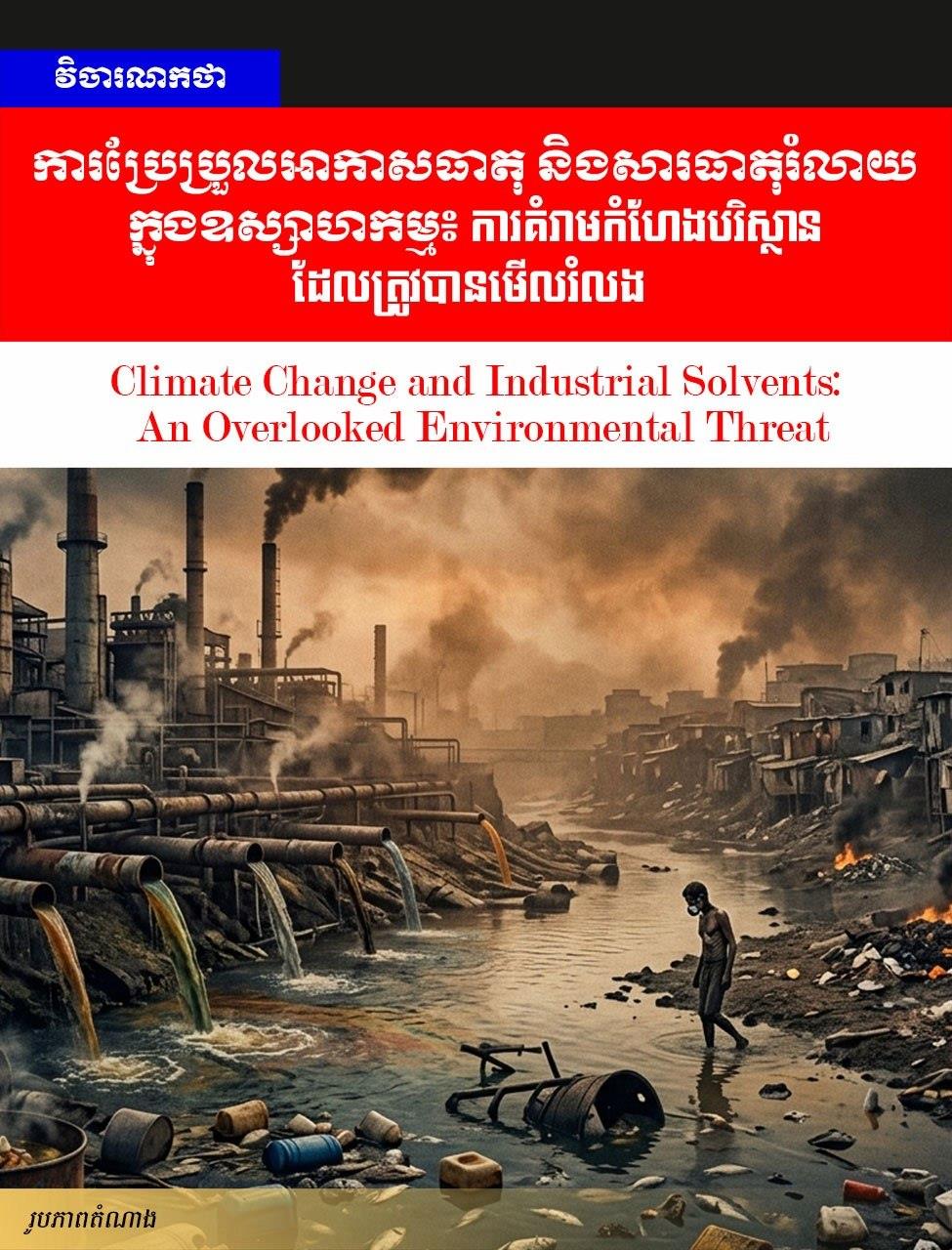
(Phnom Penh): The global debate on climate change often focuses on energy, transport, and deforestation. Yet behind factories, laboratories, workshops, and manufacturing lines lies another environmental challenge that receives far less public attention: industrial solvents.
Widely used across industries ranging from electronics and pharmaceuticals to paints, textiles, and chemical manufacturing, solvents are deeply embedded in modern production systems. Their environmental footprint, however, is becoming increasingly difficult to ignore in a warming world.
Solvents are chemical substances used to dissolve, clean, dilute, or extract materials during industrial processes. Many are volatile organic compounds (VOCs), which evaporate easily into the atmosphere. Once released, these compounds contribute to air pollution and the formation of ground-level ozone, a harmful pollutant linked to respiratory illness and environmental degradation.
The connection between solvents and climate change is both direct and indirect. The production of many industrial solvents depends heavily on fossil fuels and energy-intensive chemical processes, generating significant greenhouse gas emissions. At the same time, solvent emissions contribute to atmospheric pollution that can interact with climate systems and worsen environmental stress.
Climate change, in turn, amplifies the risks associated with solvents. Rising temperatures increase evaporation rates, causing solvents and VOCs to disperse more rapidly into the air. Heatwaves can intensify chemical reactions that form smog and ozone pollution, particularly in urban and industrial areas. As cities become hotter, air quality deteriorates, placing millions of people at greater health risk.
Extreme weather events further complicate the issue. Floods, storms, and industrial accidents linked to climate instability can release hazardous solvents into waterways and soil. In regions with weak environmental controls, storage facilities and industrial sites may be ill-equipped to withstand increasingly severe climate conditions. What begins as an industrial leak can quickly become a regional environmental disaster.
The human health implications are serious. Prolonged exposure to certain solvents has been associated with respiratory diseases, neurological disorders, skin damage, and other long-term health effects. Workers in industrial sectors and communities near manufacturing zones are often the most vulnerable, especially where safety standards and monitoring systems are inadequate.
Developing countries face particular challenges. As global manufacturing shifts toward emerging economies, industrial growth often outpaces environmental governance. Solvent-intensive industries may operate in areas lacking proper waste treatment, emissions control, or occupational protections. Climate change magnifies these vulnerabilities, exposing populations already at environmental risk.
The broader economic impact should not be underestimated. Poor air quality reduces productivity, increases healthcare costs, and strains public health systems. Climate-related disruptions to industrial operations can also affect global supply chains, highlighting how environmental risks are increasingly becoming economic risks.
Yet this challenge also presents an opportunity for transformation. Cleaner production technologies, low-VOC solvents, green chemistry, and circular manufacturing systems are already emerging as viable alternatives. Many industries are discovering that reducing harmful solvent use not only lowers environmental impact but also improves efficiency and long-term competitiveness.
International frameworks such as the Paris Agreement emphasize the need for sustainable industrial development. However, achieving climate goals requires looking beyond carbon emissions alone. Pollution control, chemical safety, and industrial sustainability must become integral parts of climate policy.
Governments have a critical role to play through stronger regulations, monitoring systems, and incentives for cleaner technologies. Industries must invest in innovation and responsible chemical management. Consumers and investors are also increasingly demanding environmentally responsible production, creating pressure for change across global markets.
The story of solvents and climate change illustrates a larger reality about the modern economy: environmental risks are interconnected. Invisible emissions from industrial chemicals may seem secondary compared to smokestacks or fossil fuels, but their cumulative impact on air quality, ecosystems, and human health is substantial.
In the end, sustainability is not simply about reducing emissions. It is about redesigning systems of production so that economic progress no longer comes at the expense of environmental and human well-being.
The climate crisis demands attention not only to the obvious sources of pollution, but also to the quieter, overlooked chemicals shaping the future of the planet.
=FRESH NEWS