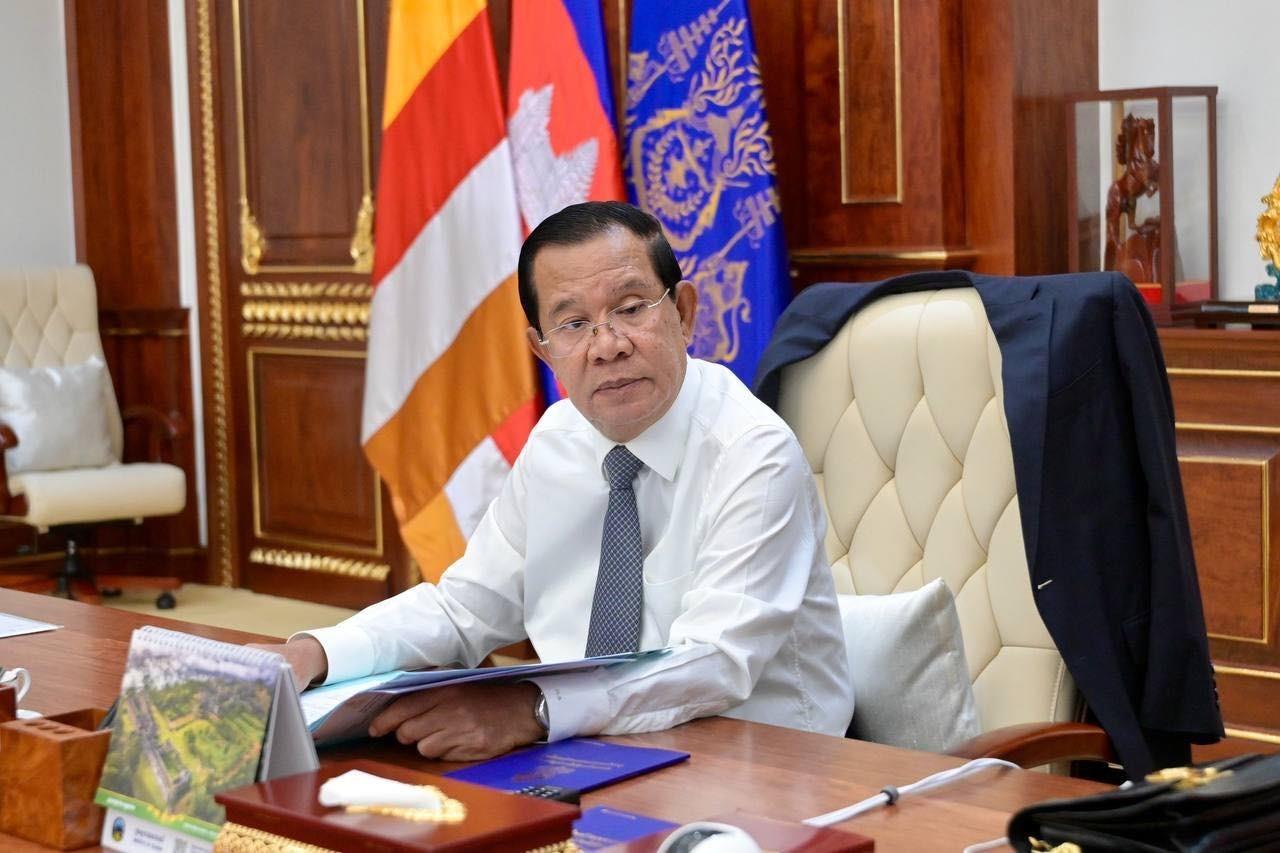
(Phnom Penh): The remarks made by Cambodia’s Acting Head of State, Samdech Akka Moha Sena Padei Techo Hun Sen, on May 12, 2026, were not merely an ordinary political statement concerning the maritime dispute between Cambodia and Thailand. Rather, they represented an important political and strategic message clearly signaling that Cambodia should not return to a new bilateral negotiation mechanism after the previous bilateral framework had already been dismantled unilaterally by Thailand.
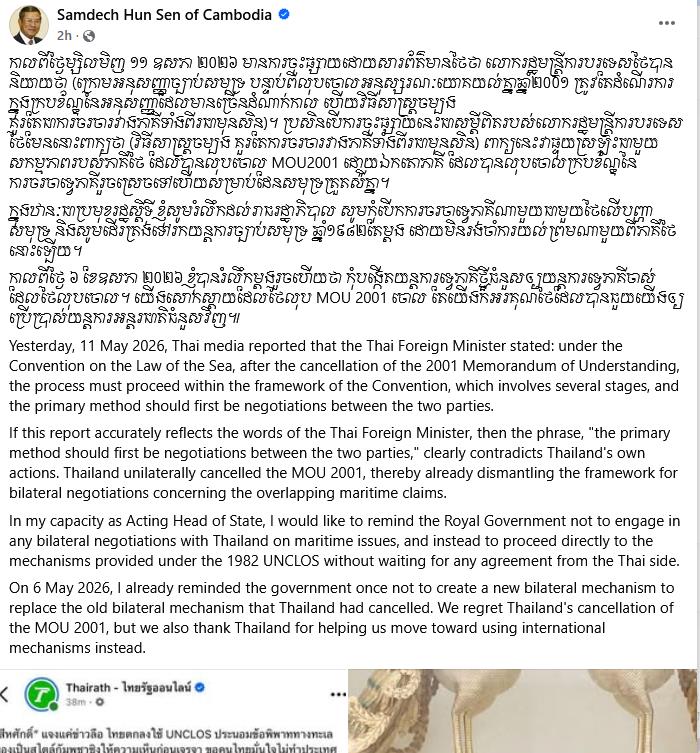
In an official social media statement, Hun Sen declared:
“Do not open any bilateral negotiations with Thailand on the maritime issue, and proceed directly to the 1982 Law of the Sea mechanism without waiting for any approval from the Thai side.”
The statement came after Thai media reported that Thailand’s foreign minister had argued that, under the United Nations Convention on the Law of the Sea (UNCLOS), “the primary method should first be bilateral negotiations between the two parties.” Yet for Cambodia, such remarks raised a fundamental question: why should Cambodia return to a new bilateral framework when the old bilateral framework had already been destroyed by Thailand itself?
Thailand Was the Party That Broke the Bilateral Framework
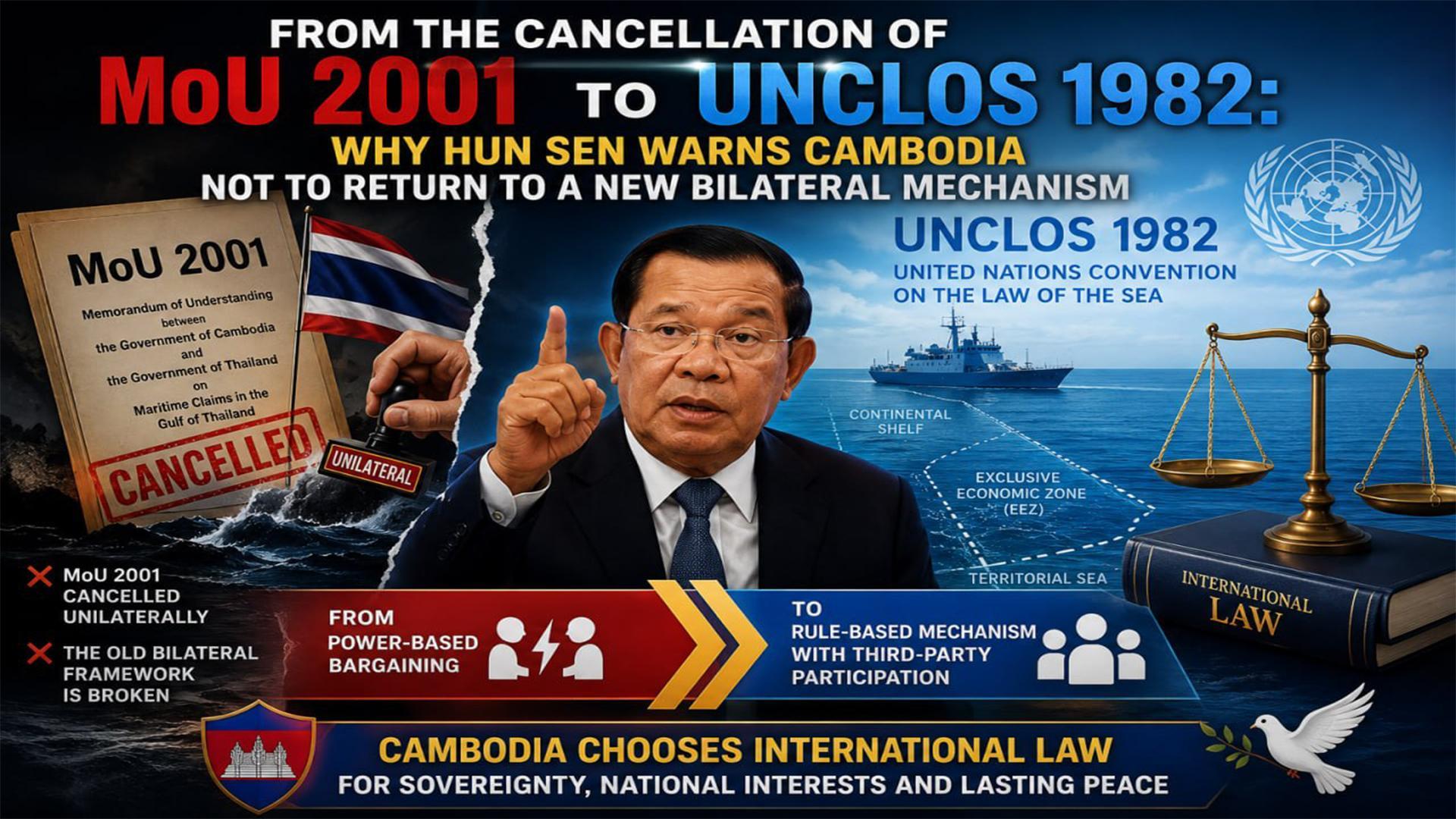
For more than 25 years, the 2001 Memorandum of Understanding (MoU 2001) served as the principal bilateral framework governing negotiations and management of the overlapping maritime claims between Cambodia and Thailand. Cambodia continued to respect and operate within this framework for over two decades.
Ultimately, however, Thailand decided to cancel the MoU unilaterally. This decision was not simply the cancellation of a document; it effectively dismantled the bilateral negotiation framework upon which both countries had long relied.
This is precisely why Hun Sen argued that Thailand’s call for “bilateral negotiations first” directly contradicts Thailand’s own actions in abolishing the very bilateral framework that previously existed.
In this sense, Cambodia was not the side abandoning bilateralism. On the contrary, the bilateral mechanism itself was destroyed by Thailand. Therefore, attempts to draw Cambodia back into a “new bilateral mechanism” could be viewed as an attempt to restart negotiations under conditions that offer no guarantee of long-term stability.
From Political Negotiation to an International Legal Mechanism
Cambodia’s decision to pursue Compulsory Conciliation under the 1982 United Nations Convention on the Law of the Sea (UNCLOS) means that Cambodia is transforming this dispute from a political negotiation process into an international legal process.
The most important point is that this mechanism does not depend on the political consent of the other party. That is why Hun Sen emphasized that Cambodia should move directly toward UNCLOS 1982 “without waiting for any approval from Thailand.”
In this context, Cambodia is attempting to transform the dispute “from power-based bargaining to a rule-based mechanism.” In other words, instead of engaging in political pressure tactics or negotiations that can shift according to domestic political circumstances in either country, Cambodia is choosing a framework governed by law, structured procedures, and third-party participation.
This is the fundamental distinction between bilateral negotiation and an international legal mechanism. One depends heavily on political will, which can change over time, while the other relies on legal frameworks and international procedures that are more stable, structured, and predictable.
Cambodia Is Choosing the Rule of Law Over Power Politics
For smaller countries like Cambodia, international law is not a secondary option; it is one of the most important strategic tools available for protecting sovereignty and national interests.
In a world increasingly shaped by geopolitical rivalry and intensifying power competition, smaller states cannot realistically compete through raw power against larger or more influential countries. Consequently, reliance on international law and multilateral mechanisms becomes a critical shield for national protection.
This is the deeper significance of Cambodia’s decision to pursue Compulsory Conciliation under UNCLOS. It is not an attempt to avoid negotiations, but rather a shift away from negotiations vulnerable to political pressure toward a more structured international mechanism involving third-party participation and legal procedures.
Hun Sen has also warned against accusing Cambodia of “internationalizing” a bilateral issue, arguing that Cambodia is simply following international legal pathways after the bilateral framework was dismantled by the other side.
The May 12 Statement: Cambodia’s New Strategic Line
When examined carefully, Hun Sen’s May 12 statement was not merely an expression of opinion. It represented the establishment of a new strategic direction for the Cambodian government.
That strategy includes:
- No return to a new bilateral mechanism
- No creation of a new MoU to replace the old one
- No return to negotiations vulnerable to recurring political pressure
- And a direct move toward UNCLOS 1982, with its clear legal framework and third-party participation
This demonstrates that Cambodia is increasingly determined to close the door on uncertain bilateral mechanisms and instead open the door to a more structured international legal process.
Conclusion: Cambodia Should Not Return to the Same Uncertainty
After Thailand’s unilateral cancellation of MoU 2001, Cambodia now stands at an important turning point in the history of its maritime diplomacy. Instead of responding through pressure or power confrontation, Cambodia has chosen to bring the dispute into the framework of international law.
When a bilateral framework has already been destroyed by one side, returning once again to a new bilateral arrangement may not represent a genuine search for peace, but rather a return to the same uncertainty that existed before.
For Cambodia, moving toward UNCLOS 1982 does not mean abandoning negotiation. Instead, it reflects the belief that even a small country can use international law as a strategic instrument to protect its sovereignty, national interests, and long-term peace.