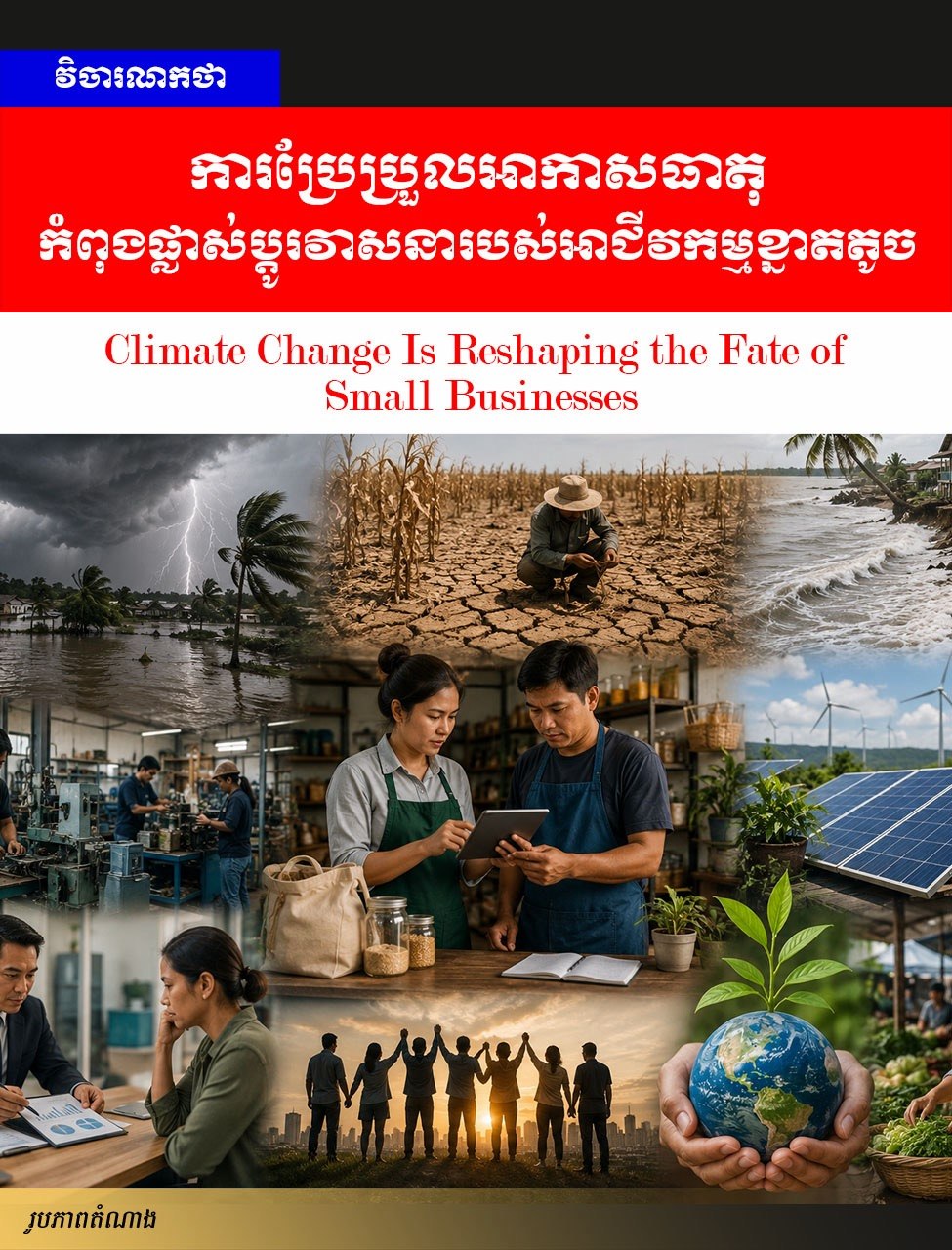
(Phnom Penh): Across the global economy, small and medium-sized enterprises (SMEs) are often described as the backbone of growth. They account for the majority of businesses worldwide, provide most employment, and sustain local communities. Yet as climate change accelerates, SMEs are increasingly on the front lines—absorbing shocks they are least equipped to handle.
The science is no longer abstract. Rising temperatures, erratic rainfall, sea-level rise, and more frequent extreme weather events—driven by climate change—are disrupting supply chains, damaging infrastructure, and altering market demand. For large corporations, these risks can often be mitigated through diversification, insurance, and capital reserves. For SMEs, the margin for error is far thinner.
In agriculture-dependent economies, small businesses tied to farming and food processing face declining yields, water scarcity, and unpredictable growing seasons. A single drought or flood can wipe out months of income. In coastal regions, tourism SMEs—from guesthouses to local transport operators—are confronting shoreline erosion and extreme weather that deter visitors. Manufacturing SMEs are not spared either; disruptions in raw material supply and rising energy costs are squeezing already tight margins.
Beyond direct impacts, climate change is also reshaping the financial landscape. Banks and investors are increasingly integrating climate risk into lending decisions. While this shift is necessary for long-term sustainability, it can unintentionally restrict access to finance for SMEs that lack the resources to demonstrate climate resilience or compliance. In effect, those most vulnerable to climate impacts may also find it hardest to secure the capital needed to adapt.
At the same time, the transition to a low-carbon economy—aligned with global efforts such as the Paris Agreement—is creating both risks and opportunities. SMEs that rely on carbon-intensive processes may face new regulations, carbon pricing, and shifting consumer expectations. However, those able to innovate—by adopting energy efficiency, renewable energy, or circular economy practices—stand to gain competitive advantage.
The challenge is that adaptation and transformation require investment, knowledge, and institutional support. Many SMEs operate informally or with limited technical capacity. Without targeted policies, they risk being left behind in the global climate transition.
Governments and development partners must therefore place SMEs at the center of climate policy. This means expanding access to climate finance tailored for small businesses, providing technical assistance for green transitions, and strengthening early warning systems and climate-resilient infrastructure. It also requires simplifying regulatory frameworks so that sustainability is not an additional burden but an integrated pathway to growth.
Equally important is a shift in mindset. Climate resilience should not be seen as a cost, but as an investment in continuity and competitiveness. SMEs that integrate climate considerations into their operations—whether through resource efficiency, diversification, or digitalization—are more likely to withstand shocks and seize emerging opportunities.
The global climate crisis is often framed in terms of nations and large industries. But its true test lies at the local level, where small businesses sustain livelihoods and communities. If SMEs fail, the social and economic consequences will ripple far beyond balance sheets.
In the race against climate change, resilience must be inclusive. Supporting SMEs is not just an economic imperative—it is a cornerstone of a sustainable and equitable global future.
=FRESH NEWS