(Phnom Penh): For more than 25 years, the 2001 Memorandum of Understanding between Cambodia and Thailand, widely known as MoU 2001, served as the most important bilateral framework for managing and negotiating overlapping maritime claims between the two countries. But today, that framework — which both sides had relied upon for more than two decades — has been unilaterally terminated by Thailand.
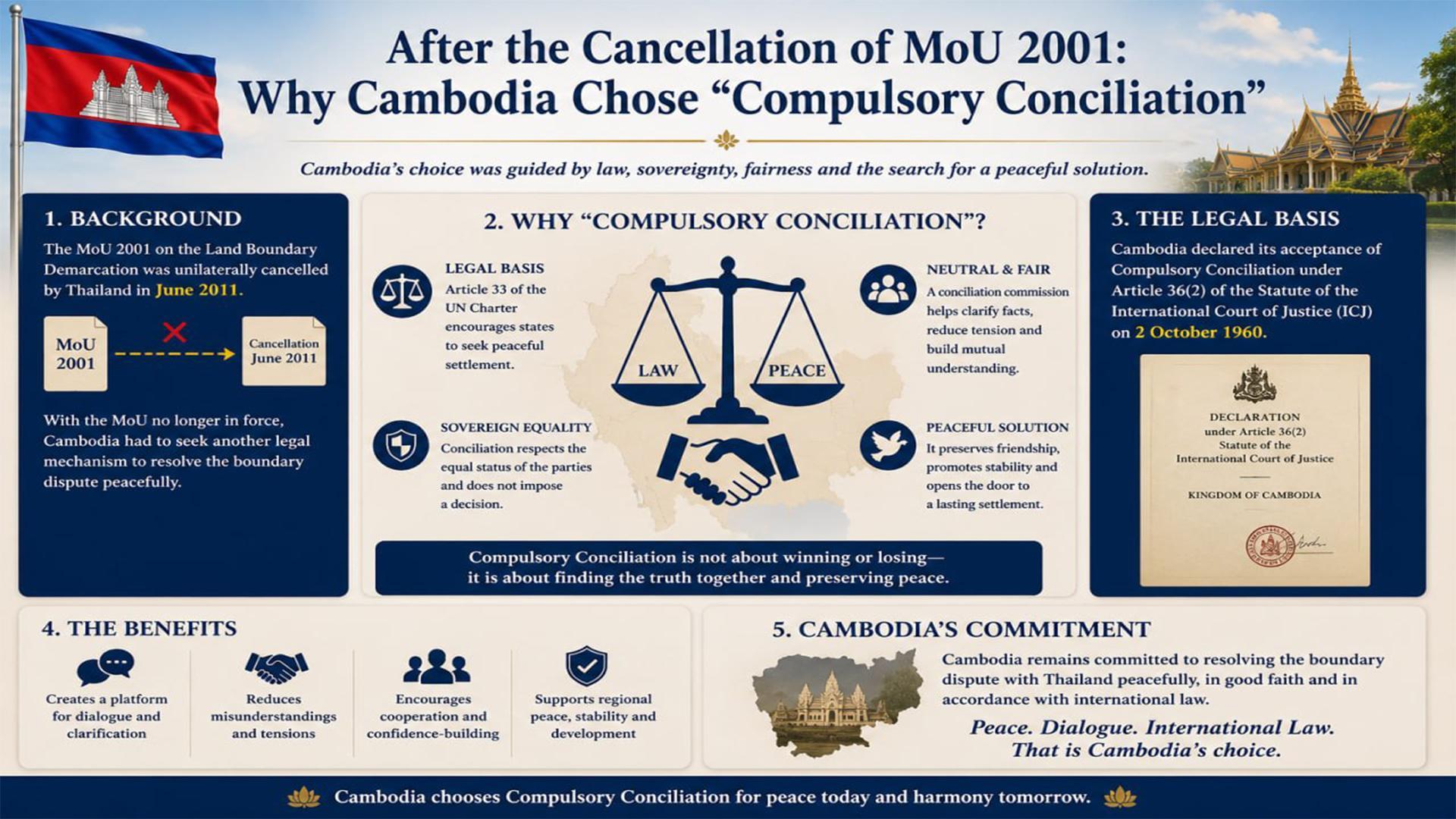
Faced with this “legal and diplomatic vacuum,” the Cambodian government did not respond with threats or military escalation. Instead, it chose another path: the use of the Compulsory Conciliation mechanism under the United Nations Convention on the Law of the Sea (UNCLOS) in an effort to seek a peaceful solution grounded in international law.
This decision is not a sign of weakness. It is a strategic attempt to transform the dispute from a “competition of force” into a “competition of law.”
From MoU to UNCLOS: Cambodia Is Shifting the Dispute Toward an International Legal Framework
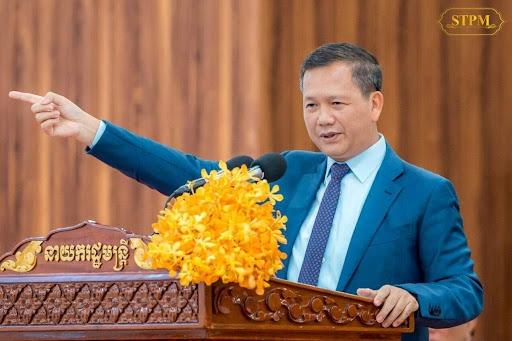
A statement by Cambodian Prime Minister Hun Manet made it clear that Cambodia remains committed to peaceful dispute resolution and respect for international law, despite Thailand’s unilateral withdrawal from MoU 2001.The Prime Minister wrote on his official social media platform:
“The unilateral withdrawal from this Memorandum of Understanding constitutes the abandonment of the only bilateral agreement and framework that both parties had relied upon and utilized for more than two decades.”
Cambodia’s decision to invoke the Compulsory Conciliation mechanism under UNCLOS means that Phnom Penh is attempting to keep the dispute within an international legal framework, rather than allowing it to slide toward political pressure or maritime power competition.
Prime Minister Hun Manet further emphasized:
“As a state that respects and adheres to international law and the peaceful settlement of disputes, Cambodia has no choice but to rely on international law and the United Nations Convention on the Law of the Sea, particularly the Compulsory Conciliation mechanism established under this convention.”
In reality, Cambodia was not the party that abandoned the bilateral mechanism. On the contrary, Cambodia continued to respect and operate under MoU 2001 for more than two decades. The cancellation of the agreement was a unilateral decision by Thailand.
Therefore, with the bilateral framework now dismantled, Cambodia has been compelled to move the dispute toward a legal mechanism involving a third party and a more structured process under UNCLOS.
Compulsory Conciliation Is Not a Sign of Weakness
In today’s world, there is a widespread misconception that countries which choose legal avenues are weak states. In reality, for smaller nations, international law is not merely a last resort — it is one of the most important strategic tools available for protecting sovereignty and national interests.
The use of Compulsory Conciliation is not an act of surrender or a display of weakness by Cambodia. Rather, it is an effort to keep the dispute within a legal and diplomatic process, instead of allowing it to drift into confrontation at sea.
Even if one party refuses to cooperate, the process may still continue and produce legal reports and records that could later be used in subsequent stages, including arbitration or international court proceedings.
Prime Minister Hun Manet stated:
“Cambodia’s decision reflects our sincere hope that both countries can achieve a just and lasting solution in accordance with international law, allowing our peoples to live together in peace, stability, and prosperity.”
This is precisely why Cambodia is attempting to transform “pressure at sea” into “legal and diplomatic pressure” by using international law as a shield to defend its national interests.
The Strategic Significance of Hun Sen’s Statement
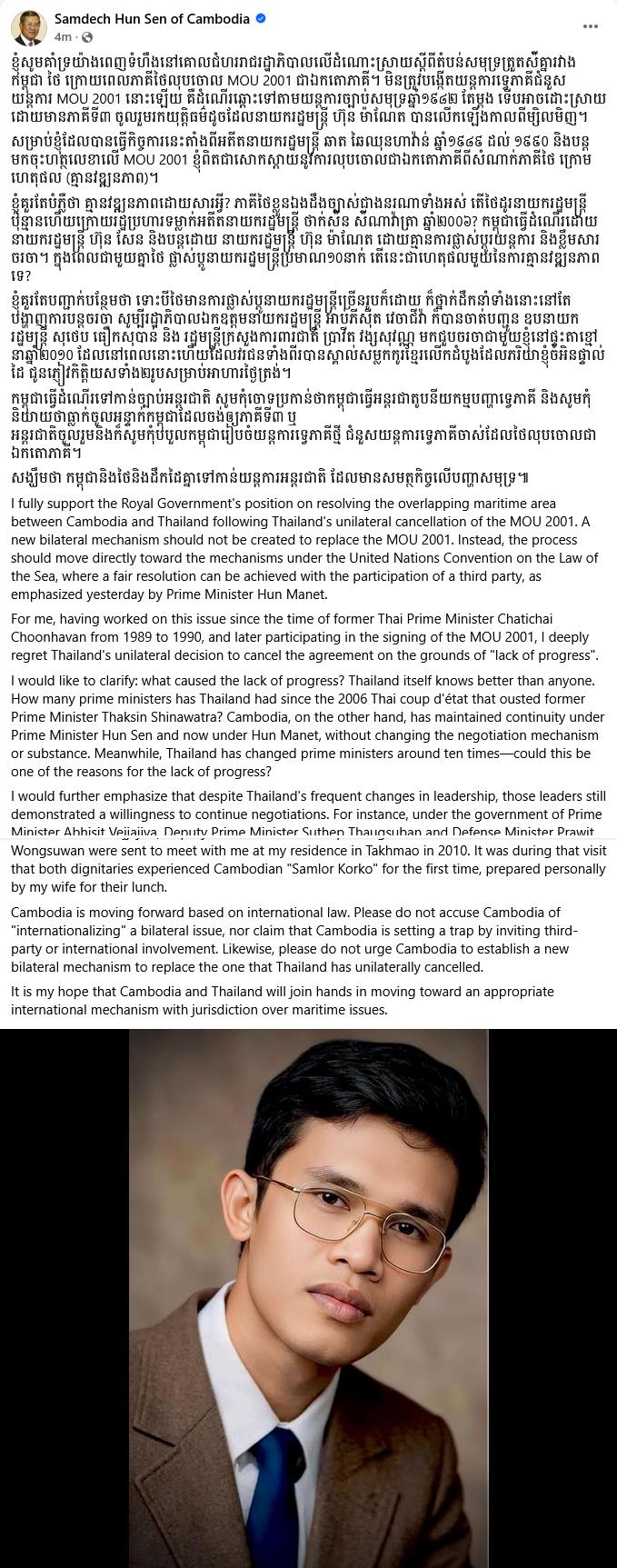
The statement issued by Cambodia’s Acting Head of State, Hun Sen, in support of the Royal Government’s position on the overlapping maritime claims with Thailand following the unilateral cancellation of MoU 2001, carries profound strategic significance.
Hun Sen clearly stated:
“No new bilateral mechanism should be created to replace MoU 2001. Instead, the process should proceed directly under the 1982 Law of the Sea framework, where a third party can participate in the search for justice.”
This statement suggests that Cambodia does not wish to return to a situation in which a bilateral framework can once again be unilaterally dismantled or abandoned. Instead, Cambodia is attempting to shift the dispute toward a more structured international legal mechanism involving third-party participation.
Hun Sen also pointed out that the lack of progress in past negotiations was not due to Cambodia’s lack of political will, but may instead be linked to Thailand’s domestic political instability and the repeated changes of prime ministers following the 2006 coup.
He further stated:
“Cambodia is moving toward international law. Cambodia should not be accused of internationalizing a bilateral issue, nor should anyone claim that Cambodia is setting a trap by seeking third-party or international involvement. Cambodia should also not be persuaded to establish a new bilateral mechanism to replace the old bilateral mechanism that Thailand unilaterally abandoned.”
Hun Sen concluded by expressing hope that:
“Cambodia and Thailand will walk together toward international mechanisms with jurisdiction over maritime issues.”
The broader message is significant: Cambodia is portraying itself as the side that has remained consistent and committed to the negotiation framework, while the existing bilateral mechanism was dismantled by the other party.
International Law Still Matters — Even as the World Order Weakens
It is increasingly clear that the contemporary international order is under strain. In a world marked by intensifying geopolitical rivalry and power competition among major states, many countries are prioritizing strategic interests and power over adherence to international law.
For smaller states such as Cambodia, however, abandoning international law would make the situation even more dangerous. In a world where power can increasingly influence law, small countries cannot rely on military competition. They must instead rely on legal frameworks and international mechanisms to protect their rights and national interests.
That is why Cambodia’s decision to use the Compulsory Conciliation mechanism under UNCLOS demonstrates that Cambodia still believes in peaceful dispute resolution grounded in international law.
This may not be the fastest path, nor does it guarantee an immediate solution. But for a small state, it may be the most stable and safest path for protecting sovereignty, national interests, and long-term peace.
Conclusion
Following the unilateral cancellation of MoU 2001, Cambodia now stands at a critical moment in its maritime political history. Rather than responding through power confrontation, Cambodia has chosen to move the dispute into the realm of international law.
The use of the Compulsory Conciliation mechanism is not a sign of weakness. It demonstrates that even a small country can use international law as a strategic instrument to defend its sovereignty and long-term national interests.
The greatest question today is not which country possesses greater power, but whether international law and peaceful mechanisms can still retain meaningful authority in a world increasingly shaken by geopolitical rivalry, power politics, and competing national interests.
Because if international law can no longer protect small states, and if peaceful mechanisms cannot restrain coercion, prevent the creation of “facts on the ground,” or compel violators to withdraw from actions that contradict international law, then the world risks sliding back toward a system in which “power determines justice,” while smaller nations are forced to live under permanent uncertainty, pressure, and fear.
Cambodia’s decision to pursue legal and peaceful mechanisms, therefore, is not merely about protecting maritime interests. It is also about defending a broader principle: that disputes between states should be resolved through law and peaceful means — not through coercion or force.