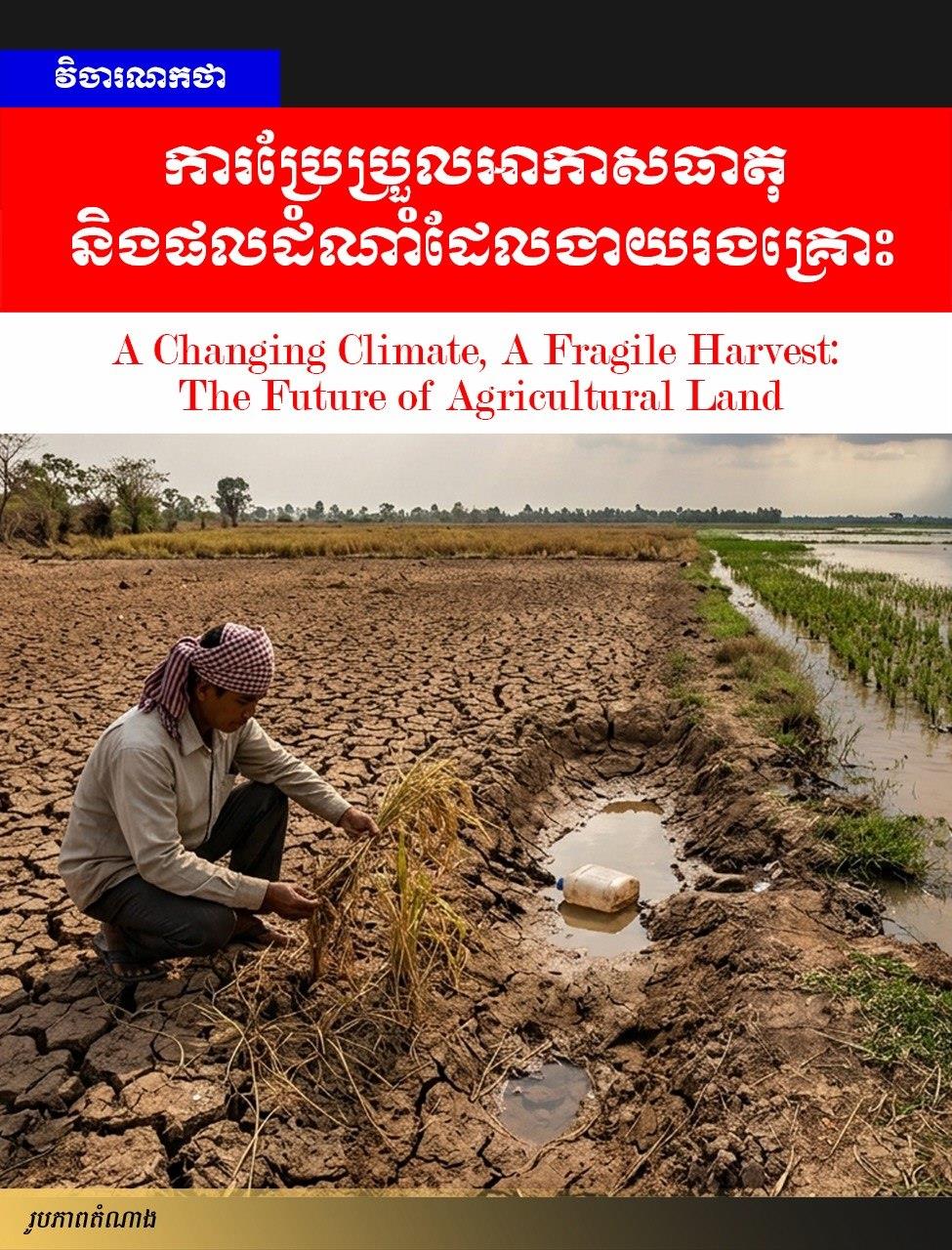
(Phnom Penh): Agricultural land has long been the foundation of human civilization, quietly sustaining economies, feeding populations, and anchoring rural livelihoods.
Today, that foundation is under growing strain. Climate change is not only altering weather patterns; it is reshaping the very land on which agriculture depends, challenging the stability and productivity of farming systems worldwide.
At the center of this disruption is temperature. Rising heat levels affect soil moisture, accelerate evaporation, and place crops under stress.
What was once a predictable growing season is becoming increasingly uncertain. Crops mature too quickly or fail to develop properly, reducing both yield and quality.
In many regions, extreme heat is no longer an anomaly but a recurring threat, capable of wiping out entire harvests.
Rainfall, the lifeblood of agriculture, is also changing in ways that complicate farming. Some areas experience prolonged droughts, leaving soils dry and infertile.
Others face intense, short-lived downpours that flood fields, erode topsoil, and wash away nutrients. The balance required for healthy agricultural land, neither too dry nor too wet, is becoming harder to maintain.
The degradation of soil is one of the most serious but often overlooked consequences. Healthy soil depends on stable climatic conditions.
When exposed to repeated droughts, floods, and temperature extremes, soil structure weakens. Organic matter declines, fertility drops, and the land becomes less capable of supporting crops.
Over time, this can lead to desertification, turning once-productive land into barren ground.
In coastal and low-lying regions, another threat is emerging: salinization.
As sea levels rise, saltwater intrudes into agricultural fields and groundwater systems.
Crops that depend on fresh water struggle to survive in saline conditions, forcing farmers to abandon land or switch to less profitable alternatives.
This process is gradual but deeply damaging, particularly for communities already operating on thin margins.
For countries like Cambodia, where agriculture remains a cornerstone of the economy, the stakes are high. Rice fields and farmlands across provinces are increasingly exposed to erratic rainfall, seasonal droughts, and flooding.
The Tonlé Sap basin, central to the country’s agricultural and fisheries systems, is especially sensitive to climate variability.
Changes in water flow and timing affect not only crop production but also the broader ecological balance that supports rural livelihoods.
The human dimension of this challenge cannot be overlooked. Farmers, particularly smallholders, are often the most vulnerable.
With limited resources and access to technology, they face difficult choices, whether to invest in uncertain seasons, shift crops, or leave farming altogether. This has implications for food security, rural employment, and national stability.
Yet, within this challenge lies an opportunity to rethink and strengthen agricultural systems.
Climate-resilient farming practices, such as improved irrigation, drought-resistant crop varieties, and better soil management, can help mitigate some of the impacts.
Agroforestry, conservation agriculture, and integrated land management offer pathways to restore soil health and enhance resilience.
Policy and governance will play a decisive role. Supporting farmers through education, financial tools, and infrastructure investment is essential.
Protecting forests and watersheds, enforcing sustainable land use, and integrating climate considerations into agricultural planning are no longer optional, they are urgent priorities.
Climate change is testing the limits of agricultural land, but it is also testing our response.
The land continues to give, but it is asking for stewardship in return. The future of agriculture will depend not only on the resilience of the soil, but on the resolve of those who manage it.
=FRESH NEWS