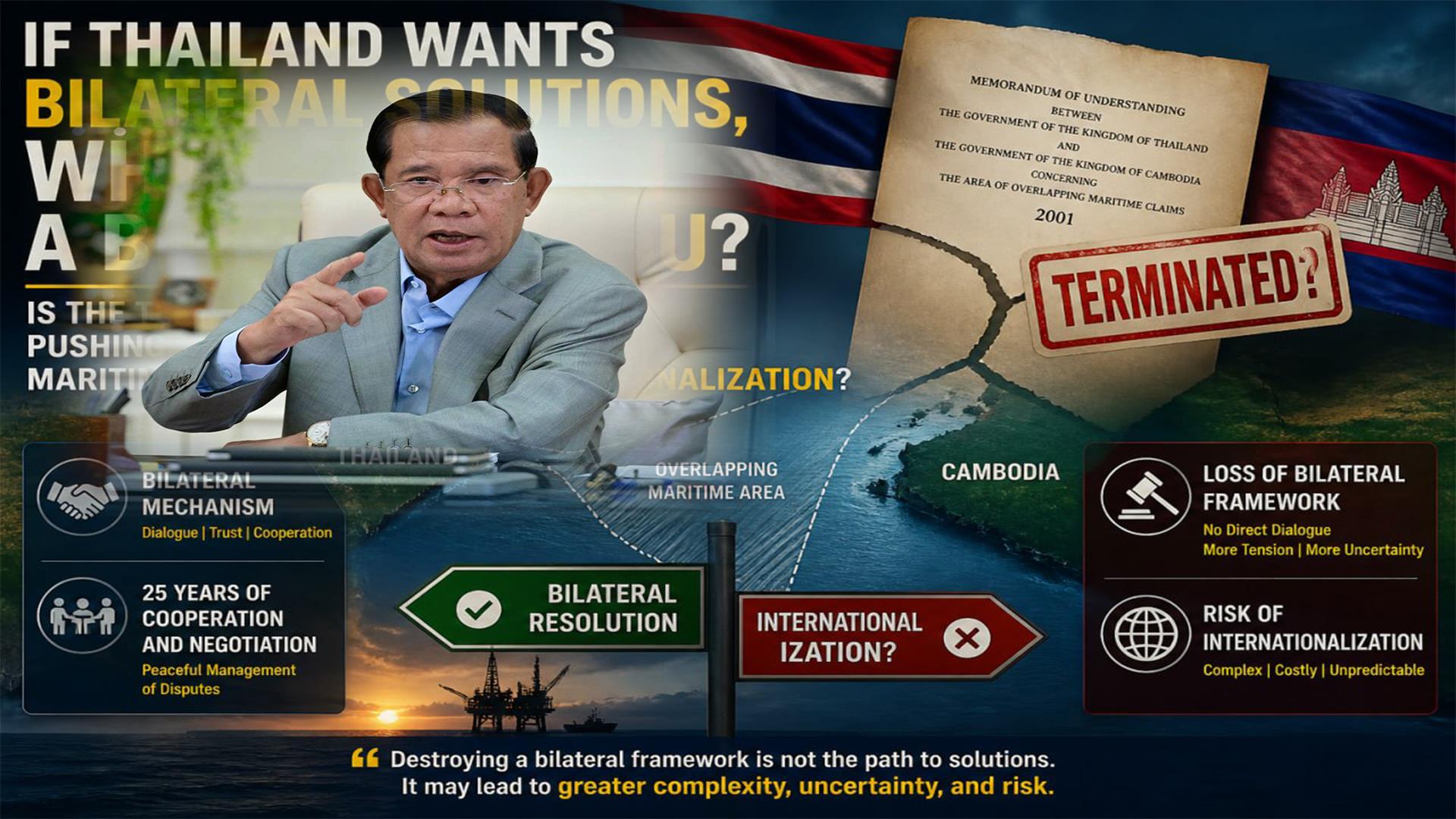
(Phnom Penh): When Cambodia’s Acting Head of State, Hun Sen, raised a critical question—whether Thailand’s effort to terminate the 2001 Memorandum of Understanding (MoU) reflects an intention to internationalize the overlapping maritime dispute—he was not merely expressing political doubt. He was opening the door to a deeper strategic analysis of the future trajectory of Cambodia–Thailand relations.
Recent developments—particularly Thailand’s decision to withdraw from the MoU—highlight a clear contradiction: while Bangkok claims to favor bilateral solutions, its move to dismantle one of the most important bilateral frameworks suggests a significant and potentially consequential strategic shift.
A Strategic Contradiction
The 2001 MoU was never a final treaty on maritime delimitation or resource division. Rather, it served as a bilateral framework designed to manage uncertainty, facilitate negotiations, and promote joint cooperation in areas of overlapping maritime claims.
Signed on June 18, 2001, the MoU established a joint technical mechanism to explore the development of shared resources. While it did not directly resolve maritime boundaries, it provided a pragmatic interim solution, enabling both countries to maintain dialogue, manage tensions, and pursue mutual benefits while awaiting a final settlement.
In this sense, the MoU carried significance far beyond a technical document. It represented political goodwill and a commitment to peaceful dispute resolution through bilateral engagement.
Therefore, its unilateral termination is not merely the removal of a document—it is the dismantling of a negotiation mechanism, the erosion of bilateral trust, and the reintroduction of uncertainty into a highly sensitive maritime dispute.
This raises a fundamental question:
If Thailand truly seeks bilateral solutions, why dismantle the very framework that enables them?
Voices from Within Thailand
Analysis by Surachart Bamrungsuk, a Thai expert in international relations and security, published in Matichon Weekly on April 30, 2026, offers important insight from within Thailand itself.
His conclusion is clear: the termination of the MoU is not a solution, but a potential source of new problems.
He notes that previous attempts to revoke the MoU failed due to legal constraints under international law. This underscores that the issue is not merely political—it is deeply rooted in legal obligations.
Moreover, he argues that the current move may be driven by domestic political pressures, particularly from nationalist groups. However, such political appeasement does not necessarily serve Thailand’s long-term national interests.
From a legal standpoint, he emphasizes that terminating such agreements must comply with the Vienna Convention on the Law of Treaties (1969), which outlines strict procedures for treaty withdrawal. A unilateral declaration without proper legal grounds risks being interpreted as a violation of international obligations.
He also questions the apparent shift in stance among Thai officials who previously supported maintaining the MoU, suggesting that political pressures may now outweigh legal consistency.
Ultimately, he warns that abandoning the MoU could harm Thailand’s own national interests by forfeiting a structured legal and diplomatic framework for managing maritime claims.
Cambodia’s Official Position
In contrast, Prak Sokhonn, Cambodia’s Deputy Prime Minister and Foreign Minister, has clearly reaffirmed Cambodia’s commitment to the 2001 MoU—both in letter and in spirit.
He emphasized that Thailand’s withdrawal effectively constitutes the abandonment of a bilateral mechanism that has guided dispute management for over 25 years.
For Cambodia, the MoU is not merely technical—it is a political foundation reflecting mutual goodwill and a shared commitment to resolving disputes peacefully under international law.
He also expressed deep regret, noting that the loss of this framework affects not only technical cooperation but also the broader level of political trust between the two countries.
Importantly, Cambodia remains committed to defending its sovereignty and maritime integrity through peaceful, law-based approaches, and will continue seeking solutions grounded in international legal principles.
The Risk of Internationalization
For Cambodia, the MoU serves as a crucial legal and diplomatic tool to manage overlapping claims and sustain bilateral engagement.
However, some Thai political perspectives view the MoU as a constraint on strategic flexibility. While removing it may appear to open new negotiating space, international legal analysis suggests the opposite:
removing structure creates instability, not leverage.
Without the MoU, the bilateral platform weakens. Without bilateral dialogue, uncertainty increases. And with uncertainty comes the growing likelihood that the dispute will shift toward international legal mechanisms, such as the United Nations Convention on the Law of the Sea (UNCLOS).
Thus, internationalization does not necessarily require intent—it can emerge as a structural outcome.
A Deeper Strategic Question
The question raised by Hun Sen is therefore deeply strategic:
Is Thailand dismantling bilateral mechanisms as a calculated move toward internationalization—or unintentionally creating conditions that lead there?
The logic is clear:
- Remove the MoU → Lose bilateral negotiation mechanisms
- Lose mechanisms → Increase uncertainty and tension
- Increase uncertainty → Force reliance on international processes
In this sense, the issue is not just about intent, but about trajectory.
Conclusion
The unilateral termination of the 2001 MoU does not resolve the dispute—it transforms it.
It replaces a structured bilateral framework with uncertainty, weakens trust, and risks pushing the issue beyond bilateral control.
Cambodia’s position remains consistent: a commitment to peaceful, rule-based resolution under international law. Thailand’s move, however, raises critical questions about strategic direction and long-term consequences.
Ultimately, the key issue is not who is right or wrong—but which approach can best ensure lasting peace and stability.
Does abandoning bilateralism lead to resolution—or does it open the door to greater uncertainty and risk?