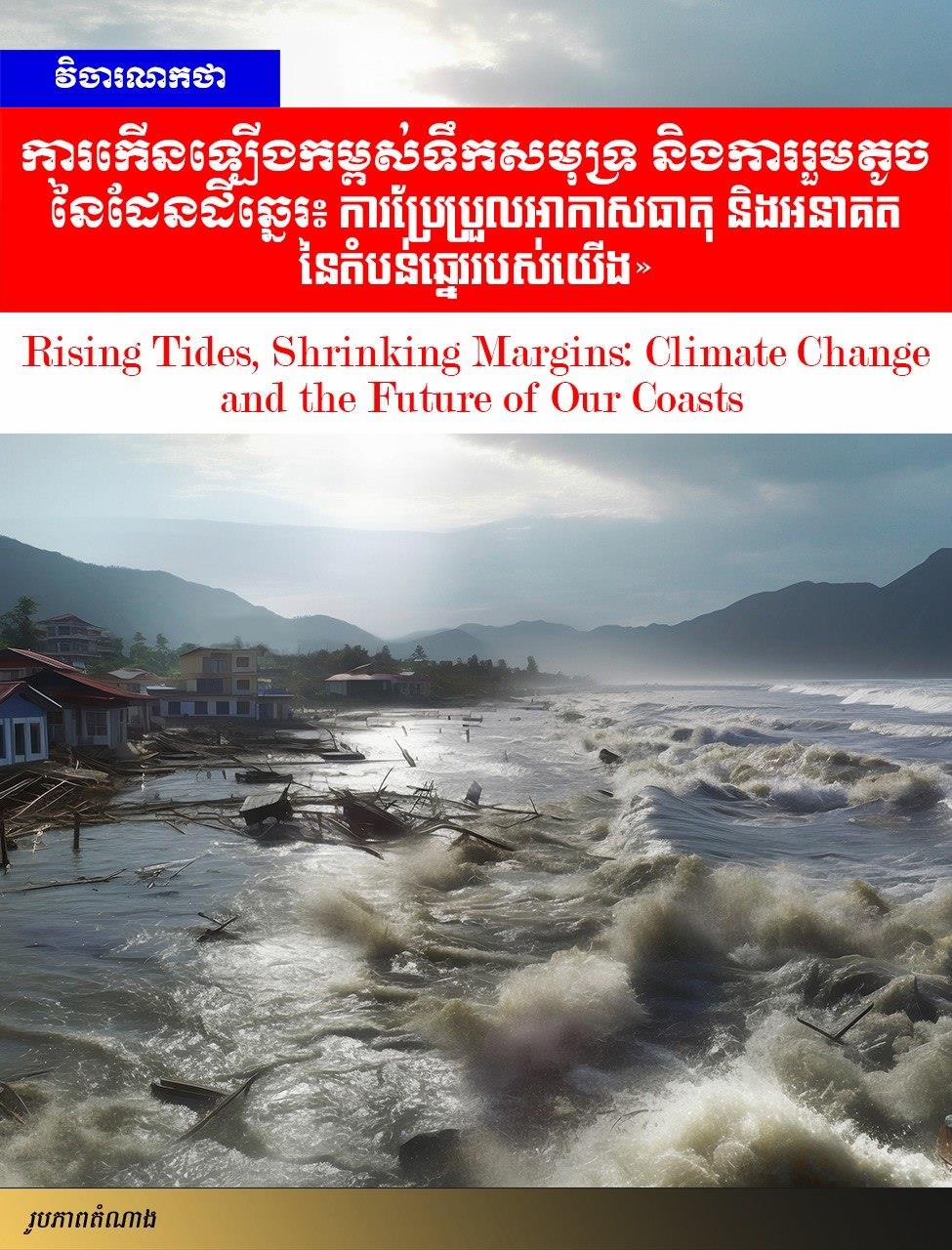
(Phnom Penh): Climate change is no longer a distant scientific warning; it is a lived reality, increasingly visible along the world’s coastlines. Among its most consequential impacts is sea-level rise, a slow-moving but relentless force that threatens ecosystems, economies, and entire communities.
For low-lying nations and coastal regions, the rising sea is not just an environmental issue; it is an existential one.
At the heart of this crisis lies a simple but powerful chain reaction. As global temperatures rise, driven largely by greenhouse gas emissions, polar ice sheets and glaciers melt at accelerating rates. At the same time, seawater expands as it warms, a phenomenon known as thermal expansion.
Together, these processes contribute to steadily rising ocean levels. What may appear as incremental change, measured in millimeters per year, translates into profound consequences over time.
The impacts are already evident. Coastal erosion is intensifying, swallowing beaches and undermining infrastructure. Saltwater intrusion is contaminating freshwater supplies, affecting agriculture and drinking water. Storm surges, amplified by higher sea levels, are becoming more destructive, pushing floodwaters deeper inland.
In many parts of the world, communities are facing more frequent and severe coastal flooding, even in the absence of storms.
For countries like Cambodia, with extensive coastlines and communities closely tied to marine ecosystems, the risks are particularly acute. Coastal provinces such as Koh Kong, home to vital mangrove forests and fishing communities, stand on the frontlines of this challenge.
Mangroves, often overlooked, serve as natural buffers, absorbing wave energy, stabilizing shorelines, and capturing significant amounts of carbon. Their protection and restoration are not optional; they are essential.
Beyond environmental damage, the socio-economic implications are profound. Fisheries, tourism, and coastal agriculture, all pillars of local livelihoods, are under threat.
Displacement is an emerging reality, as families are forced to move from increasingly uninhabitable areas. This raises complex questions about climate justice, as those who contribute least to global emissions often bear the greatest burden of its impacts.
Yet, amid the urgency, there is also a pathway forward. Mitigation and adaptation must go hand in hand. Reducing greenhouse gas emissions remains critical to slowing the pace of sea-level rise.
At the same time, investments in resilient infrastructure, coastal protection, and ecosystem-based solutions, such as mangrove restoration, can help communities adapt to changing conditions.
Innovative approaches are already taking shape. Efforts to develop carbon-neutral communities, expand renewable energy, and strengthen environmental governance demonstrate that progress is possible. These initiatives not only address climate change but also create opportunities for sustainable development, aligning environmental protection with economic growth.
Ultimately, the rising tide is a test of collective responsibility. It challenges governments, businesses, and individuals to act with foresight and resolve. The cost of inaction will not be measured solely in economic terms, but in lost homes, disrupted lives, and degraded ecosystems.
The ocean is rising. The question is whether our response will rise to meet it.
=FRESH NEWS