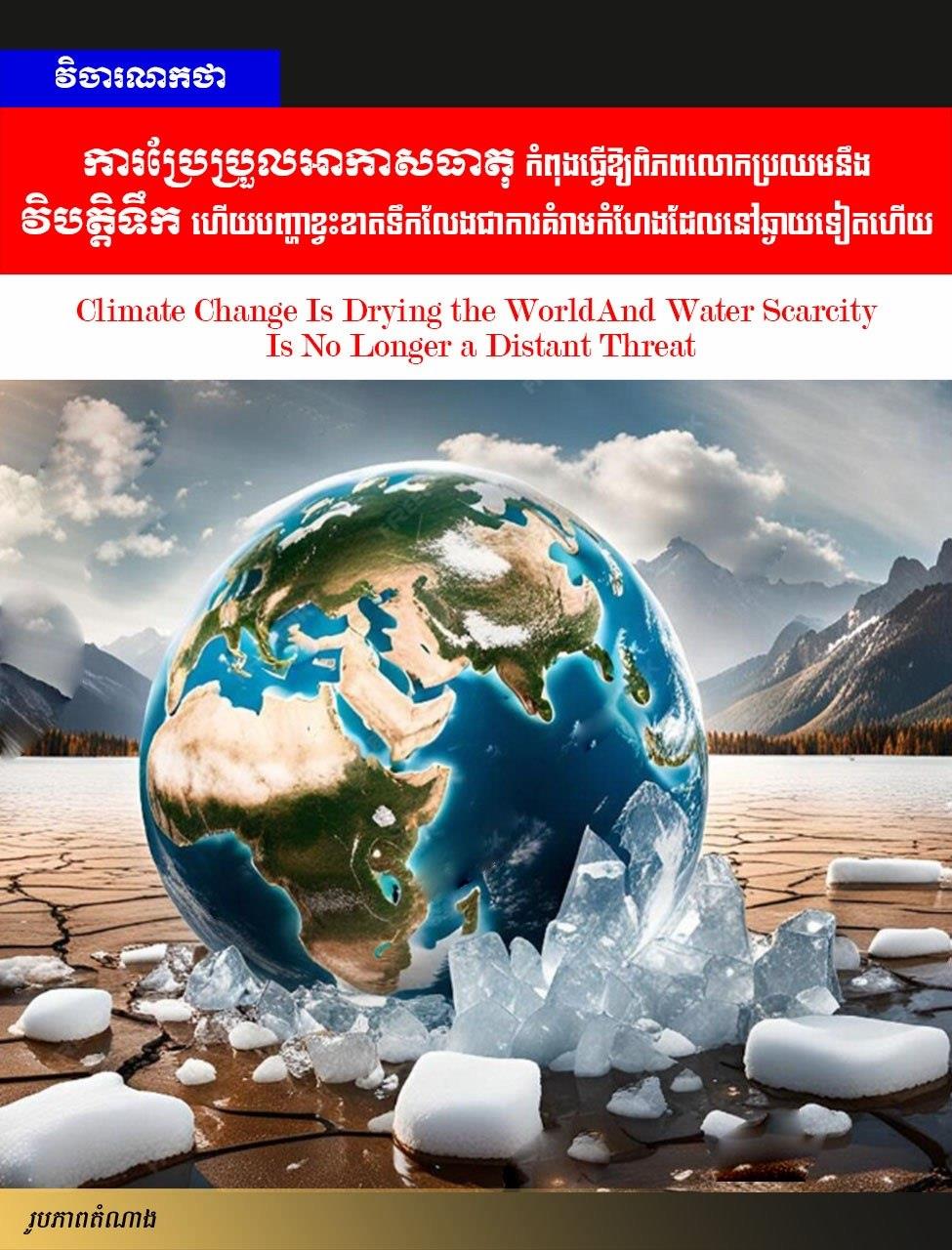
(Phnom Penh): Water has always defined the boundary between survival and hardship. Today, that boundary is shifting, rapidly and dangerously, under the weight of climate change. What was once considered a local or seasonal challenge is becoming a global crisis. Water scarcity is no longer confined to arid regions; it is emerging as one of the most immediate and far-reaching consequences of a warming planet.
The connection is direct. Rising global temperatures are intensifying the Earth’s water cycle. Heat increases evaporation from rivers, lakes, and soils, reducing the amount of water available for human use and agriculture.
At the same time, changing climate patterns are disrupting rainfall. Some regions face prolonged droughts, where rains fail for months or even years. Others experience intense but short-lived storms, where water runs off too quickly to replenish groundwater. In both cases, the result is the same: less reliable access to water.
Glaciers, often called the world’s natural water towers, are also retreating at unprecedented rates. Communities that depend on glacier-fed rivers are beginning to feel the impact as these sources diminish. What once provided a steady flow of freshwater is becoming increasingly unpredictable, threatening millions of people who rely on these systems for drinking water, agriculture, and energy.
Yet climate change does more than reduce supply; it amplifies demand. As temperatures rise, so does the need for water in agriculture, industry, and daily life. Crops require more irrigation, cities consume more water, and ecosystems struggle to survive under increased heat stress. This imbalance between shrinking supply and growing demand is at the core of the water scarcity crisis.
Human behavior compounds the problem. In many parts of the world, water resources are already overexploited. Rivers are diverted, aquifers are drained, and wetlands are degraded. Under the pressure of climate change, these systems are pushed beyond their limits. Poor management, inefficient use, and pollution further reduce the availability of clean water, turning scarcity into a crisis of both quantity and quality.
The consequences are profound. Water scarcity threatens food security as agricultural yields decline. It undermines public health, particularly where access to safe drinking water is limited. It drives economic instability and increases the risk of conflict over shared water resources. In some regions, it is already forcing communities to migrate in search of more secure living conditions.
What is most alarming is not the lack of solutions, but the lack of urgency. Water conservation technologies exist. Sustainable irrigation methods can reduce waste. Watershed protection and ecosystem restoration can enhance natural water storage. Above all, reducing greenhouse gas emissions remains essential to stabilizing the climate and preserving the global water cycle.
Yet responses remain fragmented. Too often, water scarcity is treated as a local management issue rather than a global climate challenge. This approach misses the root cause. Without addressing climate change, efforts to manage water will remain incomplete and increasingly ineffective.
Water is not just a resource; it is the foundation of life, development, and stability. Allowing it to become scarce on a global scale is not an inevitability; it is a failure of collective action.
The world is not running out of water. It is running out of time to manage it wisely.
The question is no longer whether climate change is causing water scarcity. It is. The real question is whether we will act before the taps begin to run dry.
=FRESH NEWS