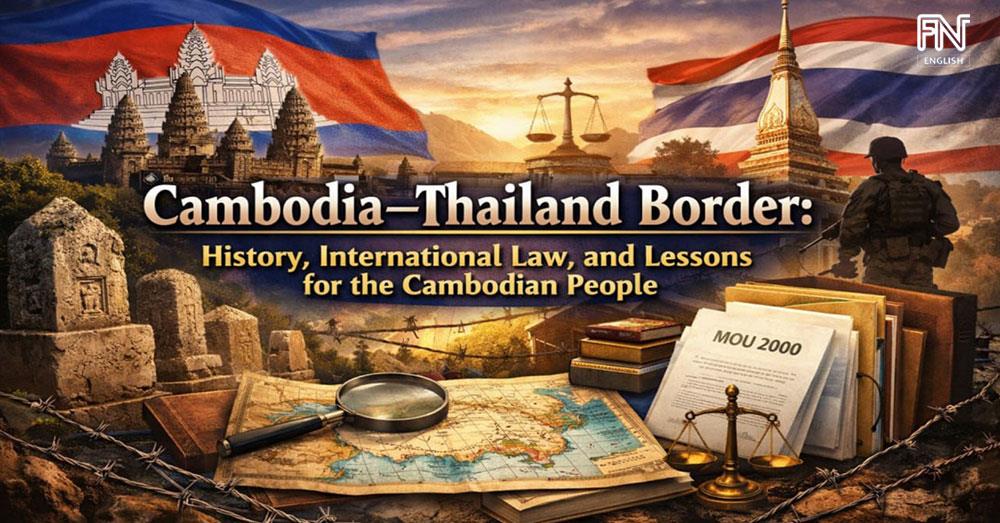
(Phnom Penh): The border issue between Cambodia and Thailand is not a new problem that has only emerged recently. It is a historical issue that has existed for more than two centuries. What is important for the Cambodian people is not to view this issue with fear or anger, but to understand it through history, maps, treaties, and international law, which are the foundations for determining modern borders.
Recent discussions in Thailand calling for the cancellation of the 2000 Memorandum of Understanding (MOU) on the Joint Boundary Commission (JBC) with Cambodia have brought the Cambodia–Thailand border issue back into political and public debate. In response, the spokesperson for Cambodia’s Secretariat of Border Affairs clearly stated that Cambodia rejects any proposal to cancel the 2000 MOU.
The statement emphasized:
“We firmly reject and completely oppose the reasons and recommendations proposed by the Thai Senate Committee to cancel the 2000 MOU, which are unfounded and contrary to international law, intended for political gain and to undermine the achievements made by the Joint Boundary Commission of both countries over the years.”
The response from Cambodia’s Secretariat of Border Affairs was not merely a political reaction. It was a defense of the legal foundation and peaceful mechanisms for border demarcation that both countries had previously agreed upon.
To understand the importance of the 2000 MOU and the Cambodia–Thailand border issue, one cannot look only at current events; it must be understood within the broader historical context. Cambodia–Siam/Thailand history shows repeatedly that border disputes do not arise by accident, but often emerge during times of political transition or when the international system is unstable.
History Shows a Pattern of Territorial Ambition
Looking at history, Cambodia–Siam/Thailand border disputes have occurred in several periods, and they reveal an important lesson for Cambodians:
Even if territories are changed temporarily by force or political circumstances, the final settlement always returns to treaties, maps, and international law.
In 1794, Cambodia lost Battambang and Siem Reap to Siam during a period when Cambodia was internally weak. However, under the Franco–Siam treaties of 1904 and 1907, these territories were returned to Cambodia.
In 1941, during World War II when the international system was unstable, Thailand took these territories again. But after the war, in 1946, under international pressure, the territories were returned to Cambodia once more.
In 1954, Thailand occupied Preah Vihear Temple by force. Cambodia brought the case to the International Court of Justice (ICJ), and in 1962 the Court ruled that Preah Vihear Temple belonged to Cambodia. Later, in 2013, the ICJ interpretation reaffirmed Cambodia’s sovereignty over the surrounding area of the temple.
These historical events show that territorial changes made by force may occur temporarily, but the final decisions are always determined by international law and official border documents.
The 2000 MOU Is Not an Ordinary Document
The 2000 MOU between Cambodia and Thailand is an important agreement that established the Joint Boundary Commission (JBC) to conduct land boundary demarcation on the ground.
The 2000 MOU is based on:
- The Franco–Siam Treaty of 1904
- The Franco–Siam Treaty of 1907
- French colonial border maps
- Border pillar records
- Joint Boundary Commission meetings
This means the 2000 MOU did not create a new border. It created a mechanism to implement the existing border based on historical treaties.
Therefore, cancelling the MOU would not simply be cancelling a document; it could affect the entire peaceful border demarcation mechanism.
Cambodians Should Not Panic — But Should Understand
In a context where one-sided information and extremist narratives—especially from some overseas groups—are being spread about territorial issues, many Cambodians have become worried and fearful that Cambodia could lose territory. These concerns are understandable because Cambodia has historical experiences of territorial loss.
However, Cambodians must understand that even if Cambodia’s legal territory is temporarily occupied or disputed, borders determined by treaties, maps, and international law recognized by the international community—especially the United Nations—cannot simply disappear.
International borders cannot be changed by political speeches or domestic laws of any single country. They must be determined based on international treaties, official maps, and decisions of international courts.
Modern Borders: Not Wars of Guns, But Wars of Maps and Law
The world is now in the 21st century, an era of international law and agreements between nations, even though global order is sometimes shaken by conflicts in Europe and the Middle East.
In the past, countries could lose territory through war. But today, border disputes are no longer wars that can be won by guns or military force. They are wars of maps, documents, and international law.
Therefore, the most important factor in protecting territory is not fear or anger, but knowledge of history and legal foundations that protect national sovereignty.
Cambodia’s legal territory is not protected by fear.
Cambodia’s territory is protected by history, maps, treaties, and international law.
Cambodia’s borders cannot be changed by political rhetoric or domestic politics of any country. Cambodia’s legal territory will not be lost, because modern border disputes are resolved through international law, not through political power or military force.
The 2000 MOU: Legal Foundation for Peaceful Border Settlement
The three key points in the statement by Cambodia’s Secretariat of Border Affairs clearly highlight the importance of the 2000 MOU as the legal foundation for resolving border issues between the two countries.
First, the 2000 MOU was signed by the governments of both countries and registered with the United Nations. Therefore, the MOU “has the legal character of a treaty or bilateral agreement related to borders that creates obligations under international law” and serves as the foundation for peaceful border resolution through the Joint Boundary Commission.
Second, under international law, no country can use its domestic law or internal procedures as a justification to cancel an international treaty. As the statement emphasized, Thailand cannot use domestic legal or procedural reasons to cancel the 2000 MOU, in accordance with the 1969 Vienna Convention on the Law of Treaties.
Third, the 2000 MOU grants authority to the Joint Boundary Commission to resolve border issues peacefully based on the Franco–Siam treaties of 1904 and 1907, official border maps, and technical documents. In practice, the JBC has achieved many positive results, including locating old French-era border pillars, repairing border markers, conducting surveys, and installing boundary markers.
These three points show that the 2000 MOU is not just a political document. It is a legal and technical mechanism for peaceful border settlement. Therefore, cancelling the MOU would not simply affect one document, but could affect the entire border resolution mechanism.
Conclusion
History has already shown that Cambodian territory may have been lost in the past through foreign invasion and force, but such force could never permanently prevail against international law.
In the end, the true winner in border disputes is not the country with greater military power, but the country that has stronger maps, stronger treaties, and stronger foundations in international law. That is the real winner in modern border disputes.