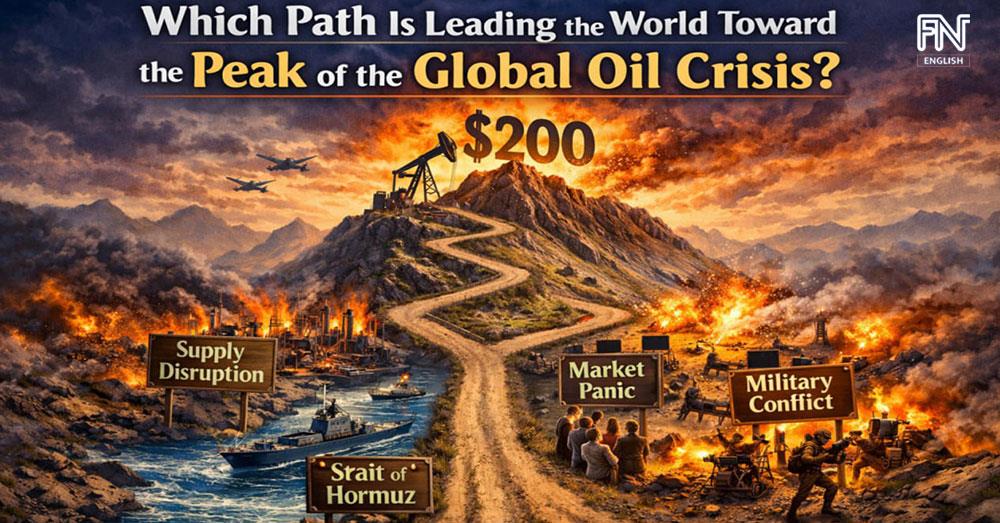
(Phnom Penh): When flames erupt at an energy facility in the Gulf and air-raid sirens echo across oil-producing cities, many may see it as just another scene of war. But behind that spectacle, something far more consequential is quietly unraveling — not the collapse of buildings, but the breakdown of a vital system that sustains the global economy.
That system is the flow of energy — a lifeline that runs from oil and gas fields in the Middle East to factories in Asia, and ultimately to dining tables across the world.
An oil crisis does not begin simply when prices rise. It reaches a critical tipping point when multiple forces converge at once: attacks on energy infrastructure, disruptions to supply routes, rising market fear, and the loss of control over escalation dynamics.
This analysis identifies four key pathways that could push the world toward the peak of a global oil crisis. While some may still be manageable, others could spiral rapidly beyond control — with consequences that may be difficult to reverse.
Path 1: Destruction of Production Capacity
Qatar’s Ministry of Defense confirmed on Thursday, March 19, that Iran launched missile strikes on the industrial city of Ras Laffan, the country’s most critical energy hub. State-owned QatarEnergy reported severe damage, affecting both production and export capabilities.
This attack is not an isolated incident, but part of a broader escalation pattern. Iran’s Islamic Revolutionary Guard Corps (IRGC) has accused the United States and Israel of targeting its own oil and gas infrastructure, including the South Pars gas field, the largest in the world. This signals a strategic shift — from military targets to the core of the global energy economy.
From a strategic perspective, attacks on oil and gas infrastructure do not only cause immediate disruption. They create long-term ripple effects. Facilities such as LNG terminals, processing plants, and offshore platforms are highly complex systems requiring significant time and investment to repair. In some cases, a single strike can disrupt supply for months — or even years.
Ras Laffan, in particular, is not an ordinary target. It is a central hub for Qatar’s LNG exports, supplying key markets in Asia and Europe. Any disruption there extends far beyond national borders, affecting global supply chains.
In essence, this pathway targets the supply side of the global energy system — undermining production capacity and destabilizing market balance.
Path 2: Disruption of Transport Routes
The Strait of Hormuz is one of the world’s most critical energy chokepoints, with approximately 20 million barrels of oil per day passing through it — around 20–25% of global seaborne oil trade.
Iranian military spokesperson Ebrahim Zolfaqari recently warned that the world should prepare for oil prices reaching $200 per barrel. That warning is no longer theoretical — it is beginning to materialize through disruptions in maritime traffic.
Reports indicate that Iran has deployed naval mines in the strait, while several oil and LNG tankers have been attacked or forced to reroute. Although the strait remains partially open, the disruption itself is enough to trigger market anxiety and price volatility.
Iran’s approach — “open for friends, closed for enemies” — suggests that energy flows are no longer governed purely by market logic, but increasingly by geopolitical risk.
Meanwhile, the United States has deployed the USS Tripoli and the 31st Marine Expeditionary Unit to the region, signaling readiness to secure maritime routes if necessary.
Strategically, a full closure is not even required to trigger a crisis. Flow disruption alone can destabilize markets. If such disruptions persist — or escalate due to miscalculation — this pathway could rapidly evolve into a global energy shock.
Path 3: Market Fear
Global oil prices have already climbed to around $110 per barrel, despite the fact that actual supply has not yet been severely reduced. This reflects a crucial reality: markets react not only to current conditions, but to expectations of future risk.
Saudi Arabia, a key global producer, has also faced security threats. Foreign Minister Prince Faisal bin Farhan Al-Saud warned that the kingdom “reserves the right to take military action” if necessary — a signal that the conflict could expand further.
In energy markets, the greatest danger is not only supply shortage, but market sentiment. As risks rise, investors, shipping companies, and importing countries begin to:
- stockpile oil,
- increase insurance costs,
- reroute shipments,
- or even suspend operations.
These behaviors amplify price increases — even before any real shortage occurs.
Energy markets are highly sensitive to expectations. Warnings of $200 oil, or signals of broader war involvement, can trigger panic-driven pricing, where fear — not fundamentals — determines price movements.
In this sense, market fear is not merely a consequence of crisis — it can become a driving force that accelerates it.
Path 4: Miscalculation Leading to Systemic Crisis
This is the most dangerous pathway — because it does not require overwhelming force, only a small mistake.
The escalation logic is simple:
1. An attack is misinterpreted
2. A disproportionate response follows
3. Escalation spirals beyond control
Recent events illustrate how real this risk has become:
- strikes on South Pars,
- retaliatory attacks on Qatar’s LNG facilities,
- and threats to close the Strait of Hormuz.
These developments show that the conflict is shifting from conventional warfare to energy system warfare.
The greatest danger lies not in weapons themselves, but in misperception. In a multi-actor environment without centralized control, a limited strike can be interpreted as a major escalation — triggering reactions that exceed initial intent.
A single decision can therefore create a chain reaction, linking:
- production disruption,
- transport blockage,
- and market panic —
resulting in a system-wide crisis.
The outcome could be severe:
- a regional conflict escalating into a global energy war,
- major supply disruptions,
- and oil prices reaching $150–$200 or higher.
Conclusion
An oil crisis does not emerge from a single cause. It arises when multiple pathways converge.
When attacks on energy infrastructure combine with disrupted transport routes, amplified by market fear, and ultimately triggered by a single miscalculation — a regional conflict can rapidly transform into a global energy and economic crisis.
This is no longer a distant scenario. It is a pathway that is gradually unfolding.
And unless it is carefully managed and contained, the world may be moving — step by step — toward the peak of an unavoidable oil crisis.