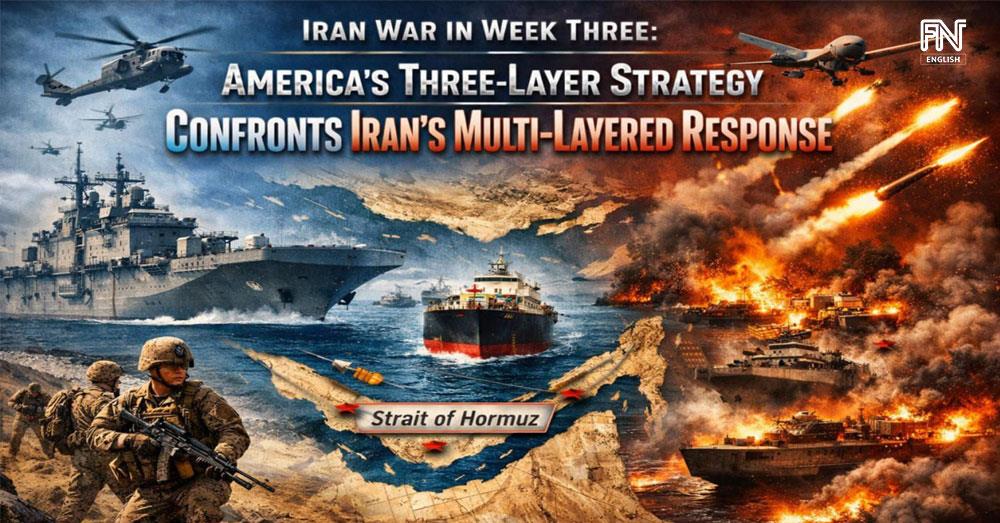
(Phnom Penh): As the Iran war enters its third week, it is increasingly taking shape as a full-spectrum strategic contest between the United States’ “three-layer strategy” and Iran’s “multi-layered response.”
While Washington is reinforcing its military presence, degrading Iran’s capabilities near the Strait of Hormuz, and managing global energy market impacts, Tehran is countering through direct retaliation, regional destabilization, and efforts to raise the political and economic costs for the United States. In this context, the war is no longer defined by raw military strength, but by each side’s ability to impose unsustainable costs on its adversary.
At this stage, the United States is demonstrating a clear strategic posture. The deployment of the USS Tripoli and the 31st Marine Expeditionary Unit aims to enhance maritime control, safeguard shipping lanes, and provide operational flexibility should the situation escalate further.
At the same time, the use of GBU-72 5,000-pound bunker-buster bombs against underground missile facilities near the Strait of Hormuz signals a shift in U.S. strategy—from deterrence to the systematic degradation of Iran’s threat capabilities. This underscores Washington’s objective of ensuring freedom of navigation along one of the world’s most critical energy corridors.
America’s Three-Layer Strategy: Force Expansion, Capability Degradation, and Disruption Control
The deployment of the USS Tripoli and the 31st MEU does not necessarily indicate an imminent ground invasion. Rather, it reflects Washington’s intent to maintain a full spectrum of operational options—protecting maritime routes, reopening the Strait of Hormuz if necessary, and responding rapidly to escalation.
This approach highlights a broader strategy of maritime dominance and control over what can be described as the “lifeline of global energy.”
Simultaneously, the use of GBU-72 strikes against hardened missile sites near Hormuz demonstrates that U.S. objectives extend beyond immediate threat containment. The goal is to reduce Iran’s long-term ability to disrupt global shipping. This marks a transition from deterrence-based strikes to capability-denial operations.
Iran’s Multi-Layered Strategy: Fragmenting the Battlefield and Raising Costs
Iran, for its part, is not relying solely on direct missile warfare. Instead, Tehran is implementing a multi-layered strategy that includes direct retaliation, attacks on U.S.-linked targets in Iraq, and efforts to destabilize key energy and maritime zones.
Rocket and drone attacks near the U.S. Embassy and diplomatic facilities in Baghdad indicate that Iran—or its aligned networks—is attempting to force Washington to disperse its resources across multiple fronts simultaneously.
The reported killing of senior Iranian official Ali Larijani during the third week has not reduced Tehran’s response; rather, it appears to have intensified its retaliatory posture. According to the Associated Press, Iran has launched missiles and drones toward Israel and targets across the Gulf region following the loss. This suggests that retaliation is not confined to a single theater, but is part of a broader regional pressure strategy.
At the same time, Iran’s influence is extending beyond the military domain into energy and maritime security. Reuters reports that Iraq has engaged Iran in discussions over protecting oil shipments through Hormuz, while the United Arab Emirates is considering participation in U.S.-led international efforts to secure the strait.
These developments indicate that Tehran is leveraging geography, allied networks, and energy pressure as strategic tools to increase the political, economic, and military costs for Washington.
In essence, Iran is pursuing an asymmetric warfare strategy—one that does not require decisive battlefield victory, but instead aims to prevent the United States from achieving a quick, low-cost win.
Hormuz: The Military and Global Economic Battleground
With Brent crude prices surpassing $103 per barrel and average U.S. gasoline prices rising to $3.79 per gallon, the impact of the conflict has clearly extended beyond the battlefield into the global economy.
The International Energy Agency’s support for the emergency release of approximately 400 million barrels, along with the U.S. release of 172 million barrels from its Strategic Petroleum Reserve, highlights the scale of pressure on global energy markets.
This confirms that the Strait of Hormuz is no longer merely a geographic chokepoint—it has become the central arena of global energy competition.
At this stage, the war is not moving toward a rapid resolution. Instead, it is evolving into a contest of endurance and escalation management.
The United States is leveraging technological superiority, naval power, and integrated operations to degrade Iran’s capabilities. Meanwhile, Iran is using geography, regional networks, and energy leverage to impose long-term costs and complicate Washington’s ability to manage the conflict.
Ultimately, the real contest is no longer about who is stronger, but about who can deny the other the ability to sustain the war first.
Conclusion
The most significant takeaway from the third week of the Iran war is that modern warfare no longer unfolds along a single front line. It operates simultaneously across multiple domains—maritime, air, energy, diplomatic, and global markets.
The United States is attempting to contain and manage the conflict within controllable limits, while Iran is deliberately expanding and complicating the battlefield to drive up costs.
This is not merely a confrontation of military power, but a competition of strategic endurance, complexity management, and cost imposition.
If current trends continue, the Strait of Hormuz will remain the core of this crisis. And victory in this war will not be measured solely by firepower, but by each side’s ability to withstand political, economic, and geopolitical costs.
In the end, the decisive question is no longer “Who is stronger?” but rather:
“Who can endure longer—and force their adversary to lose the capacity to continue the war first?”