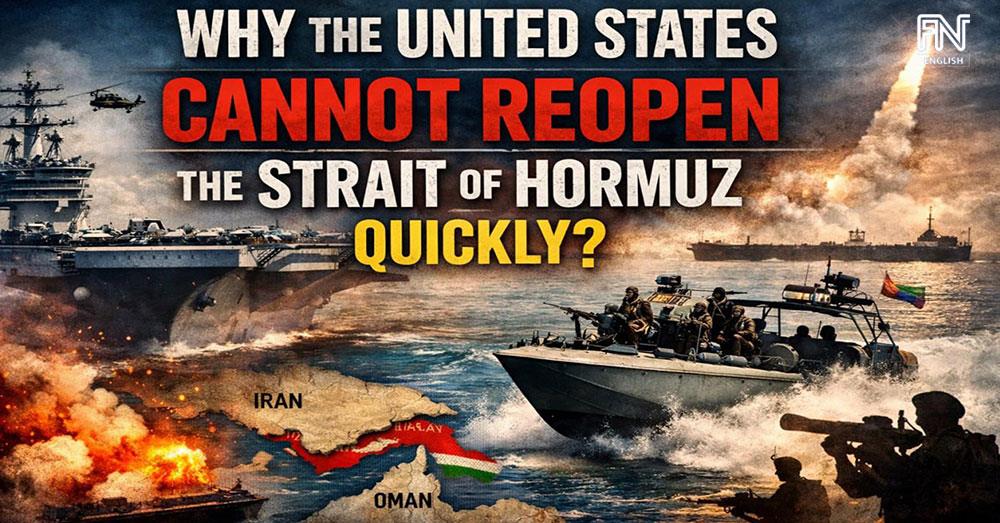
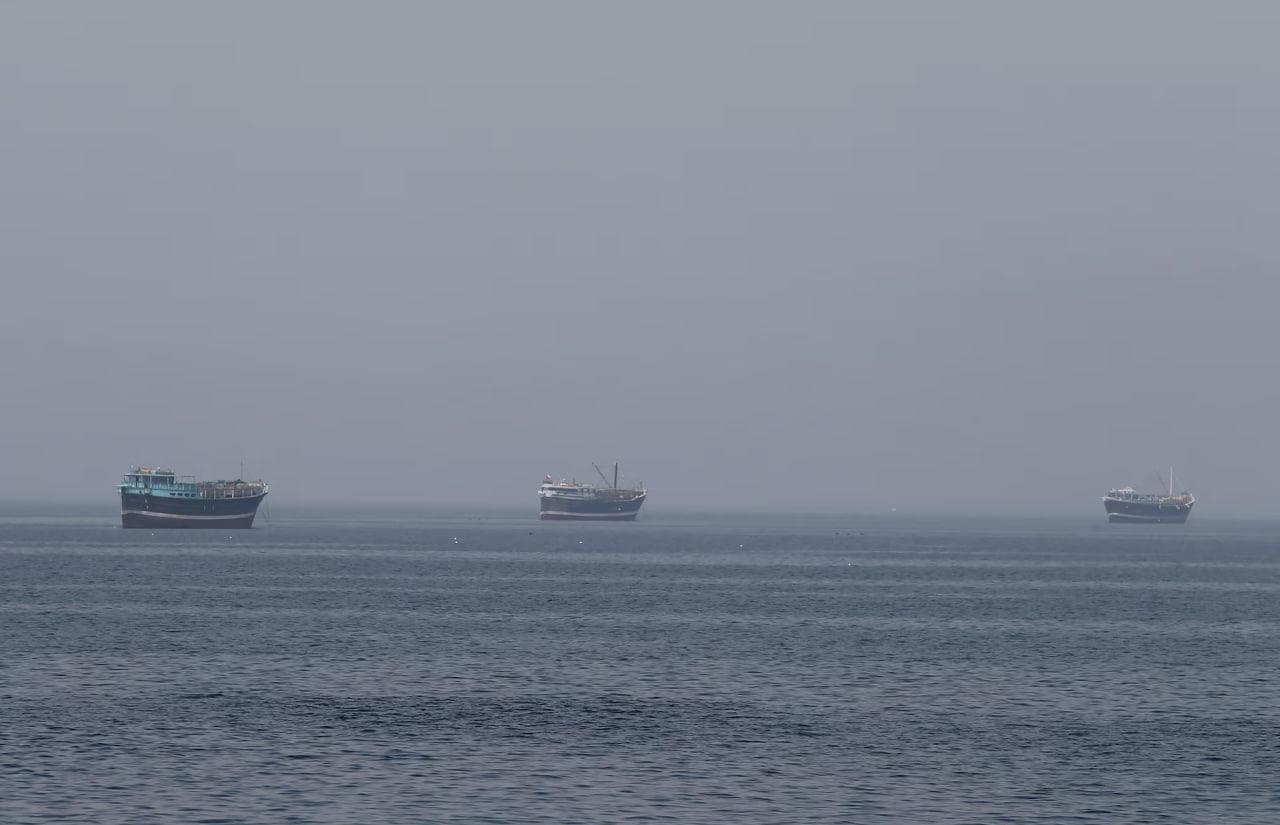
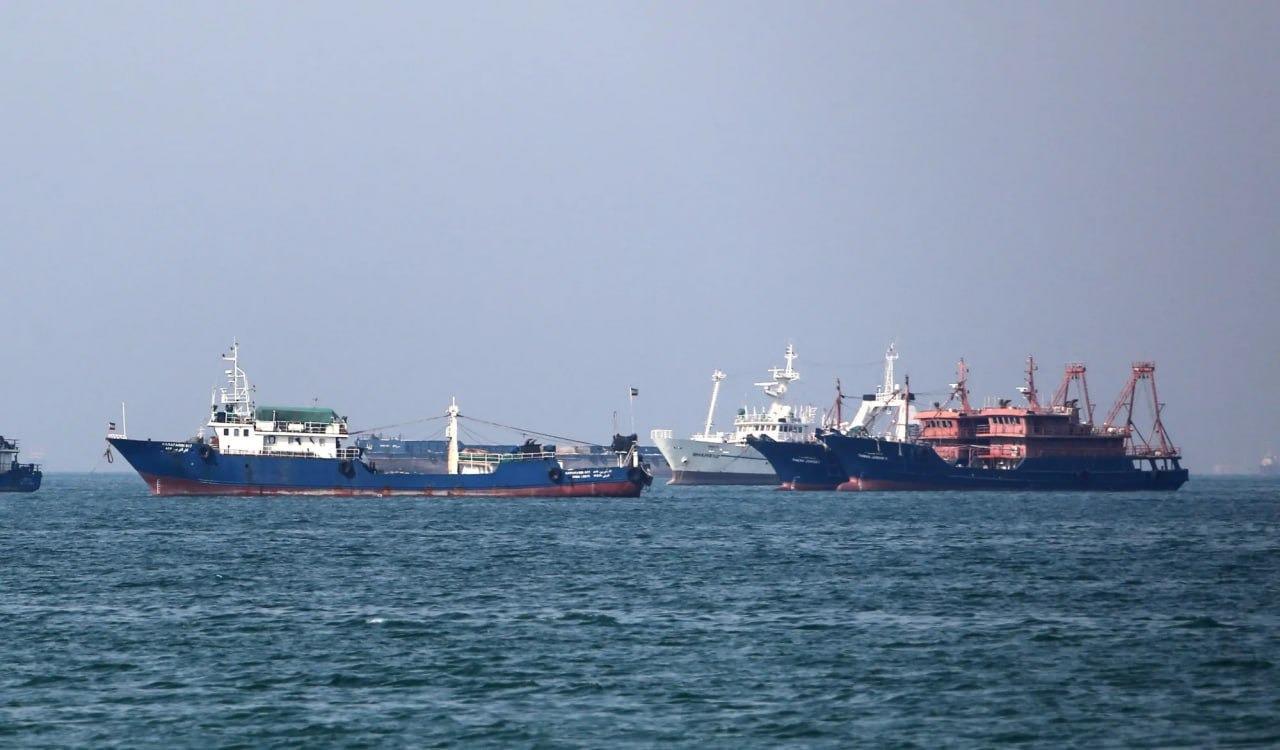
(Phnom Penh): If the United States is widely regarded as possessing the most powerful navy in the world, why has it not been able to reopen the Strait of Hormuz immediately after the outbreak of war with Iran?
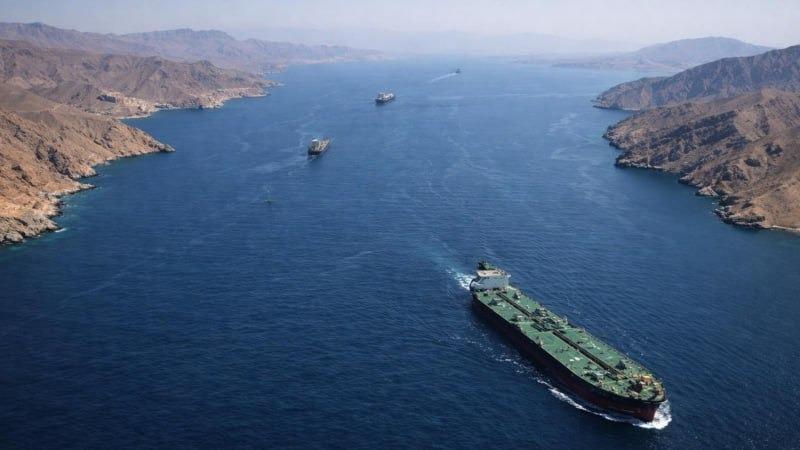
This question has become a central issue in the current global energy crisis. The Strait of Hormuz—one of the most strategic waterways in the world economy, through which roughly 20 percent of global oil shipments pass—has now become one of the most dangerous pressure points in the conflict.
Although Washington has announced that it is working to build an international naval coalition to escort oil tankers and restore maritime traffic through the strait, the situation has proven far more complex than many initially expected.
The delay is not due to a lack of American military capability. Instead, it stems from a combination of factors, including geopolitical caution, international legal considerations, the complexity of coordinating multinational military operations, and Iran’s asymmetric warfare strategy, all of which make reopening the strait far more difficult than simply deploying naval forces.
A Military Coalition Cannot Be Built Overnight
One of the biggest obstacles facing the United States in reopening the Strait of Hormuz is the challenge of forming an international naval coalition.
Washington has called on several allies—particularly countries in Europe and Asia that rely heavily on Middle Eastern oil—to contribute warships or military assets to escort oil tankers passing through the strait. However, many countries have not yet responded positively to joining such an operation.
Among the countries considered potential participants are the United Kingdom, France, Japan, South Korea, China, Italy, Greece, and Pakistan. Yet so far, most of these nations remain in a stage of deliberation and have not made firm commitments to participate.
A key concern is that joining such escort operations could effectively make them direct parties to the conflict with Iran. If Iranian forces were to attack escorted tankers or coalition warships, participating countries could quickly find themselves drawn into a much broader regional war.
Because of these significant political and military risks, many governments have chosen a strategy of caution and careful political consideration before committing to a U.S.-led military coalition.
Legal and Operational Challenges
Beyond political concerns, legal and operational issues also complicate the formation of such a coalition.
The Strait of Hormuz is classified as an international strait under international maritime law. As a result, any multinational military operation in the area requires clear agreements on several key issues, including:
- Rules of Engagement
- Command and operational control structures
- Intelligence sharing and military coordination among participating countries
Reaching consensus on these matters requires extensive consultations between governments and naval authorities from multiple nations, a process that can take several weeks before a formal agreement is reached.
In addition, deploying warships, surveillance aircraft, and military equipment to the Middle East requires time and complex logistical planning.
For these reasons, many military analysts estimate that establishing an effective escort operation in the Strait of Hormuz could take four to eight weeks before becoming fully operational.
The Crisis Could Escalate if Coalition Formation Is Delayed
If an international naval coalition cannot be organized within the expected four to eight weeks, the crisis in the Strait of Hormuz could escalate into a major global economic and security problem.
The reason is clear: the strait controls roughly 20 percent of global oil transportation. If maritime shipments continue to face disruption, global energy markets could experience supply shortages and heightened panic.
Under such circumstances, oil prices could continue rising sharply, placing additional pressure on the global economy.
Furthermore, prolonged delays in securing the strait could raise new questions about the United States’ role in safeguarding international maritime routes. Countries heavily dependent on Middle Eastern oil may begin exploring alternative security arrangements or energy strategies to reduce their vulnerability.
Some analysts argue that this crisis demonstrates that the struggle over the Strait of Hormuz is not solely a military contest—it is also a race against time. While oil markets react almost instantly to perceived risks, multinational military operations require far longer to organize.
This gap could allow the crisis to exert major economic impacts on the global system before any effective military solution is implemented.
Iran’s Asymmetric Warfare Strategy
Another major factor complicating efforts to reopen the strait is Iran’s military strategy.
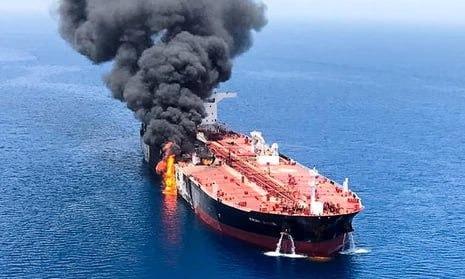
Rather than confronting the U.S. Navy directly—which possesses overwhelming conventional superiority—Iran has adopted an asymmetric warfare approach designed to disrupt maritime traffic.
These tactics include:
- Deploying naval mines
- Using fast attack boats
- Launching anti-ship missiles
- Conducting drone attacks against maritime targets
Such methods do not require large military forces but can still cause significant disruption to shipping routes.
For shipping companies and insurers, even a small attack can create serious fear and uncertainty, leading vessels to avoid the area altogether.
In global energy markets, the perception of risk can be almost as powerful as actual attacks. As a result, even without a complete blockade of the Strait of Hormuz, limited security threats alone can disrupt global oil flows and create instability in energy markets.
Can Strategic Oil Reserves Stabilize Prices?
While the Strait of Hormuz remains under threat, many countries have attempted to stabilize markets by releasing Strategic Petroleum Reserves (SPR).
The United States and members of the International Energy Agency (IEA) collectively hold hundreds of millions of barrels of emergency oil reserves, which can be released to reduce supply pressures and calm markets in the short term.
However, this measure has clear limitations.
The world consumes roughly 100 million barrels of oil per day. Even large reserve releases can therefore only ease supply pressures for a limited period—perhaps several weeks or a few months—if disruptions continue.
If the crisis in the Strait of Hormuz persists, many energy analysts warn that oil prices could rise above $120 per barrel, and in severe scenarios could reach $150 or even higher if maritime transport through the strait remains disrupted.
In this sense, releasing strategic reserves can provide short-term relief but cannot replace the restoration of normal oil flows through the Strait of Hormuz.
The Strategic Competition Over Time
In reality, the crisis in the Strait of Hormuz is not only a military contest—it is also a competition over time.
Global oil markets react immediately to security risks. Even reports of small attacks or threats against oil tankers can trigger panic and push prices higher.
By contrast, building an international naval coalition to secure shipping routes requires much more time—from political negotiations to military coordination and operational deployment.
Many analysts believe Iran is attempting to exploit this difference in speed as part of its strategy. While markets react within hours or days, multinational military operations may take weeks to organize.
In a world heavily dependent on energy, control over a narrow maritime chokepoint like the Strait of Hormuz can influence the global economy almost as significantly as victory on a battlefield.
Conclusion
In summary, although the United States possesses the most powerful navy in the world, reopening the Strait of Hormuz is not simply a matter of deploying warships.
It requires building an international coalition, resolving legal issues, coordinating complex military operations, and countering Iran’s asymmetric tactics that can disrupt shipping with relatively small-scale attacks.
At the same time, releasing strategic oil reserves can only provide temporary relief to global energy markets. If the crisis continues, it could place significant pressure on the global economy and drive oil prices even higher.
Therefore, the real competition in this crisis is not merely about military power—it is about time and the pressure of global energy markets.
The key question facing the world today is not only when the Strait of Hormuz will reopen, but also how long the global economy can withstand the disruption of one of its most critical energy lifelines if the conflict continues to drag on.