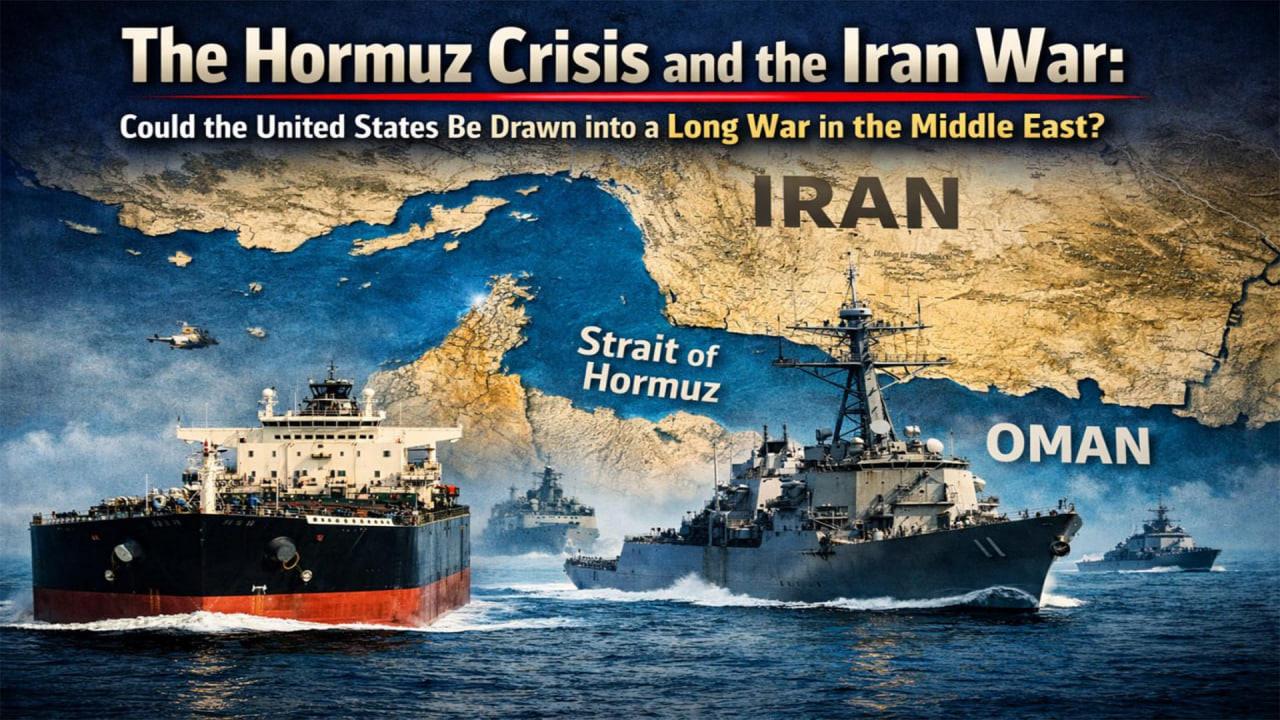
(Phnom Penh): The current conflict in the Middle East is not merely a conventional military confrontation. It has become a strategic contest over time, energy, and geopolitical influence.
While the United States is expanding its military presence around the Strait of Hormuz, Iran appears to be attempting to transform the conflict into a prolonged war of attrition, one that could generate pressure not only on the global economy but also on domestic politics within the United States.
Recent U.S. strikes on military targets on Kharg Island, combined with preparations to deploy additional U.S. Navy and Marine forces to the Middle East, indicate that the conflict may be entering a new and more dangerous phase.
In this context, the central question is no longer simply who can win on the battlefield, but rather who can better control time and manage long-term strategic pressure.
Iran and the Strategy of “Strategic Patience”
Unlike traditional warfare—where a weaker state must confront a stronger power directly—Iran has developed what analysts describe as an asymmetric strategy.
Under this concept, Iran does not necessarily need to win a decisive military victory. Instead, its strategic objectives may include:
- Prolonging the conflict
- Creating instability in global energy markets
- Increasing political pressure on the United States and its allies
In this kind of strategy, time becomes a critical weapon. States capable of sustaining pressure over a long period often gain strategic advantages over those relying primarily on superior military power.
Iran’s Strategic Leverage
Many military analysts argue that Iran possesses at least three key factors that could create strategic pressure on the United States and its partners.
1. Difficult Geography
Iran covers approximately 1.6 million square kilometers, making it one of the largest countries in the Middle East. Much of its territory is dominated by major mountain ranges such as the Zagros and Alborz, creating natural defensive barriers against foreign invasion.
In addition, Iran has a population of more than 90 million people, providing significant manpower for national defense and prolonged resistance.
From a military perspective, this means that any full-scale ground war would likely become a highly complex and costly operation for the United States.
History has repeatedly shown that large territory and difficult geography can offer strategic advantages to defending nations. These factors can allow a country to prolong conflict, impose casualties, and increase both military and political pressure on technologically superior forces.
2. Proxy Network
Iran has also built an extensive network of regional allies, which forms a central component of its asymmetric warfare strategy.
This network includes:
- Hezbollah in Lebanon
- Iran-aligned groups in Iraq
- Iran-supported armed factions in Syria
- The Houthi movement in Yemen
These groups can act as pressure points against U.S. forces and allies throughout the region.
Strategically, this means that a war involving Iran may not remain confined to a bilateral conflict. Instead, it could expand into a multi-front regional confrontation across the Middle East.
Under such circumstances, military and security pressure could emerge simultaneously in multiple locations, increasing the risk that a limited conflict could escalate into a broader regional war.
3. Energy Weapon: The Strait of Hormuz
The Strait of Hormuz is one of the most critical maritime chokepoints in the global energy system. Roughly 20 percent of the world’s oil shipments pass through this narrow waterway, linking the Persian Gulf with the Arabian Sea and global energy markets.
In this sense, Hormuz is not merely a shipping route; it functions as the energy artery of the global economy.
If the strait were blocked or threatened, global oil flows could be severely disrupted, potentially causing sharp spikes in oil prices.
For Iran, this is not simply a geographic advantage but also a powerful economic and strategic lever. Threats to restrict traffic through Hormuz can create pressure on global energy markets and on countries heavily dependent on oil imports.
For this reason, many analysts view the Strait of Hormuz as one of Iran’s most significant economic and strategic weapons.
Who Could Win?
In conflicts of this nature, victory is not determined solely by battlefield outcomes. Instead, the balance of power may depend on military capability, economic pressure, and the ability to manage time strategically.
From a purely military perspective, the United States clearly possesses superior capabilities. Its air power and naval forces have the ability to strike targets across Iranian territory using advanced military technology and an extensive network of regional bases.
However, in asymmetric and prolonged conflicts, superior military strength does not necessarily guarantee ultimate victory. States capable of sustaining pressure over time may generate significant political and economic costs for their opponents.
A War That Could Reshape the Global Order
As the conflict in the Middle East approaches its third week with no clear sign of de-escalation, many analysts warn that it could evolve into a prolonged war with significant consequences for global economic stability and international security.
In such wars, victory is not determined solely by military firepower. Rather, it often goes to the side that can better control time and sustain strategic pressure.
The U.S. strikes on Kharg Island and the deployment of additional U.S. Navy and Marine forces suggest that the conflict may be entering a new stage—one that could prove difficult to end quickly.
If the war continues to expand, it may no longer remain simply a confrontation between the United States and Iran. Instead, it could evolve into a broader crisis capable of reshaping global energy markets and geopolitical power balances.
In this sense, the conflict may ultimately become not just a military contest but a struggle over the future structure of global power—determining which actors will retain influence and strategic advantage in the coming decade.
Conclusion
The confrontation between the United States and Iran illustrates that modern warfare is no longer defined solely by military battles. Instead, it is a competition involving military strength, economic pressure, and strategic control of time.
After more than two weeks of fighting, analysts increasingly worry that the United States may not only struggle to decisively weaken Iran’s military capabilities but could also become more deeply entangled in a prolonged conflict if the war continues to escalate.
From this perspective, some analysts argue that Tehran’s strategy may not focus on achieving direct battlefield victory. Rather, it may aim to extend the conflict, thereby increasing economic and political pressure on Washington.
If the war continues to drag on, the situation could resemble other conflicts in which major powers became trapped in long and costly wars—such as Russia’s war in Ukraine.
Therefore, at this stage, what analysts are watching is not simply who can win the military battles, but rather who can endure longer and manage long-term strategic pressure more effectively.