(Phnom Penh): In war, the words of leaders are rarely ordinary political statements. At times they serve as psychological signals of deterrence. At other times they are subtle indications of negotiation. And occasionally, they become instruments of psychological pressure deployed ahead of a decisive phase in the conflict.
In the context of the ongoing confrontation between Iran and the U.S.–Israel alliance, a statement attributed to Iranian President Masoud Pezeshkian has attracted significant attention. According to the statement, Iran has entered what he described as a “new phase of the war.”
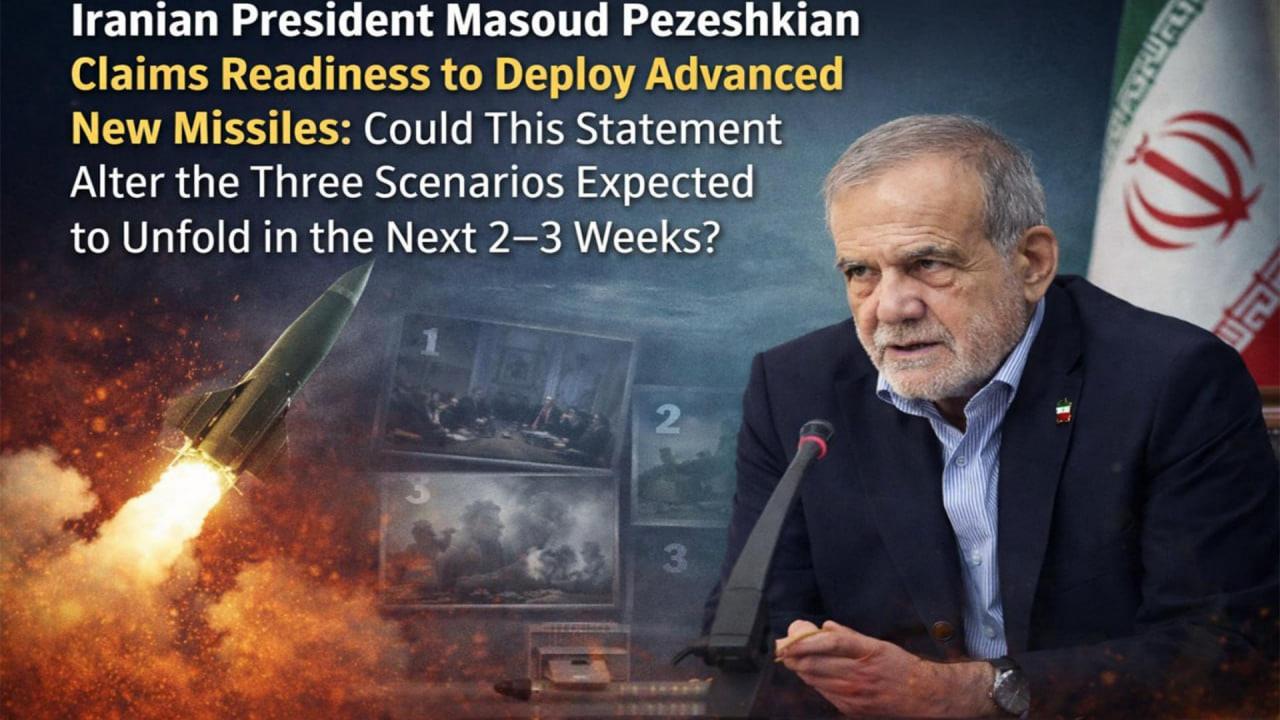
The president reportedly indicated that after utilizing older missile stockpiles, Iran is now prepared to demonstrate its “real technological capabilities,” potentially deploying the Kheibar Shekan-4 missile against Israel and U.S. forces in the region.
This assertion has raised a new analytical question: Could such a statement alter the three scenarios that analysts believe may become clearer within the next two to three weeks?
The short answer is that it may not fundamentally change the three scenarios themselves, but it could significantly influence their pace, weight, and direction.
Scenario 1: Military Pressure Forces Iran Toward Negotiations
The first scenario—still considered by many analysts to be the most likely outcome—is a war that eventually ends through negotiation.
The strategic logic behind this scenario is that the United States and Israel appear not to be preparing for a large-scale ground invasion of Iran. Instead, their strategy seems focused on degrading Iran’s key military capabilities, including missile infrastructure, command networks, and strategic assets, in order to create sufficient military pressure that would push Tehran toward a political settlement.
Under this framework, the goal is not necessarily the immediate collapse of the Iranian regime, but rather the gradual narrowing of Iran’s strategic options until negotiation becomes the most viable path.
However, President Pezeshkian’s latest remarks introduce a new analytical dimension. By declaring that Iran has entered a “new phase” of the conflict and by emphasizing the potential use of more advanced missile technology, Tehran appears reluctant to enter negotiations from a position of perceived weakness.
Instead, Iran may be attempting to increase military pressure before negotiations, seeking to strengthen its bargaining position.
This means that Scenario 1 is not eliminated, but it may be delayed. Before diplomatic talks emerge as a realistic solution, the conflict could first pass through another period of intensified confrontation.
In other words, Pezeshkian’s statement does not fundamentally change Scenario 1—but it suggests that negotiations might come after another round of escalation.
At the same time, reports have emerged of back-channel diplomatic contacts through intermediaries such as Qatar and several European countries, which are reportedly attempting to facilitate possible negotiations.
Scenario 2: Strategic Exhaustion — Iran Survives but Significantly Weakened
The second scenario envisions Iran surviving politically but emerging from the war significantly weakened in terms of military capability and strategic deterrence.
This scenario could materialize if the conflict continues to escalate and prolong. In such circumstances, Iran might lose more than it gains, even if the political system itself remains intact.
At this point, President Pezeshkian’s statement may actually increase the likelihood of this scenario.
If Iran truly chooses to escalate its military actions or demonstrate new missile capabilities, it may trigger stronger counterstrikes from the U.S.–Israel alliance. In many wars throughout history, escalation does not necessarily improve the chances of victory; rather, it often accelerates strategic exhaustion.
If such a dynamic unfolds, potential outcomes could include:
- A reduction in Iran’s missile capabilities
- Significant damage to naval forces and air-defense systems
- A decline in Iran’s regional strategic influence
- A restructuring of the balance of power in the Middle East
Politically, this would mean that Iran could remain an important regional state, but one emerging from the conflict considerably weaker than before.
In this context, Pezeshkian’s assertion about deploying advanced new missiles appears to increase the weight of Scenario 2 compared with the others.
Scenario 3: Internal Power Crisis in Tehran
The third scenario involves the emergence of an internal political crisis within Iran’s leadership structure.
External wars often do more than damage military targets; they can also affect domestic political stability and public morale.
If the war intensifies and destruction increases, pressure on Iran’s governing system could grow accordingly. Under such circumstances, several developments could occur:
- Power struggles within the political leadership
- Uncertainty within the Islamic Revolutionary Guard Corps (IRGC)
- Rising domestic political pressure or opposition
- Potential restructuring of the country’s power system
If Pezeshkian’s statement indeed signals a major escalation, it also implies that Tehran is accepting a higher level of risk.
Should such escalation fail to produce convincing military results, the pressure generated externally could eventually rebound internally, increasing domestic political strain.
Strong rhetoric can sometimes strengthen national unity in the short term. But if the war drags on and casualties and economic damage rise, such escalation could also accelerate internal political instability.
Therefore, Scenario 3 is not yet the most immediate outcome, but the declaration of a “new phase of war” may increase the risk that this scenario could emerge more rapidly.
Global Ripple Effects: Oil Markets Measure Risk, Not Just Words
In this conflict, the outcome is not determined solely on the battlefield. It is also being measured in global energy markets.
This is where the Iranian president’s remarks carry significance beyond political messaging.
When Tehran announces a new phase of escalation and hints at expanded missile use, oil markets do not interpret this merely as rhetoric. Instead, they see it as a signal of risk to global energy security, particularly in relation to the Strait of Hormuz, one of the world’s most critical oil shipping routes.
As a result, the conflict in the Middle East is already beginning to exert pressure on economies far beyond the region.
Countries in Southeast Asia—including Cambodia, Thailand, the Philippines, Vietnam, Singapore, and Indonesia—may feel the impact through rising energy prices, shipping disruptions, and inflationary pressures.
Thus, Pezeshkian’s statement does not only influence military calculations; it also shapes risk assessments across global energy markets.
Conclusion
When President Pezeshkian’s remarks are measured against the three scenarios expected to become clearer within the next two to three weeks, several conclusions emerge:
- The statement does not eliminate Scenario 1, but it may delay negotiations.
- It strengthens the probability of Scenario 2, as escalation could accelerate strategic exhaustion.
- It raises the risk of Scenario 3, since external pressure could eventually trigger internal instability.
In short, Pezeshkian’s statement does not yet change the fundamental trajectory of the war, but it signals that Tehran is attempting to increase both military and psychological pressure in order to improve its strategic position before the conflict reaches a decisive stage.
The central question therefore remains:
Will this escalation help Iran negotiate from a stronger position—or will it push the country deeper into strategic exhaustion and internal strain?
The answer to that question may not only determine Iran’s immediate future, but could also influence the stability of global energy markets and the broader international economy in the weeks ahead.