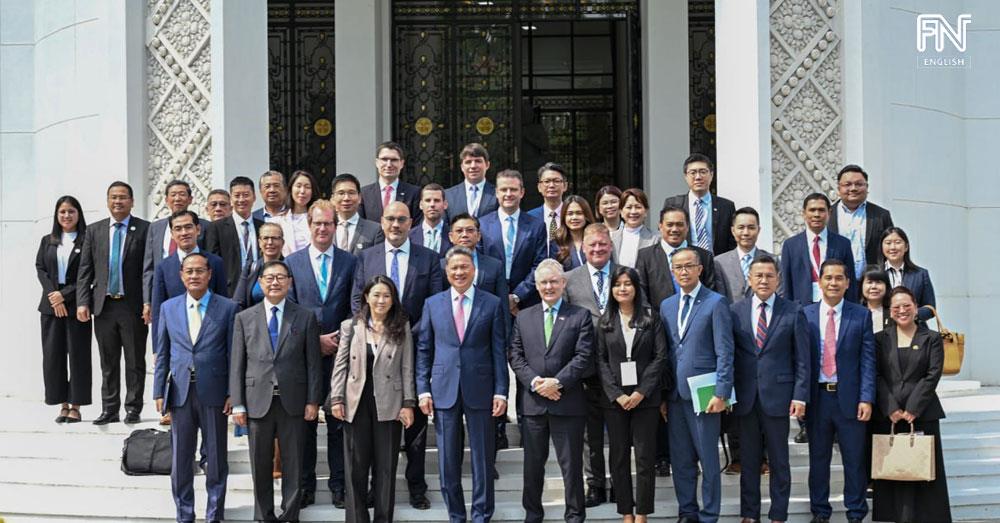
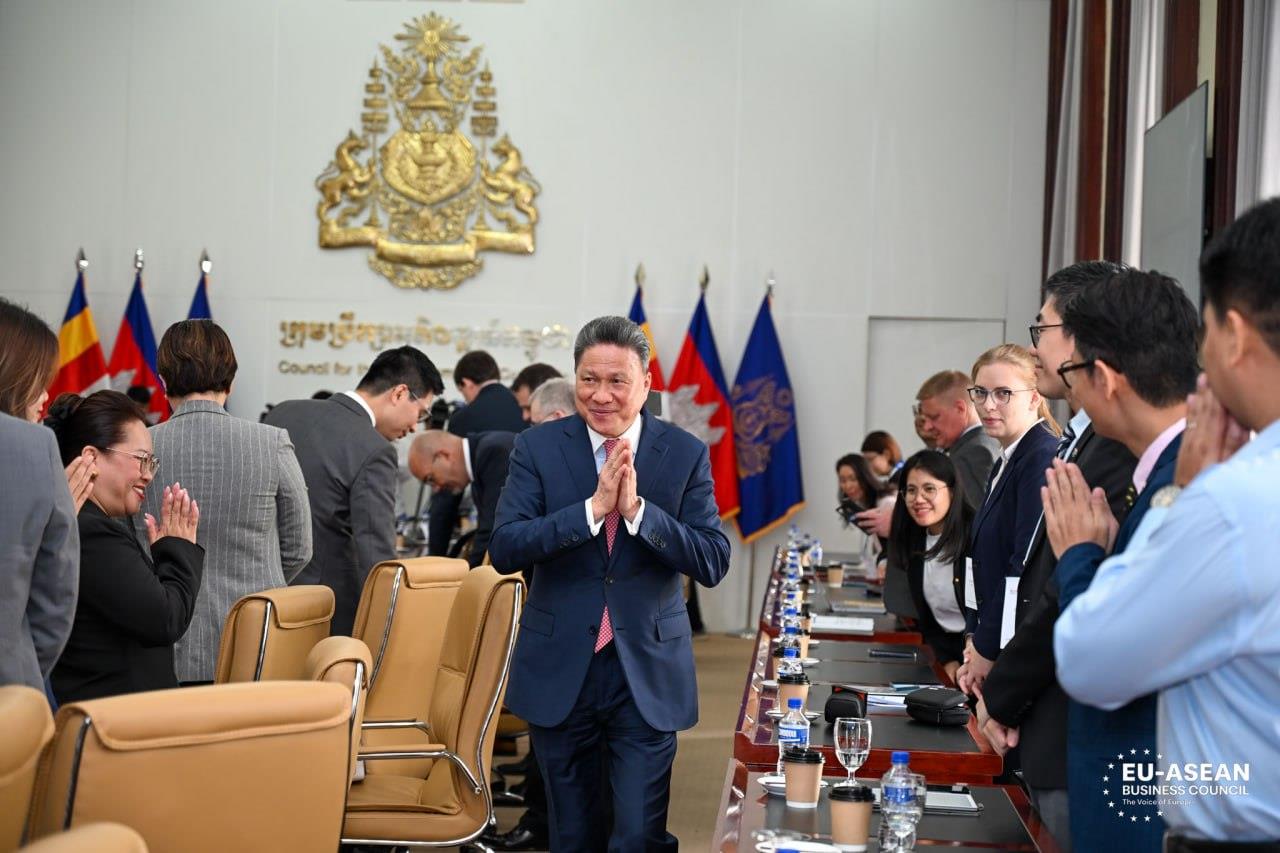
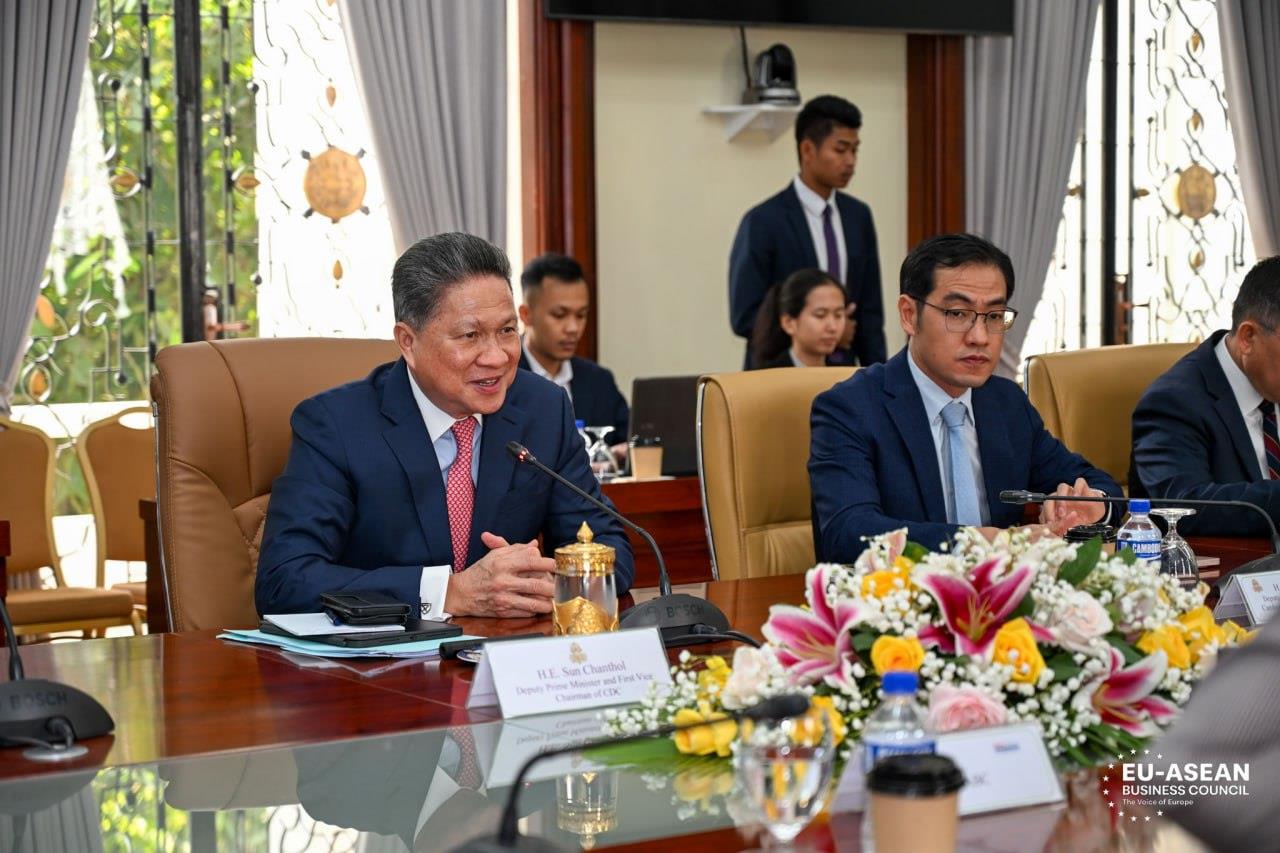
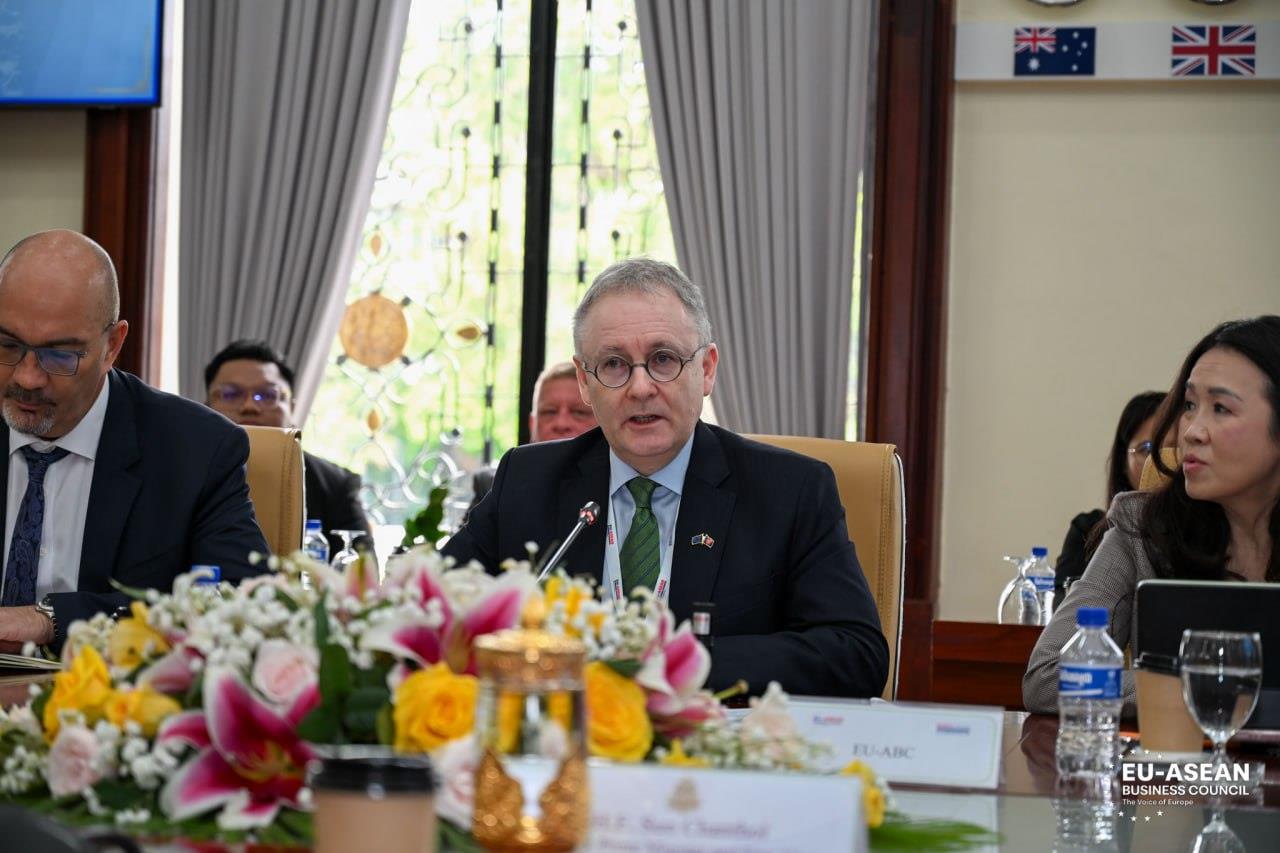
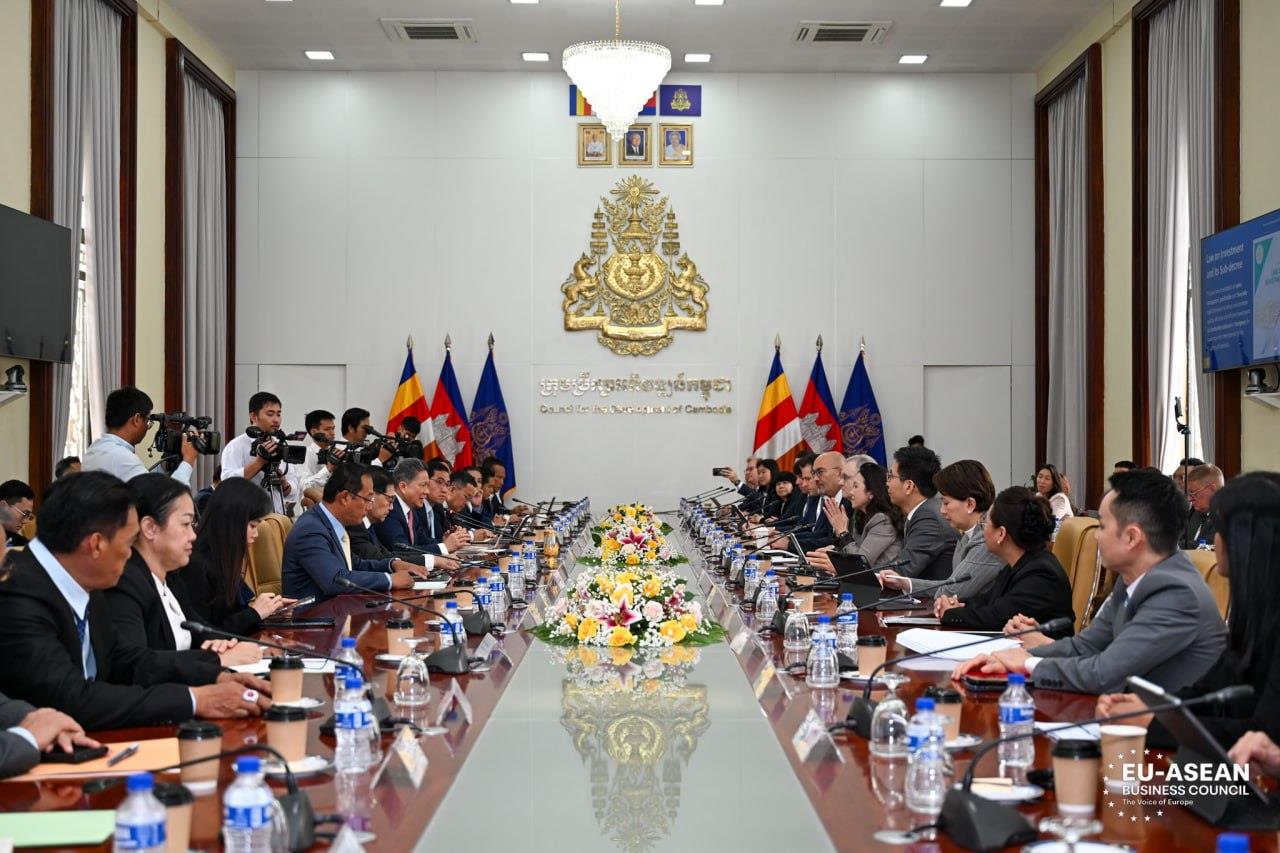
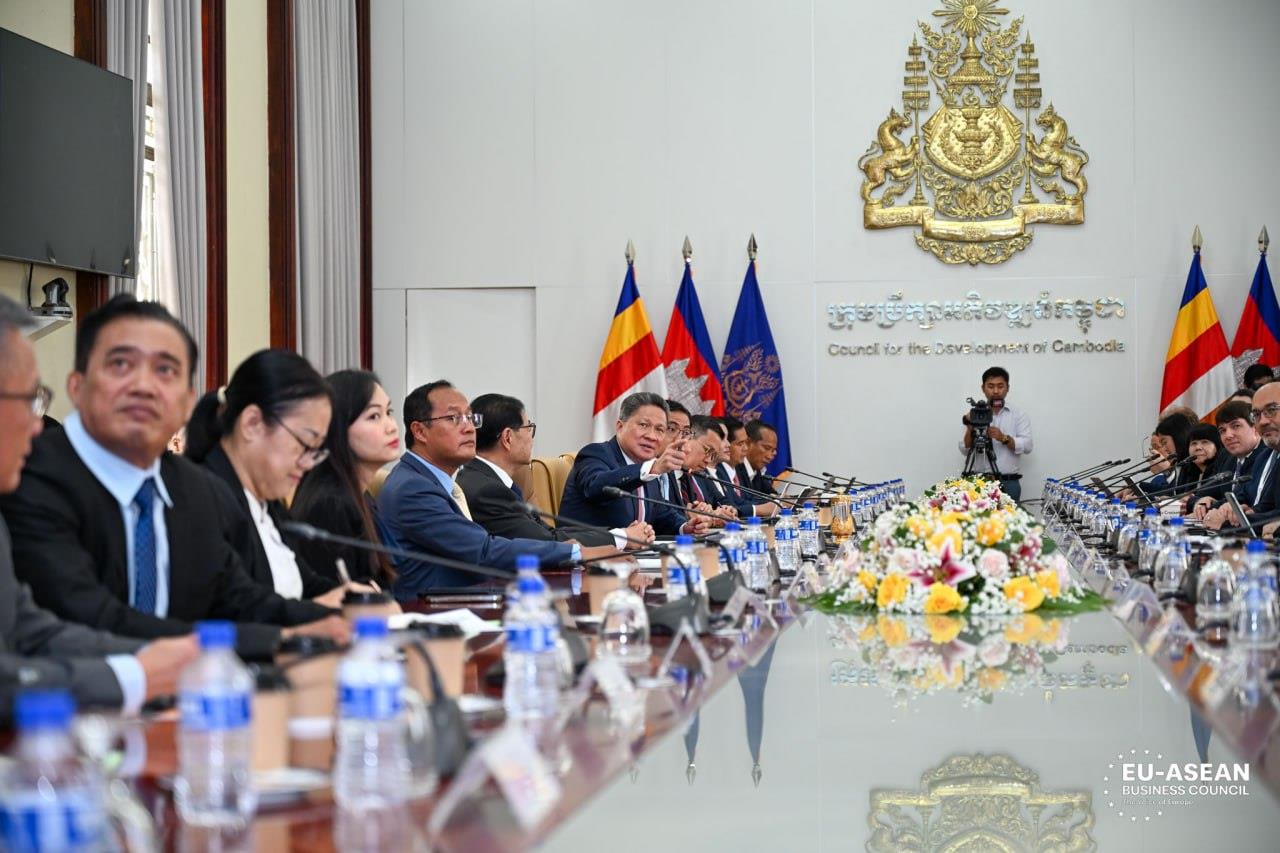
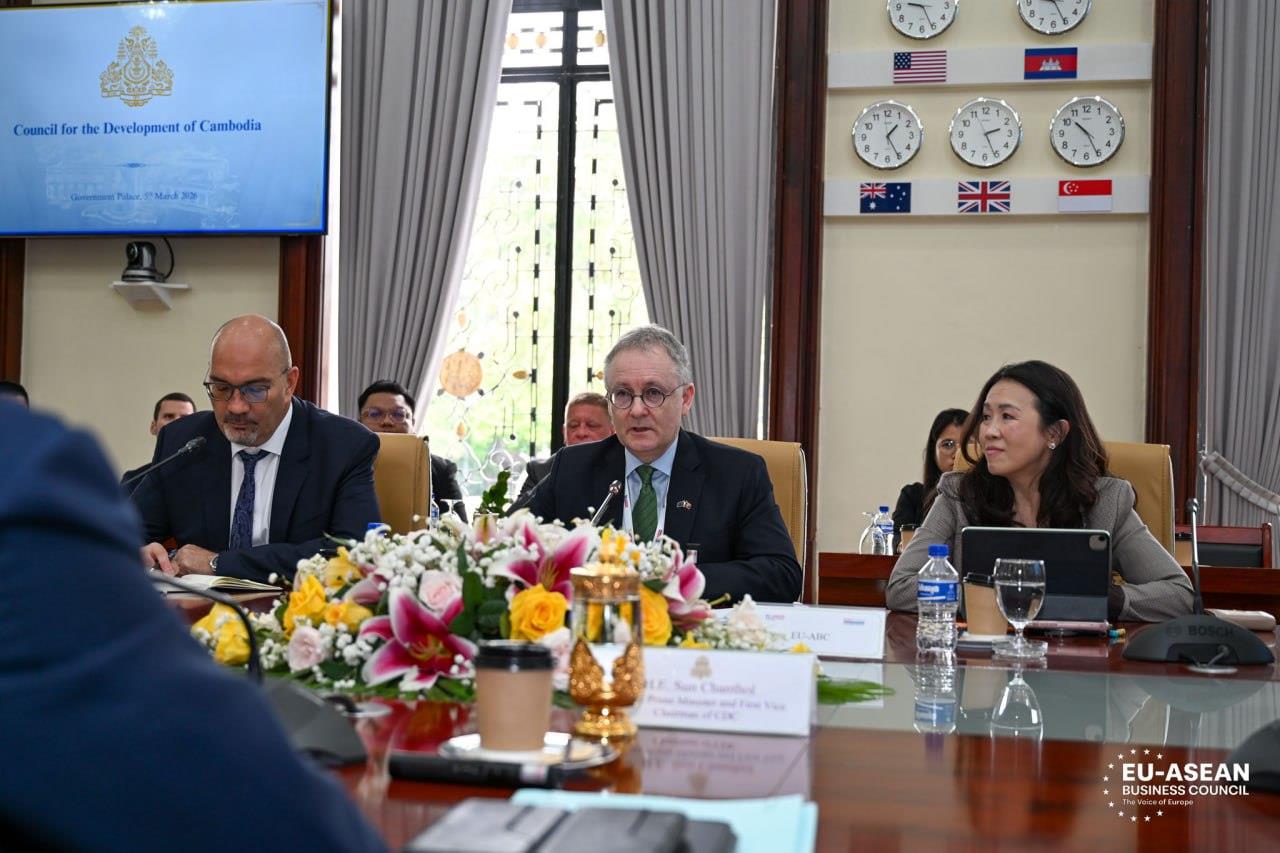
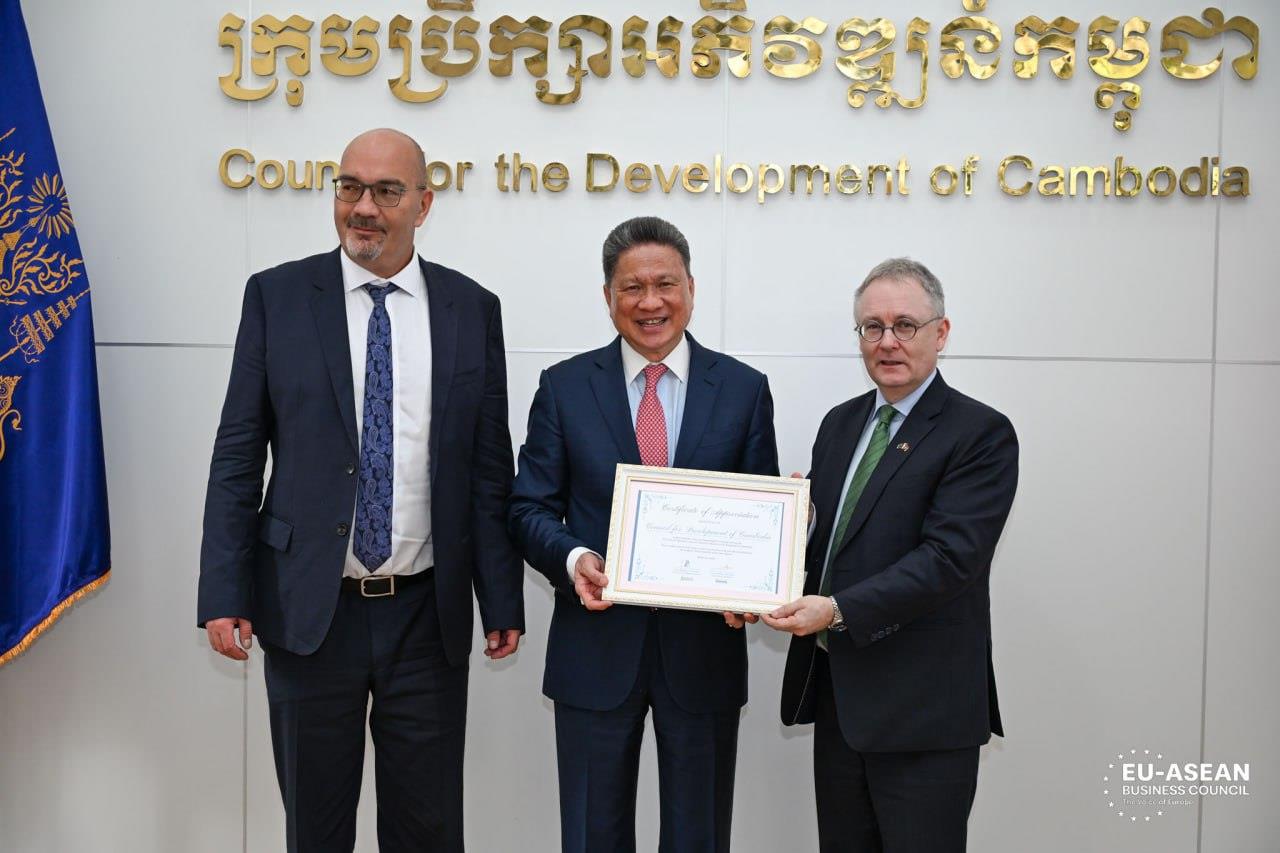
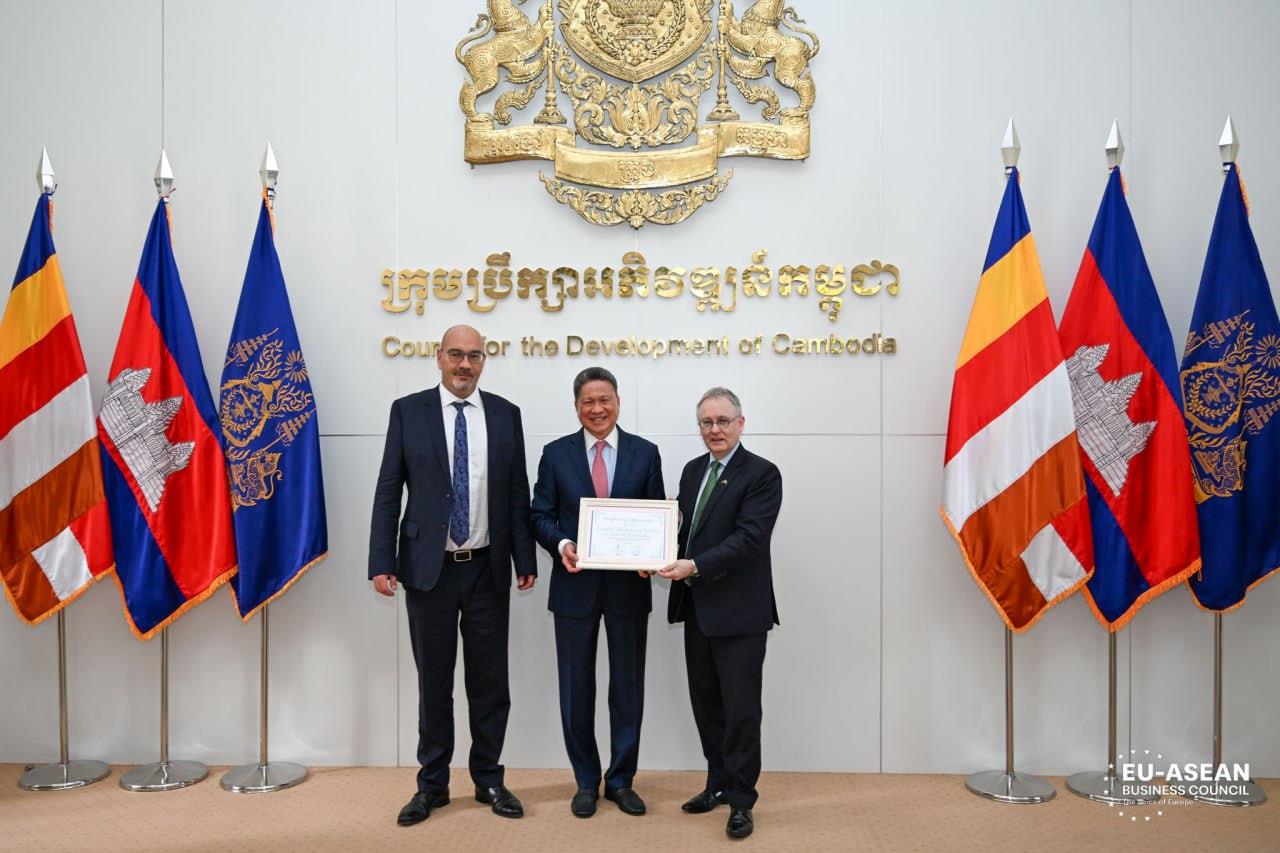
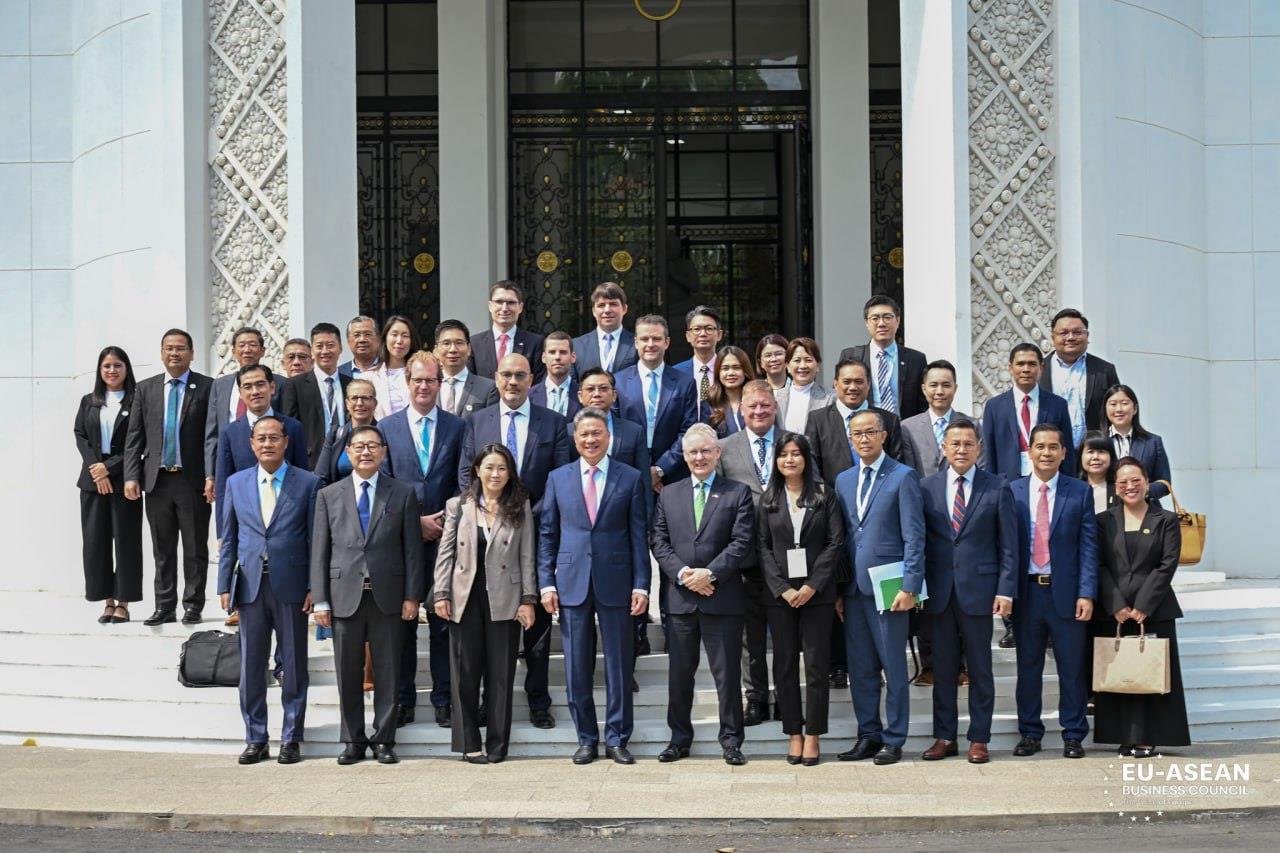
(Phnom Penh): Senior European business leaders from the EU-ASEAN Business Council met Sun Chanthol, Deputy Prime Minister and First Vice Chairman of the Council for Development for Cambodia, on Thursday (Mar. 5) in Phnom Penh to discuss EU-Cambodia trade priorities and opportunities for deeper public-private cooperation.
The meeting with Sun Chanthol marked the highlight of the council’s two-day visit to Cambodia, which brought together around 50 delegates from over 20 European multinational corporations and organisations for a series of high-level engagements with Cambodian ministers and government officials.
Central to the discussion with the deputy prime minister was the significant role European businesses play in Cambodia’s economy, with both sides voicing their eagerness to elevate cooperation, especially as the Kingdom works to diversify its export market and move up the value chain. Potential areas for collaboration include agri-food production and nutrition, sustainable manufacturing, textiles and apparels, furniture assembly, and logistics and connectivity, key sectors represented by EU-ABC delegates on the visit.
In his opening remarks, Sun Chanthol stressed that the private sector was a key engine of Cambodia’s economic growth.
“We cannot build Cambodia alone. We need our partner, the private sector,” he said.
EU-ABC Vice Chair Noel Clehane, who led the delegation, told officials in the room that European businesses were already convinced of Cambodia’s attractiveness for trade and investment.
Commenting on the visit, Vice Chair Clehane said, “We’re very positive about Cambodia’s economic outlook. It may be a smaller market within ASEAN, but it’s incredibly dynamic with a young workforce and significant room for growth.”
“There’s been much enthusiasm from government officials to deepen cooperation with the European private sector, and we’re equally keen to invest in Cambodia’s future,” he added.
Another key topic in meetings with the deputy prime minister and other ministers was Cambodia’s economic trajectory as it prepares to graduate from Least Developed Country (LDC) status in 2029. European firms hailed this development as a major success but raised concerns over the Kingdom’s ability to remain competitive once it loses near-zero tariff access to the European market under the Everything But Arms (EBA) scheme, which applies only to LDCs. The potential costs of exporting to the EU would deal a huge blow to the 1,400 European businesses operating in Cambodia, a crucial manufacturing hub in the region.
During a meeting with Minister of Commerce Cham Nimul yesterday, she expressed confidence that the Kingdom would achieve a smooth transition, signalling the government’s intention to work towards applying for the EU’s Generalised Scheme of Preferences Plus (GSP+). The scheme grants developing countries zero-tariff access for most exports to the European market. While this ambition was welcomed, European businesses noted that achieving GSP+ eligibility would require significant reforms and sustained progress in meeting the scheme’s criteria.
“We want to see Cambodia succeed. When Cambodia succeeds, European businesses succeed too. This is why we’ve consistently urged the government to commit to implementing the reforms necessary for GSP+ qualification,” said Chris Humphrey, EU-ABC Executive Director.
“We hope the message has gotten through. We’re here to help, and we want to lend our full support to Cambodia’s economic growth,” he added.
The EU-ABC delegation visit will conclude on the evening of 5 March, following meetings with Minister of Environment Eang Sophalleth, Minister of Post and Telecommunications Chea Vandeth, Director General Kun Nhem from the General Department of Customs and Excise, Trade Policy Advisory Board Chairman Sok Siphana, Minister of Industry, Science, Technology and Innovation Hem Vanndy, and Minister of Tourism Huot Hak.
On the first day of the visit, the delegation held meetings with Minister of Commerce Cham Nimul, Secretary of State at the Ministry of Economy and Finance Ros Seilava, National Bank of Cambodia Governor Chea Serey, Minister of Agriculture, Forestry and Fisheries Dith Tina, Minister of Public Works and Transport Peng Ponea, Secretary of State at the Ministry of Health Koy Vanny, and EU Ambassador to Cambodia Igor Driesmans.
“If there’s one thing this visit has shown, it is that European businesses are here to stay. We remain committed to supporting Cambodia’s economic development and deepening our partnership with the Kingdom in the years ahead,” said Clehane.
The EU-ASEAN Business Council (EU-ABC) is an advocacy organisation focused on promoting EU-ASEAN trade. Formally recognised by both the ASEAN Secretariat and European Commission, the Council serves as a key representative for European businesses operating in the ASEAN region. We engage directly with governments and key decision-makers, working to shape policy, drive regulatory changes, and ultimately foster an environment where European businesses can thrive.
With our members at the forefront of our work, the council deals with a wide range of industry and cross-sector issues through our Advocacy Groups, covering Sustainability, Energy, Healthcare, Digital Technology, amongst many others. A strong champion of public-private cooperation, our priorities include creating platforms for open dialogue, cultivating B2B and B2G networks, and facilitating opportunities for substantive partnerships, all towards the goal of driving trade and economic progress in both regions.
=FRESH NEWS