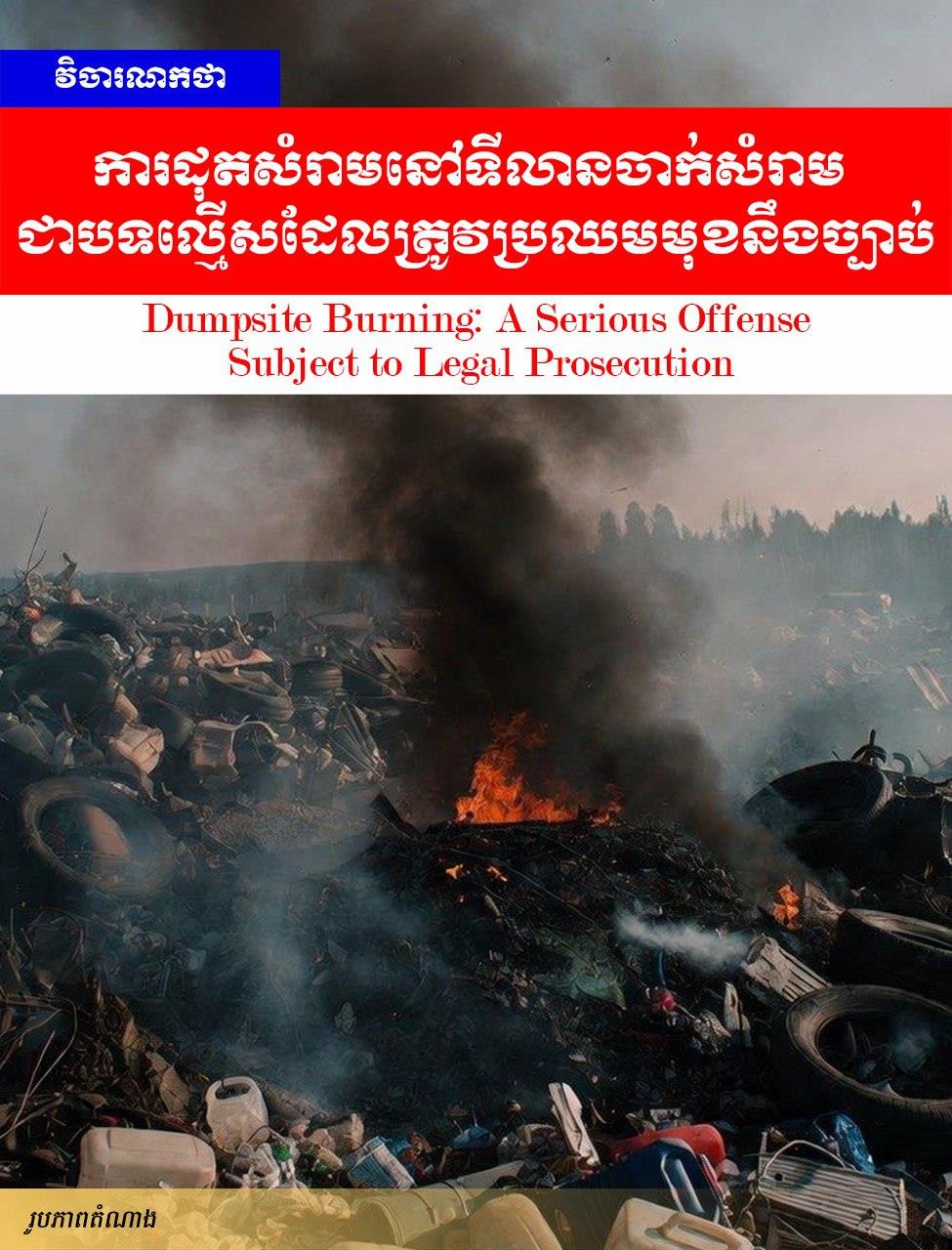
(Phnom Penh): Burning waste at a dumpsite is not merely a public health and environmental hazard; it is a serious criminal offense under the law. While some may view burning as a quick solution to reduce waste volume or extract valuable metals, these actions can lead to severe legal consequences.
1. The Offense of Arson and Property Damage
Intentionally igniting a fire at a dumpsite can be prosecuted as Arson. This refers to the deliberate act of starting a fire that destroys property, threatens human life, or compromises public safety. Even without malicious intent, a fire started in a waste area can spread rapidly and uncontrollably to neighboring lands, homes, or businesses.
If the fire results in injury, death, or property damage, further charges may be applied. Responsible parties may face prosecution for negligence, reckless endangerment, or even more severe crimes in serious cases. Civil lawsuits for damages are also possible. According to the Criminal Code of the Kingdom of Cambodia, intentional destruction—especially by fire—is not a minor offense. It can range from a misdemeanor (imprisonment under 5 years) to a felony (imprisonment from 5 years to life), depending on the scale of damage and the danger posed to human life.
2. Environmental Crimes and Statutory Penalties
Many countries have strict regulations prohibiting open-air waste burning due to the release of toxic substances into the atmosphere. Therefore, burning a dumpsite constitutes an environmental crime, such as illegal waste disposal, air pollution, or the improper handling of hazardous substances. These offenses can lead to heavy fines, imprisonment, or both.
Specifically, according to the Environment and Natural Resources Code of the Ministry of Environment:
- Article 272: "It is strictly prohibited to store, release, burn, bury, or dispose of hazardous waste in any manner that impacts public health, the environment, or causes property damage." Penalties are enforced as per Book 10, Chapter 2, Article 844, which states: "Individuals who burn or dispose of hazardous waste causing impact to the environment or public health shall be sentenced to 1 to 5 years in prison and fined 100,000,000 Riels (USD 25,000) if the offender has already been fined administratively twice within one year."
- Article 830: "Any person who causes noise, vibration, or odors that disturb living conditions, human health, or public/private interests shall be sentenced to 1 month to 1 year in prison and fined between 10,000,000 to 100,000,000 Riels for repeat offenses."
- Article 835 (Point 2): "Any person who causes the emission of hazardous substances into the environment, impacting biodiversity or public health, shall be sentenced to 1 to 5 years in prison and fined between 100,000,000 to 500,000,000 Riels (USD25,000 – USD125,000)."
3. Burden on the Community and Public Services
Beyond legal penalties, these actions undermine community safety and trust. Dumpsite fires place an immense burden on emergency services, endanger firefighters, and cause widespread fear among residents. The financial costs of fire suppression and environmental remediation often fall upon local authorities and taxpayers.
Conclusion
Dumpsite burning is neither a trivial nor a harmless act. Depending on the context, it is treated as arson, an environmental crime, or reckless endangerment. Strict law enforcement, combined with public awareness and proper waste management, is essential to prevent and deter these illegal activities.
=FRESH NEWS