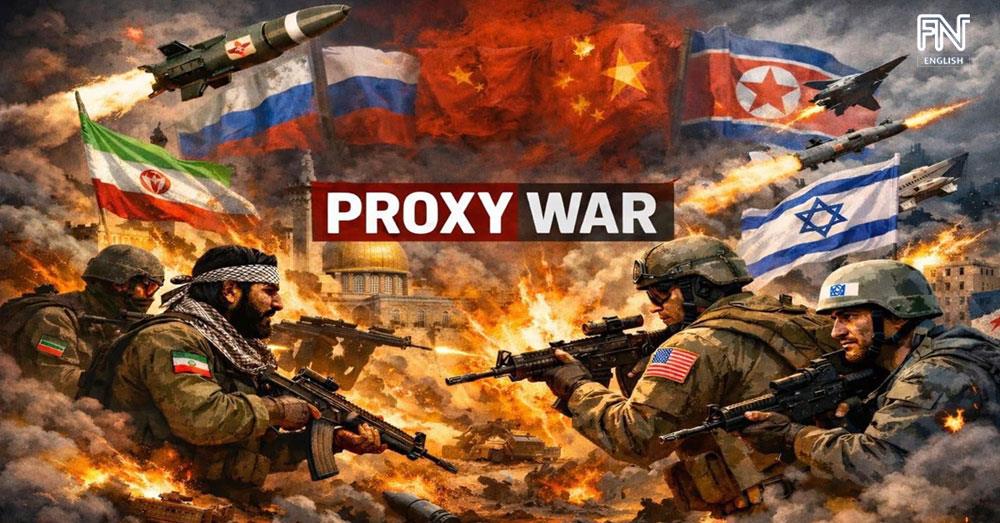
(Phnom Penh): The reported death of Iran’s Supreme Leader, Ayatollah Ali Khamenei, following what has been described as a joint Israeli-U.S. military operation, marks a potentially transformative moment in Middle Eastern geopolitics. Tehran’s immediate retaliation — through drones, ballistic missiles, and various other military means targeting U.S. bases across Gulf states, as well as through allied militias — suggests that this crisis has moved beyond a limited confrontation.
The central question now is not whether tensions will escalate, but how. Could this evolve into a full-scale regional war? Or are we witnessing the early stages of an expanding proxy conflict — what some analysts are beginning to describe as a “Cold War 2.0 in the Middle East”?
What Does “Cold War 2.0 in the Middle East” Mean?
This term does not imply an imminent global war. Rather, it refers to a prolonged power competition between major blocs that avoid direct military confrontation, instead relying on third parties (proxies) and leveraging economic pressure, energy dominance, technological competition, and information warfare as strategic tools of deterrence and influence.
From Direct Confrontation to Expanding Proxy Warfare
Historically, major powers tend to avoid direct warfare when the risks of uncontrollable escalation — particularly nuclear confrontation — are too high. Instead, they pursue indirect competition through third parties and multidimensional pressure tactics.
The conflict in Ukraine offers a clear precedent. NATO member states have provided military aid, intelligence, and economic support to Kyiv, while Russia engages Ukraine on the battlefield without formally declaring war against NATO. Similarly, during the Syrian civil war, external powers intervened through local allies and armed groups rather than confronting each other directly.
In the current context, the confrontation among Iran, the United States, and Israel could follow a similar trajectory. Rather than escalating into full state-to-state war, the conflict may expand into a broader proxy struggle — spreading through regional alliances, armed networks, and competition in technology, economics, and information domains.
Iran’s Network Strategy
Iran does not need to deploy conventional forces across borders to exert pressure. Instead, Tehran can rely on its network of allied militias and armed groups, including Hezbollah in Lebanon, militia forces in Iraq and Syria, and the Houthis in Yemen.
These actors enable Iran to strike at U.S. and Israeli interests through proxy operations, while maintaining a degree of “strategic ambiguity” to reduce the risk of direct interstate war.
Should tensions intensify further, countries aligned with Iran, such as China and Russia, may provide indirect support — including military-related technologies, intelligence assistance, economic backing, and diplomatic protection in international forums. Such assistance would not constitute direct participation in the conflict, but it could enhance Iran’s operational capabilities and strengthen its broader alliance network.
This pattern resembles the Ukraine conflict, where indirect support has prolonged hostilities while major powers avoid direct confrontation.
The U.S. and Israeli Response
Washington and Tel Aviv are likely to favor calculated, calibrated responses. These may include targeted airstrikes, cyber operations, intelligence warfare, and maritime security measures around the Strait of Hormuz.
Rather than pursuing large-scale invasion or ground deployment, the strategy would likely focus on controlled escalation — maintaining deterrence while preventing the conflict from spiraling beyond manageable limits.
However, if the situation shifts toward sustained proxy warfare and Iran directly targets U.S. strategic interests across the region, the United States could find itself drawn into a broader proxy conflict it did not initially intend to fight.
That said, the most probable scenario at present is not immediate full-scale war, but a prolonged proxy confrontation under managed escalation.
The real strategic concern lies not in where the conflict will move next, but in whether all parties can accurately calculate risks and avoid crossing a point of no return.
The Role of China and Russia
Beijing and Moscow are unlikely to engage directly in combat. However, they may choose indirect forms of support designed to strengthen Iran while avoiding direct confrontation with the United States.
Such support could include:
1. Dual-use military technology
2. Satellite intelligence and cyber expertise
3. Diplomatic protection in international institutions
4. Sustaining Iran’s economic lifelines, particularly through energy trade and alternative financial systems
While indirect, such measures could reinforce Iran’s capacity and prolong a proxy conflict.
Strategically, this dynamic may lead to a recalibration of the regional balance of power, compelling Middle Eastern states to reassess their alliances and geopolitical positioning.
Is a New Global War Likely?
At present, a global war remains unlikely for one fundamental reason: no major power appears willing to absorb the catastrophic military, economic, and political costs of direct confrontation.
Russia remains deeply engaged in Ukraine. China prioritizes economic stability and long-term strategic competition with the United States over open military conflict. Gulf states favor regional stability over becoming battlefields. Even Washington appears to prefer deterrence over costly occupation.
However, the probability of an expanded regional proxy war is significantly higher. The reported strike against Iran’s Supreme Leader appears to have crossed what Tehran had long defined as a red line. Iran and its network have responded by targeting U.S. positions across Gulf states under the banner of defending sovereignty and national dignity.
Such cycles of retaliation raise a new strategic question: Is the Middle East entering a new era of proxy warfare?
If so, the consequences will extend far beyond the region. Energy markets, global supply chains, and broader geopolitical stability could all face sustained pressure — especially if international institutions struggle to provide effective mechanisms for de-escalation.
In this scenario, the Middle East could become the principal theater of global power competition — much like Europe during the Cold War of the 20th century.
Conclusion
The death of Iran’s Supreme Leader may prove to be a historic inflection point, accelerating bloc polarization and reshaping regional alliances. The immediate danger does not lie in an imminent world war, but in an expanding proxy conflict — one that drains resources, destabilizes energy markets, and deepens geopolitical fragmentation.
The coming weeks will test the strategic calculations of global and regional leaders: will they pursue calibrated restraint to prevent escalation, or allow cycles of retaliation to spiral beyond control?
For smaller states observing from a distance, the lesson is clear: in an era defined by proxy warfare and bloc competition, strategic neutrality, economic resilience, and diplomatic agility are no longer optional — they are essential for national survival.
If escalation management fails, the strike that killed Iran’s Supreme Leader could mark the beginning of a new era of proxy warfare in the Middle East. This is not an event concluded by the death of a single leader, but a potential crossing of a red line that may ignite a prolonged cycle of confrontation.
In such a context, peace cannot be secured through targeted killings alone. Instead, it risks fueling a long-burning proxy conflict whose consequences could extend far beyond the Middle East — affecting global energy markets, economic stability, and the overall balance of international power.