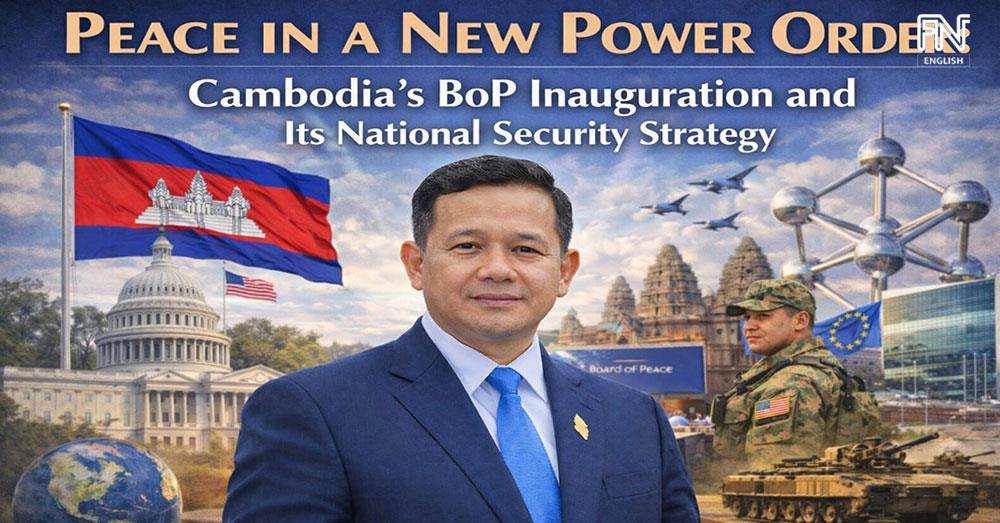
(Phnom Penh): In a rapidly shifting world order, peace is no longer defined only by law and multilateral institutions as it once was. Increasingly, it is shaped by the speed of decision-making, the strength of support networks, and the capacity to pursue strategic outcomes through agile diplomacy. For smaller states that can no longer afford to wait for slow-moving international procedures, having a seat at key decision-making tables becomes, in itself, a component of national security.
At 10:00 p.m. on February 15, 2026, Cambodian Prime Minister Samdech Moha Borvor Thipadei Hun Manet led a high-level delegation to attend the first meeting of the “Board of Peace” (BoP) at the Donald J. Trump United States Institute of Peace in Washington, D.C. According to an official announcement, the meeting formally launches the BoP’s mandate under a UN Security Council decision aimed at advancing peace and supporting reconstruction efforts in Gaza.
For Cambodia, however, the significance of this trip extends beyond Gaza. The central question is this: How can participation in this new forum be translated into a national security strategy—especially regarding the Cambodia–Thailand border?
Cambodia’s participation in the BoP inauguration should be understood as a diplomatic move within an emerging “new power order.” In an era where influence and international support are increasingly determined by networks and fast-paced negotiation, Cambodia must broaden its partnerships to strengthen deterrence and reinforce international perception that Cambodia upholds peace and international law. This is not a strategic “switch” to a new camp; rather, it is an effort to expand strategic balance to safeguard national security—particularly along the Cambodia–Thailand border.
The Board of Peace: A New Platform in a Fast-Moving International Order
The Board of Peace (BoP) was established under a decision of the UN Security Council to promote peace and reconstruction in Gaza. Its inaugural meeting is not merely the start of an official mandate; it is also a signal that the international system is searching for a new working method—faster, more concrete, and more operational.
Although it operates under a UN framework, the BoP appears more highly “operational” than traditional multilateral institutions. It is designed for rapid decision-making, faster mobilization of resources, and political coordination through direct networks of decision-makers. As the global order shifts from long, procedural frameworks to faster, action-oriented decision cycles, countries that are present in such forums are better positioned to access centers of influence and enhance their negotiating power more effectively.
For Cambodia, joining the BoP is not symbolic. It is strategic. It provides an opportunity to affirm Cambodia’s stance in favor of peace, stability, and solutions grounded in international law. Participation in a forum capable of mobilizing support quickly can help generate new networks of cooperation—networks that may function as a form of deterrence if border pressure or instability escalates.
In this sense, the BoP is not only a Gaza-focused mechanism. It is also a platform that can strengthen the “security diplomacy capacity” of smaller states. Countries that can link peace to supportive networks—and link international law to operational influence—can raise the political cost for any actor seeking to provoke instability. For Cambodia, this is an additional layer of national defense—built not from weapons, but from diplomacy, legitimacy, perception, and carefully designed strategy.
The Border: Not Only a Military Issue, but a Diplomatic and Legitimacy Contest
The Cambodia–Thailand border challenge is not merely a military confrontation. It is deeply connected to map claims, historical treaties, interpretations of international law, and a competition over legitimacy in the eyes of the international community. A border may be a line on a map, but border disputes are contests over interpretation, narrative, and international perception.
In this new power order—where decisions move faster and networks matter more—deterrence is not limited to troops and weapons. It rests on three key layers:
1. Military capability (hard power)
2. Networked diplomacy
3. Legitimacy capital and international support
A state that demonstrates commitment to peace and international law increases the political cost for any party considering the use of force or escalation. In today’s environment, international legitimacy can function as a form of deterrence—one that does not fire bullets, yet can make aggression significantly more costly.
From this perspective, Cambodia’s BoP engagement should be understood as part of a peace-based deterrence strategy. It is not a rush to seek military backing; it is an expansion of diplomatic networks and an effort to strengthen international perception that Cambodia addresses disputes through law and regional stability.
If Cambodia continues to build its legitimacy capital and connect it to international platforms and supportive networks, the risk of border provocation becomes more difficult—and less attractive—for any actor seeking confrontation. Borders require defense capacity, but they also require diplomatic capacity and strategic design that ensures peace carries greater power than conflict.
Strategic Expansion, Not Strategic Switching
When smaller states enter new international forums, they must be especially cautious about misinterpretation. In an era of great-power competition, any move can be framed as a strategic “pivot” or alignment with one side. For Cambodia, the guiding principles must be clear—and the diplomatic signaling must be disciplined and immediate to prevent misreading.
Cambodia’s approach should be anchored in three core principles:
1) Expand partnerships without abandoning existing partners
Joining new forums does not mean leaving old relationships. It is about adding options, not replacing them.
2) Anchor policy in international law and ASEAN centrality
Grounding foreign policy in international law and ASEAN’s central role helps protect Cambodia against accusations of tilting toward any single bloc.
3) Maintain multi-vector diplomacy
Multi-vector diplomacy allows Cambodia to strengthen negotiating power without being forced into a “one-choice-only” position. In a shifting power order, balance is a lifeline for smaller states.
Therefore, the BoP should not be viewed as a change of political direction. It is a tool to expand negotiating capacity and support networks in defense of sovereignty—one element within Cambodia’s broader national security package, not a new national alignment.
Strategic expansion increases options while preserving independent decision-making. Strategic switching, by contrast, risks altering a country’s power dependence and weakening balance. For Cambodia, the correct path is expansion, not switching.
From Washington to Brussels: Support Networks Bigger Than a Single Forum
According to the official program, after attending the BoP’s inaugural meeting in Washington, D.C., Prime Minister Hun Manet is expected to continue a working visit to Europe, including Geneva and Brussels, meeting key leaders and stakeholders to strengthen partnerships and expand cooperation.
This extension from Washington to Europe shows that Cambodia is not confined to a single diplomatic track. It is a continuous diplomatic sequence linking the United States and Europe within one strategic frame: broadening support networks.
In the new power order, smaller states cannot rely on a single pillar of support. A diversified network—across the United States, Europe, ASEAN, and other partners—enhances negotiating capacity and reduces the risks of dependence on any single actor. It is a strategy built on multiple connecting lines, not a single alliance.
In the Cambodia–Thailand border context, third-party support means more than statements. It may include:
• Clear endorsement of principles such as non-use of force and respect for international law
• Technical assistance in legal expertise or border governance
• Investment and development in border areas to strengthen economic resilience and stability
Such diversified networks raise the political cost for any actor seeking to trigger instability. A border issue is not only a bilateral dispute; it can become a regional stability issue when third parties are engaged and international perceptions are shaped accordingly.
In this sense, the Washington-to-Brussels trajectory reflects Cambodia’s effort to build network-based security—protecting sovereignty by expanding friendships, not by multiplying enemies. In today’s international order, the country with a broader network does not merely have more friends; it has more options—and greater negotiating power.
Conclusion
Peace in a changing world order does not mean that smaller states must trade away sovereignty. On the contrary, it means smaller states must learn to use diplomatic networks, international law, and international perception to strengthen deterrence through peace. In a world where power competition is intensifying, sovereignty cannot be protected through force alone; it requires a strategy that links peace to negotiating power.
Cambodia’s participation in the BoP inauguration should be seen as part of building a new model of national security—one grounded in support networks and legitimacy. Connecting peace with partnerships, and connecting international law with the defense of sovereignty, is a way to raise the political cost for anyone who seeks to provoke border instability.
A border is not merely a line on a map. It is a line of perception, diplomacy, and carefully calculated strategy. In this new order, Cambodia should not be a passive observer while others shape its future. Cambodia must act strategically—expanding networks, maintaining balance, and defending sovereignty through the principle of peace that carries greater power than conflict.
Ultimately, peace is not surrender. Peace is a strategy—managed by those who understand that national value is not something to be traded away, but something to be strengthened through higher influence on the global stage.