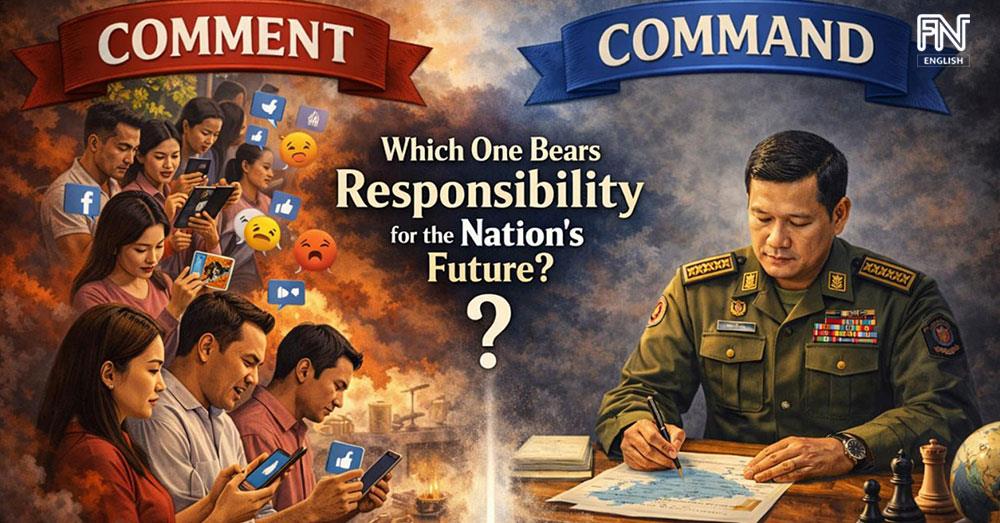
(Phnom Penh): “In just ten minutes, one can express four different emotions, and the last may contradict the previous three. But when it comes to the decisions of the Royal Government… because some ask: Why does the government act this way and not that way?”
These remarks by Prime Minister Hun Manet highlight a critical distinction between public commentary and state decision-making during times of border crisis.
While public sentiment may shift rapidly—from grief to fear, and from fear to anger—the decisions of government cannot follow emotional momentum. They must stand on responsibility: responsibility for national territory, for human life, and for the country’s future.
This speech was not merely a response to individual questions or temporary public pressure. It was a declaration of governing principle in a time of emergency. Its core message was unmistakable: a state cannot operate at the speed of emotion.
Comment arises instantly, often from limited perception and immediate reaction. Command, by contrast, emerges from deliberation. It requires careful consideration of territory, civilian lives, the safety of armed forces, diplomatic consequences, international law, economic impacts, regional stability, and long-term national interests.
Sustainable peace cannot be built on emotional impulses. It requires law, institutional mechanisms, and strategic foresight. Protecting territory cannot be separated from protecting people—because sovereignty only has meaning when citizens are safe.
In this sense, Comment is the right to speak. Command is responsibility for outcomes.
Governing a Nation Is Not a Single Choice
In times of crisis, governance is not a simple either–or decision.
The state cannot choose “sovereignty” while ignoring human life. Nor can it protect lives by abandoning territorial integrity.
Territory is the foundation of the state—its legal identity and sovereign legitimacy. But people are the purpose of the state. Sovereignty without citizen security is hollow. Life without secure territory remains perpetually vulnerable.
Protecting land without protecting lives defeats the purpose. Protecting lives while sacrificing territorial integrity undermines the foundation.
Therefore, state decisions must rest on strategic balance—between immediate safety and long-term stability.
Immediate safety prevents irreversible losses. Long-term stability ensures the nation does not fall into recurring cycles of conflict.
A responsible government does not think only about today. It must think about next month, next year, and the next generation. Because a decision made today may echo across time.
This is the difference between emotional thinking and statecraft: one reacts to momentum; the other secures stability.
When Society Feels, the State Must Think
In today’s networked world, emotion spreads faster than analysis. One image provokes sympathy. Another sparks anger. A third generates fear.
Such reactions are human—and understandable.
But governing a country is not the management of emotion; it is the management of consequences.
Every state decision must consider multiple layers:
- the safety of frontline forces,
- the protection of civilians,
- diplomatic and legal ramifications,
- economic stability and investor confidence,
- regional peace and long-term security.
The question for government is not: “What will satisfy public emotion most quickly?”
It is: “What will produce the most responsible outcome for the nation?”
Here lies the real distinction:
Opinion carries no direct consequences.
State command carries full responsibility.
In an era where emotional momentum can outrun reflection, true strength lies in restraint—the ability to choose the path that secures the nation for the long term, not merely the path that responds most quickly.
Silence Is Not Stability
Calm along a border line may create the impression that a crisis has ended. But in governance, silence is only a phase—not the conclusion.
Conditions may ease, yet stability may not be fully restored. Displaced families still require rehabilitation and renewed confidence. Risk zones must be cleared and secured. Damaged infrastructure must be rebuilt so that economic and social life can normalize.
War may end with a ceasefire.
But a crisis ends only when people live safely and with renewed hope.
True peace is not measured by the silence of weapons, but by citizen security, livelihood recovery, and confidence in tomorrow.
Rapid responses may extinguish a moment of tension. Strategic patience can prevent an entire cycle of conflict.
That is the difference between quiet and stability: one removes noise; the other builds trust.
Law as Strategy, Not Weakness
In modern conflict, force is often mistaken for strength. But for a state that thinks long-term, adherence to international law signals legitimacy and credibility.
Choosing to stand on international law and established mechanisms such as the Joint Boundary Commission (JBC) is not passivity. It is positioning the nation on a platform of international legitimacy—one capable of generating legal and moral pressure against violations.
Force may produce immediate change. Law produces sustainable stability.
Victory by force may raise questions: legitimacy, international reaction, future retaliation.
Victory through law closes those questions permanently.
In strategic terms, law is a silent weapon. It does not roar like artillery—but its impact endures.
Choosing the legal path is not retreat; it is disciplined strength. It prioritizes stability over impulse and future security over present emotion.
Internal Strength Is the Real Shield
In modern conflict, battlefields are not confined to borders. Internal division can be more dangerous than external firepower.
A nation may possess weapons, strategy, and international partners—but without internal unity and confidence, it becomes vulnerable to external pressure.
Unity is not enforced silence. It is shared understanding of national principles and collective responsibility for the future.
True strength does not emerge in comfort. It emerges when a nation stands firm together—when emotion is guided by reason and differences do not fracture common purpose.
That is the nation’s true shield: not the sound of weapons, but the strength of collective awareness.
Conclusion
When emotion moves faster than thought, the Prime Minister’s message remains clear and unambiguous: governing a nation cannot follow emotional momentum.
State decisions are not instant reactions; they are responsibilities—to territory, to human life, and to the nation’s future.
They may not be rapid. They may not be dramatic. But they must be deliberate—because their consequences extend beyond today.
True strength does not lie in responding fastest. It lies in restraining impulse and choosing responsibly.
Comment changes by the minute. Command lives with long-term consequences. That is the difference between momentum and stability. Between opinion and leadership. Between speaking—and deciding for a nation.