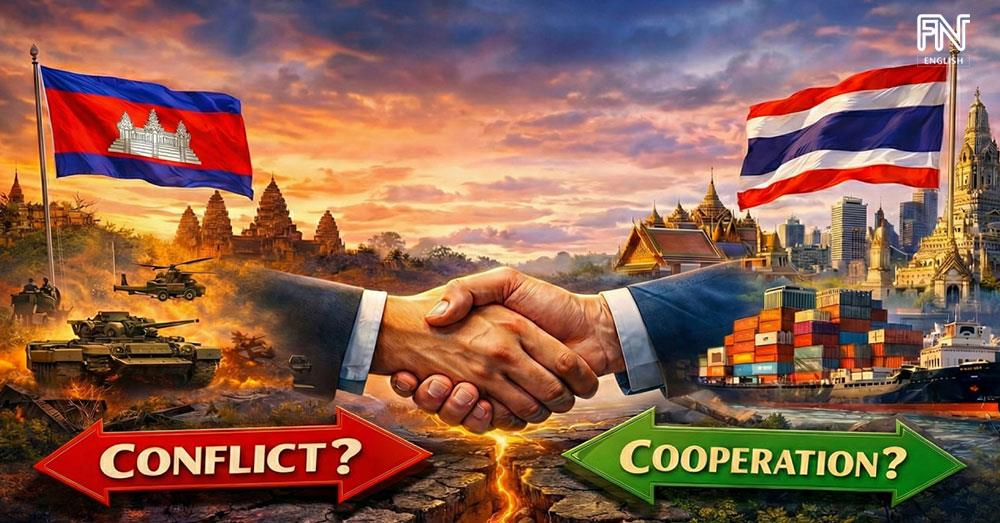
(Phnom Penh): The prospect of Anutin Charnvirakul and the Bhumjaithai Party emerging as the dominant force in Thailand’s next general election is increasingly being treated as a near-term political reality. Even with rising popularity and stronger domestic legitimacy, there is no solid basis to assume that a new war with Cambodia would automatically follow—should Anutin become Thailand’s next prime minister in the coming term.
Rather, the future of Cambodia–Thailand relations will be shaped by a complex political equation that includes Thailand’s internal political conditions, nationalist pressure, the influence of the military establishment, the international environment, and Cambodia’s ability to sustain its political weight and legal standing on the international stage.
An electoral victory may confer domestic legitimacy, but it cannot erase the constraints imposed by international law, nor can it dissolve the deep economic interdependence between the two ASEAN member states. In this context, the more relevant question is not “Will war happen?” but rather: “Will both sides choose to manage conflict—or allow it to escalate again?”
Some analyses warn that a Bhumjaithai victory could open a new chapter of tension. Yet recent experience suggests that using war as a tool for political popularity has clear limits. The author’s assessment is that Anutin has already benefited politically from this approach in the short term; repeating the same strategy after securing electoral success would likely create risks that outweigh any potential gains.
In the post-election period, Bhumjaithai’s leadership is more likely to pivot toward economic stability, investment attraction, and international relations management. In an era defined by global markets and regional supply chains, careful conflict management tends to deliver more durable results than the repeated escalation of hardline nationalist sentiment.
After Anutin’s Victory: Can a Third War Be Avoided?
Two rounds of conflict between Thailand and Cambodia have severely damaged bilateral trade—once valued at billions of dollars annually. The 2025 confrontation did not merely disrupt border commerce and labor mobility; it also triggered sustained shocks across tourism, investment confidence, and financial markets.
War has not improved economic fundamentals or the investment climate. Instead, it has deepened losses—driven largely by hardline nationalist impulses that may serve short-term political objectives but cannot withstand long-term economic reality.
This strain has also affected Thailand’s international credibility. A country once described as an “Asian economic tiger” has faced increasingly critical assessments. Financial Times, for example, has reported on Thailand’s high household debt, heavy reliance on tourism, and delayed structural reforms—factors that leave the domestic production base and consumption patterns in a condition best described as “surviving, but not growing.” These signals underscore a strategic point: Thailand’s economic challenges cannot be solved by opening external confrontations.
Within this context, Anutin’s electoral momentum could become an opportunity for policy realignment. Rather than continuing a cycle of conflict, he could use renewed political legitimacy to repair damage to the economy, trade, tourism, and diplomacy. Launching a new war against Cambodia would not only be a security risk; it would also be a major risk to Thailand’s reputation and international confidence.
Because Thailand’s economy depends heavily on export markets, regional supply chains, and cross-border investment, any renewed conflict would impose costs far greater than the short-term political benefits it might generate. From this perspective, the choice to manage tensions and restore economic stability is not only rational—it is a responsibility of governance.
International Constraints: The Limits of Domestic Power
The Cambodia–Thailand border dispute is not a simple bilateral issue that can be settled by unilateral domestic decisions. It exists within the framework of international law and historically binding agreements recognized globally.
The dispute rests on a clear legal foundation:
- the 1904–1907 treaties, which delineated borders; and
- the International Court of Justice (ICJ) decisions of 1962 and 2013, which affirmed legal validity and the obligation to respect boundary arrangements.
ICJ judgments carry final legal weight under international law. This means any party—even after gaining power—cannot unilaterally overturn or reject that legal status without facing international consequences.
If a Thai government were to violate international law, it would trigger predictable repercussions:
- diplomatic pressure from the international community,
- formal criticism by international institutions, and
- heightened economic and investment risks.
In addition, ASEAN and major regional powers—especially China—have shown a clear interest in preventing escalation. Southeast Asia is a strategic region for trade and global supply chains. Any military confrontation that spreads would affect the interests of many stakeholders, not just Cambodia and Thailand.
The key point is this: Thailand’s domestic power has limits when its actions threaten regional and international interests. The international system may not stop a conflict instantly, but it can impose a much higher “price” on escalation—politically, economically, and diplomatically.
Nationalism may generate domestic popularity, but it cannot rewrite core principles of international law or the realities of a global economic system. A country dependent on investment and international markets cannot afford actions that erode credibility for long.
Therefore, if Anutin wins and gains full political legitimacy, he does not need war to “prove” his authority. War as a political instrument is most effective when legitimacy is weak; after an electoral victory, it becomes a risk greater than its value.
Could Tensions Still Return?
Even if an election victory does not automatically lead to war, a comprehensive analysis must acknowledge scenarios that could revive pressure toward renewed conflict.
1) Pressure from hardline groups and intensified nationalism
If nationalist movements in Thai society rise sharply and turn the border issue into a domestic political instrument, pressure on the government could intensify. In such a climate, the border dispute may shift from a legal issue into a contest of national identity. When public emotion becomes the priority, the military—an influential institution in Thai politics—may be pushed into a stronger role in security decision-making.
However, such pressure does not guarantee immediate war. The outcome depends on whether the government chooses to manage public sentiment—or allows sentiment to dictate policy.
2) Domestic economic crisis and diversionary strategy
A second scenario involves severe domestic economic stress. If Anutin’s leadership cannot boost growth or ease household debt and employment pressures, social tension could escalate. History shows many governments have used external crises to divert attention from internal problems. Under such conditions, the border issue could be used to rally nationalist unity.
Yet in today’s environment—where investors and markets react rapidly—this strategy could impose economic costs that exceed any short-term political gains.
Conclusion
If the Bhumjaithai Party wins, it is reasonable to assume that a new war will not occur automatically. Political victory does not inherently mean renewed conflict.
Still, the possibility of a third war cannot be ruled out entirely—especially if pressure from hardline nationalist movements rises significantly or if a severe domestic economic crisis emerges and leaders attempt to divert attention through external confrontation.
For any prime minister seeking to hold power for a full four-year term, war may produce short-term political returns, but conflict management and regional stability remain the true foundations of long-term political security and economic recovery.
Another reality cannot be ignored: the border issue cannot be “closed” quickly. It is rooted in history and international law, requiring careful management and long-term strategy.
Ultimately, an Anutin victory would not mean he can continue war—or seize Cambodian territory unlawfully. Any act of territorial aggression would face scrutiny and accountability under international law, regardless of which party holds power in Bangkok.