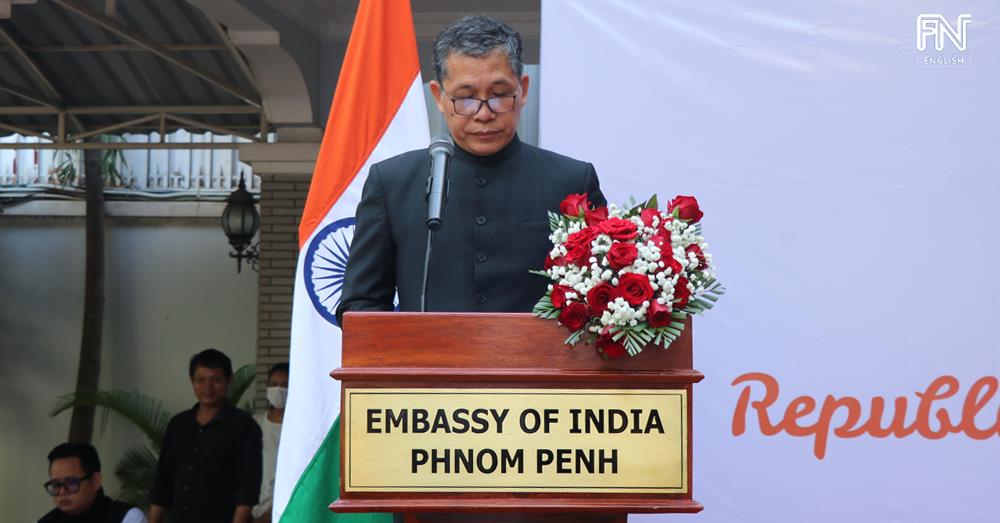
(Phnom Penh): Last year on 7 November 2025, India commenced the year-long celebrations of 150th anniversary celebrations of India's National Song Vande Mataram, which translates to “Mother, I Bow to Thee”. This historic composition has been an inspiration to generations of Indians from the time of India’s freedom struggle till today. It is an embodiment of India’s timeless message of unity, devotion and sacrifice. The celebrations, therefore, present each Indian an occasion to reaffirm our national identity and collective spirit and our resolve to overcome any challenges that we may face as a nation.
In order to understand the significance of India’s national song Vande Mataram, one has to go back to the origins of what influenced the composer to write a song as profound as this. The national song was composed by Bankim Chandra Chatterjee and was first published on 7 November 1875 in a literary journal Bangadarshan. Later, the song was inserted in the 'Anandamath', a novel written by the composer.
The composition was subsequently set into music by none other than Guru Rabindranath Tagore, the first Asian to win a Nobel Prize in Literature. Vande Mataram was officially adopted as India’s national song by the Constituent Assembly in 1950 and the song continues to embody the message of sacrifice, devotion and unity for all Indians through the years.
The lessons of this enduring national song of India remain extremely relevant in today’s world as we are confronted with various challenges, including mounting debt, destabilizing conflict, food and energy security etc. This idea of considering the nation as mother and the mother as the embodiment of power, helped those who fought for India’s independence to dream of an India where women would contribute equally to the dream of nation-building.
The aspirations and efforts of multitudes of Indians whose struggle were encapsulated in this song, continue to energize the people of India and this has contributed to India’s rapid socio-economic growth and resulted in India becoming the fourth largest economy in the world and thereby ensuring better lives for its citizens.
The commemoration of 150 years of Vande Mataram is a recognition of the song’s continuing influence on the evolution of India’s national identity. Vande Mataram has evolved beyond its literary origins and has become a symbol of India’s collective aspiration. Therefore, the celebrations reaffirm the continuing relevance of the composer’s vision as it seeks to continue to shape and influence our sense of national identity, unity and cultural self-awareness.
In Cambodia too, the 150th anniversary of Vande Matarm is being celebrated by members of the Indian community and the Indian Embassy. Activities include mass singing of Vande Mataram and organisation of cultural performances by artists to showcase India’s rich cultural heritage. Other activities include recording of individual rendition of Vande Mataram and uploading them on a dedicated portal vandemataram150.in, which also features other activities related to the celebrations. We invite friends of India in Cambodia to join us in this year-long celebrations.
Vanlalvawna Bawitlung is the Ambassador of India to the Kingdom of Cambodia. Views expressed are personal.
=FRESH NEWS