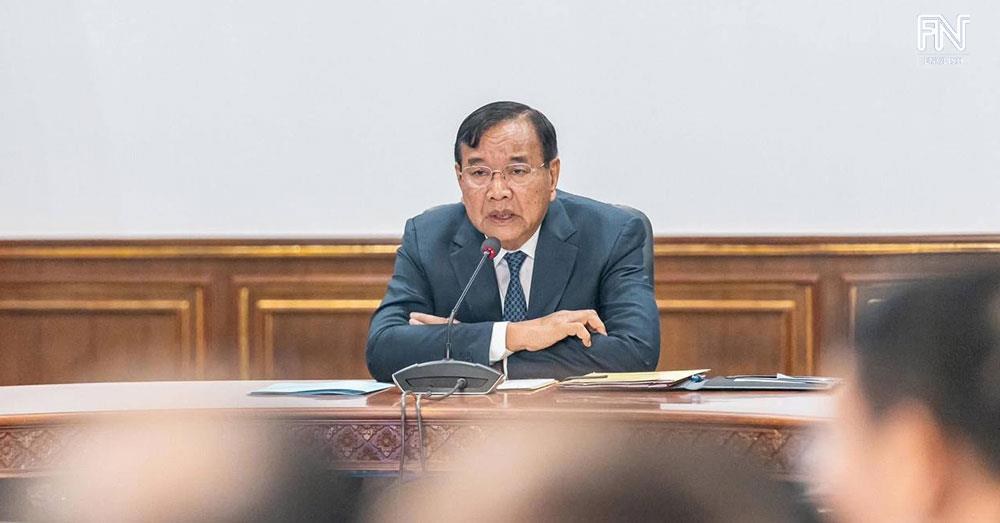
(Phnom Penh): Cambodian Foreign Minister Prak Sokhonn voiced serious concern that hundreds of thousands of displaced Cambodians remain unable to return to their homes across several locations in four Cambodian provinces.
He cited the continued military presence and activities affecting civilian infrastructure and access to these areas, stressing the importance of ensuring that actions on the ground align with commitments to the ceasefire, relevant international principles, and the spirit of ASEAN cooperation.
His remarks were made on the afternoon of 6 January 2026 during his diplomatic briefing on recent developments along the Cambodia–Thailand border with Heads and Representatives of Diplomatic Missions and International Organisations in Phnom Penh.
At the briefing, Cambodian foreign minister expressed appreciation for the continued engagement of the diplomatic community and noted that, following a recent surge in tensions, the situation appears to be moving back onto a constructive path, according to a press release on the outcomes of the briefing dated 6 January 2026.
This progress has been reflected in several key diplomatic achievements, including the ASEAN Foreign Ministers’ Special Meeting in Kuala Lumpur on December 22, the Third Special Meeting of the Cambodia–Thailand General Border Committee (GBC) on December 27, and the trilateral meeting between Cambodia, Thailand, and China held in Yunnan Province, China, on December 29, 2025.
Minister Prak Sokhonn highlighted the positive outcomes of the joint communiqué issued at the third special GBC meeting, which addressed key priorities aimed at reducing tensions, building confidence, and restoring peace and normalcy. These included the implementation of an effective ceasefire starting at noon on December 27, 2025, agreements to ensure the safe, dignified, and unhindered return of internally displaced persons, and a renewed commitment to resolving disputes peacefully through addressing root causes, including the resumption of work by the Joint Boundary Commission (JBC).
The foreign minister also welcomed the release of 18 Cambodian soldiers, describing it as an important contribution to rebuilding trust, and expressed gratitude to all parties that supported and contributed to these positive developments. However, he voiced serious concern that hundreds of thousands of displaced Cambodians remain unable to return to their homes across several locations in four Cambodian provinces. He cited the continued military presence and activities affecting civilian infrastructure and access to these areas, stressing the importance of ensuring that actions on the ground align with commitments to the ceasefire, relevant international principles, and the spirit of ASEAN cooperation.
On border issues, Prak Sokhonn reaffirmed that Cambodia and Thailand share an internationally recognized boundary, defined by maps produced in accordance with the 1904 Convention and the 1907 Treaty. He noted significant progress made by the JBC in boundary demarcation work, particularly in areas between boundary markers 52–59 and 42–47, and recalled Point 3 of the joint communiqué from the third GBC special meeting, which clearly states that all agreements under the communiqué do not prejudice ongoing surveying and demarcation work. In this context, Cambodia has proposed convening an urgent JBC meeting to accelerate progress in line with the spirit of the joint communiqué.
On the occasion, he underscored Cambodia’s firm commitment to maintaining the current ceasefire. Cambodia’s immediate priorities include the full, sincere, and good-faith implementation of the ceasefire and related agreements; enabling displaced civilians to return home safely and with dignity; resolving disputes peacefully through existing mechanisms; continuing boundary surveying and demarcation work through the JBC; practical cooperation under agreed frameworks; humanitarian demining through the Joint Mine Action Coordination mechanisms; and maintaining open communication channels between military authorities and foreign ministries.
He further stressed the importance of strengthening the role of ASEAN observers to verify and ensure full implementation of the ceasefire and agreed measures, thereby enhancing transparency, confidence-building, and mutual trust.
Prak Sokhonn emphasized that Cambodia and Thailand are neighbouring countries and will remain so, sharing a common responsibility to ensure lasting peace, stability, and prosperity for their peoples, the region, and the ASEAN family. He reaffirmed that Cambodia chooses peace and the peaceful settlement of disputes through diplomatic means to safeguard its sovereignty and territorial integrity.
=FRESH NEWS